Yu-Gi-Oh! Damage Step: what can you activate?
On this page
The Yu-Gi-Oh! Damage Step is a part of the Battle Phase with restricted activation windows. It is not enough for a card to be a Quick Effect or a Quick-Play Spell to be used there. You must identify the exact moment and check whether its type of effect is permitted or whether its text expressly authorizes it.
Battle Step and Damage Step are different times
During the Battle Step, the attack is declared and the target is chosen according to the rules. Before entering the Damage Step there may be responses and changes that cause a replay. Once the Damage Step is reached, a specific battle sequence begins and the activation possibilities are narrowed.
Do not announce "I respond to the attack" when you are already calculating damage without clarifying which window you intend to use. Some cards respond to attack declaration and cannot be activated several moments later. A clear conversation about the step you are in prevents both people from believing that they are in different stages while selecting cards.
The moments that distinguish the official guide
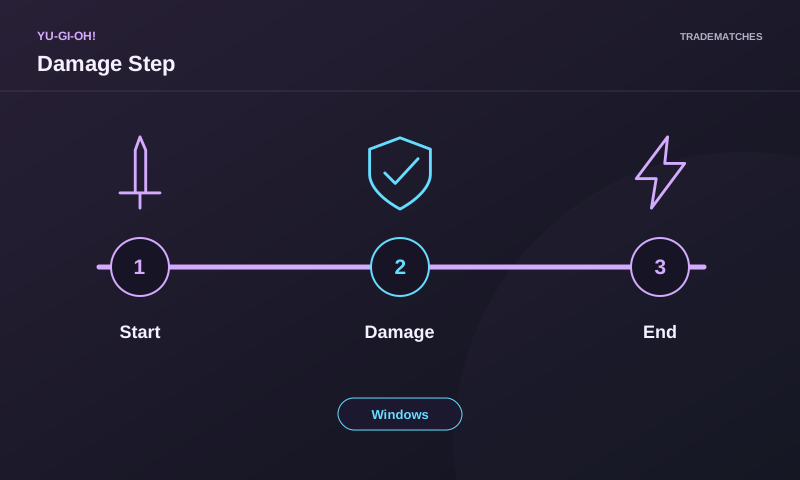
Konami separates the beginning of the Damage Step, before the damage calculation, damage calculation, after the calculation and end of the Damage Step. Each moment has particular actions and conditions. A phrase like "during the Damage Step" covers several substeps, but does not make all activations valid in all of them.
Entry into this step is announced at the beginning. Before calculation, a face-down attacked monster turns face up and there may be appropriate effects that modify ATK or DEF. During the calculation, values are compared and damage and destruction are determined by battle. Then conditions derived from the battle are resolved. In the end, monsters determined as destroyed are sent to the Graveyard and the corresponding conditions are processed.
Modify ATK or DEF has a specific window
Effects that directly modify ATK or DEF may have permission at certain times of the Damage Step, but may not be freely moved to or after the damage calculation. The basic rules and the detailed guide distinguish these moments. If a card expressly states ‘during the calculation of damage’, that specific indication deserves a self-verification.
Imagine a quick effect that directly increases your attacker's ATK and another that destroys a card without directly modifying ATK or DEF. They do not receive the same permission simply because they have the same speed. For the first you must check the window and its text; the second cannot be activated there simply because it is fast. The effect function matters in addition to Spell Speed.
Negating activation does not mean negating effect
There are effects capable of negating activations that can be used in the Damage Step according to its rules and text. Don't extend that permission to any effect negation. The difference already matters in other chains, but here you can also decide if a card can be activated. Read the exact verb and response condition.
If a card requires responding to the activation of a monster effect, that activation must first have occurred and you must be able to respond in the corresponding Chain. Do not save it for a later time after the effect has already resolved. For a specific card, consult the database and its rulings; a broad classification of “negation” does not resolve all cases.
Counter Traps and Exceptions
Counter Traps may have activation permission in this step, subject to their conditions and to an event to which they respond. That doesn't mean that any Set Trap can be activated or that you can pay a cost you don't have. The permission of the type of card and the compliance with the text are checked together.
Mandatory effects, specific effects triggered by events of this battle and cards expressly authorizing their use may also be activated. A short list helps guide you, but it does not replace reading the effect or pretend to be an exhaustive catalog of rules. If the case does not fit clearly, stop and consult before placing the card on the Chain.
Flip the defender does not activate everything immediately
When the attacked monster is face down, it turns before the damage calculation. Its Flip effects and other corresponding triggers are not all solved at that moment: the official sequence places effects triggered by that flip after the calculation. That may matter if the monster is destroyed by battle or if the effect needs to select a card.
Do not send the defender to the Graveyard as soon as you compare ATK and DEF. Destruction is determined during the calculation, but the corresponding move occurs at the end of the Damage Step. Keeping it in place during the sequence allows you to correctly apply the abilities that need to be solved before and the restrictions on what you can choose.
«Destroyed by battle» has a moment
The conditions of destruction by battle and being sent to the Graveyard should not be confused with receiving damage or participating in a battle. A card may require both facts, or only one. Read the full condition before announcing it. The destination can also change for other effects, altering what requirement was met.
If a monster was determined to be destroyed, follow the sequence to send it and then activate the corresponding effects at that time. Do not remove it earlier to release an area or activate its effect using a condition that has not yet occurred. In a complex game, announcing "after the calculation" and "end of the Damage Step" is usually more useful than just discussing the speed of a card.
What happens when the battle ends
After the Damage Step returns to the Battle Step. The turn player may continue with other legal attacks or advance to the Battle Phase End Step. Finishing a battle does not mean automatically finishing the whole turn or entering directly into Main Phase 2 without giving the appropriate opportunities.
The effects that last until the end of the Damage Step cease to apply at the time indicated. Do not keep a bonus for the next attack if its duration is over. If another card generates a different effect for the entire Battle Phase, track both separately. The printed duration is not interpreted from how long the conversation took.
How to resolve a doubt in a tournament
Explain what card has been activated, what condition has occurred, and what sub-moment you are in. Keep the state of the table and call the judge before continuing. A photo isolated from ATK values does not explain a Chain or activation window. The card number allows you to locate the official text and the rule of the corresponding printing.
To practice outside the tournament, use a simple battle and add a single answer each time. First identify the allowed step; then resolve the Chain and the calculation. That method avoids learning an incorrect sequence by simultaneously mixing damage, flipping face-up, destruction, and triggers.
Explain the question without revealing extra cards
If you have a possible response, establish the current point in the battle first. Do not show your entire hand merely to ask whether any card in it can be activated. At a tournament, request appropriate judge assistance and explain the relevant text without volunteering additional hidden information to the opponent. The judge will determine how to handle the question within that event.
A precise question identifies the effect, activation condition and timing: for example, whether it directly changes ATK before damage calculation or responds to an activation at a particular window. Saying it is a Quick Effect leaves the central issue unresolved. Saying it negates something is also incomplete unless you distinguish activation negation from effect negation.
Apply the ruling to the situation you actually asked about. Do not treat it as general permission for every card containing a similar word. After the game, keep the exact card name and the relevant point in the official guide. That reference is more reliable than remembering that a Trap was once allowed during the Damage Step without remembering why.
Frequently asked questions
Can every Quick-Play Spell be activated in the Damage Step?
No. Speed isn't enough. You must check what it does, when it can be activated, and any authorization or restriction of its text.
Is a face-down defender sent to the Graveyard during damage calculation?
Not immediately for that determination. The sequence of the Damage Step is followed and the sending the battle-destroyed monster to the Graveyard occurs at the corresponding end.
Do effect negation and activation negation have the same permission?
You mustn't equate them. Check out the kind of negation, the response condition, and the rules on the exact card.