Yu-Gi-Oh! Chains and Spell Speeds explained
On this page
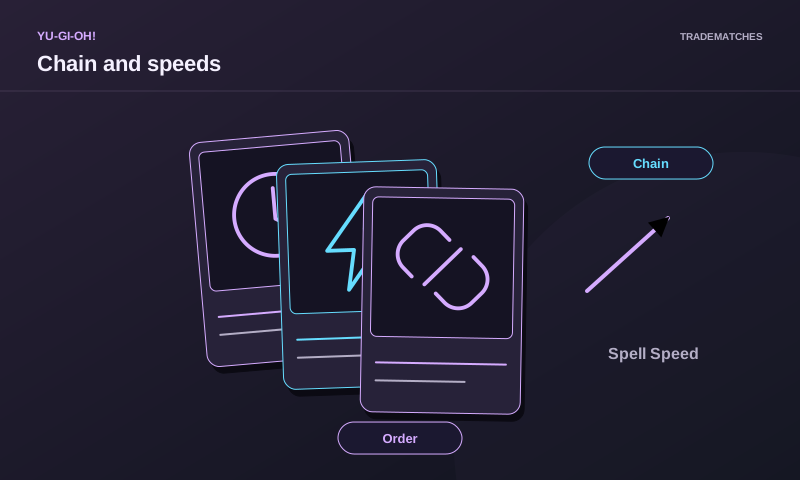
A Yu-Gi-Oh! chain records effects that respond to each other. They activate in order, but resolve from the last link to the first. The Spell Speed limits what can respond.
Three speeds, one response rule
Effects of speed 1 usually do not respond normally to another activation in a chain. Effects of speed 2 can respond to speed 1 or 2. Effects of speed 3, such as Counter Traps, can respond to the three; to respond to speed 3 you need another speed 3. Check also the printed conditions of each card.
Resolves from top to bottom
Imagine an effect A, a response B and a response C. The chain has A as link 1, B as 2 and C as 3. First C is resolved, then B and finally A, as long as each effect can still do what it corresponds. Players do not interrupt mid-resolution to add a new card.
It's not enough for a card to be fast
A Quick Play Magic Card or a Trap can have the appropriate speed and yet not be activable by its condition, by the moment of the turn or because it does not have a legal target. Read the exact text before announcing a response. For a competitive doubt, consult the rulebook and ask the judge for a decision on the specific interaction.
The chain records responses, not immediate results
A chain begins when an effect is activated that starts a link and the other player has an opportunity to respond. The first activation is link 1; the response is placed as link 2; a response to that response would be 3. After both players stop adding effects, the chain resolves in reverse order: 3, 2 and 1. The easiest way to remember this is to stack three cards face up and read them from the last one placed. Activating a card does not equate to finishing its effect at that instant if more links can still be added.
This explains why an opponent can respond before you get the announced result. If you activate an effect to search for a card and the opponent chains a legal response, that response is resolved first. Only after that can you go back to your search, if it can still resolve according to its text and game state. Avoid jumping directly from the announcement to the result: doing so denies the response window and can lose necessary information to resolve correctly. Saying "I activate this, response?" before moving cards makes both players know at which point they are.
Speed 1: normally initiates, does not respond
Spell Speed 1 is the slowest. It includes categories such as Normal Magic and many monster effects. Normally you cannot use a card or effect of speed 1 as link 2 to respond to the opponent's activation. This does not mean that a card of that speed is weak; it means that its activation moment is different. If your card is in your hand and you want to use it against the opponent's action in the middle of a chain, check its speed first. If it is 1, do not place it as a response just because its effect benefits you.
There are special situations with speed 1 effects that activate at the same time and form a chain according to their rules. That is why it is better to say "normally does not respond" than to memorize "never will be link 2". For a specific doubt, identify whether you are voluntarily responding to a previous activation or if several effects have been triggered at the same time. The general speed rule resolves the first case; the second may require the rules of simultaneous activations. Do not mix the two problems when teaching chains to a new player.
Speed 2: usual responses
Speed 2 can respond to speed 1 or 2, as long as the conditions and activation moment of the card are met. This category includes Quick Play Magic, many Traps and Fast Monster Effects. The number indicates a possibility of response, not a permission to activate any card at any time. A recently placed Trap may have usage restrictions; an effect may require a valid target, a cost, or a specific phase. Check the legality of the effect first and then the comparison of speeds.
Example: you activate a Normal Magic as link 1. The opponent has a legal response of speed 2 and adds it as link 2. Now you can add another response of speed 2 if it is available and meets its text. When both players stop chaining, the last one is resolved first, then the previous one, and finally the Magic. It is tempting to resolve each card as it is placed, but this sequence changes the result. Annotate the numbers next to the cards if the table is still learning.
Speed 3: the response has to match it
Counter Traps have speed 3. They can respond to an appropriate activation of lower or equal speed, according to their text. Once one of them is the last link, a subsequent response needs to also be speed 3. It is not enough for a card of speed 2 to be "fast" in common language. For example, a Fast Effect cannot be placed on top of a Counter Trap just because both seem instantaneous. The numerical comparison is what decides this part.
If a chain has link 1 of speed 1, link 2 of speed 2 and link 3 of speed 3, the next link, if any, must be speed 3. Then the resolution goes back from the top. Do not confuse the activation speed with the strength of the result: a card of speed 3 can have a small effect and a card of speed 1 can have a decisive effect. The speed limits who can respond to whom; the text defines what happens when it resolves.
Two examples of resolution backward
First, consider a chain of only two links. You activate A to get an effect; the opponent responds with B. B resolves before A. If B modifies the game state, A resolves with that updated state according to its rules. Do not go back in time to apply A as if B did not exist. Second, if you chain C to B, the final order is C, B, A. Although A was announced first, its result comes last. Saying "three, two, one" aloud helps follow the steps without skipping effects.
The chain does not allow inserting a new response in the middle of that resolution. Once both players have stopped adding links and the resolution begins, no new link can be inserted between 3 and 2 of the same chain. Other opportunities or effects may appear, but they are treated at the moment they are due. This distinction avoids a common confusion: wanting to wait to see the result of the opponent's response before deciding to chain another card to the original activation.
A checklist before chaining
First, ask what card or effect just activated and what is the last link. Then identify the speed of that last link. Verify that your response has sufficient speed: as a general rule, at least 2 and not lower than the previous one. Check the printed conditions, targets, costs and restrictions of the moment. If everything fits, clearly announce the new link. If not, let the other player have an opportunity to respond or start the resolution. This sequence avoids discussing only about the word "fast" without looking at the real text.
In live games, physically separate the chain cards from other cards already on the table. Label "link 1" and "link 2" before touching the Deck or the Graveyard. In a digital application, the interface usually lists them, but it is better to understand the process outside the screen. If a card changes zone as part of its activation, follow the text and specific rules; the speed alone does not cover all resolution details.
Common errors and how to avoid them
One: trying to respond with a Normal Magic to a rival activation. Two: responding at speed 3 with speed 2. Three: resolving link 1 before link 2. Four: announcing an effect and applying its result without asking for responses. Five: believing that sufficient speed ignores costs or restrictions. Each error is corrected with a different question: "Can it activate now?", "Does it have sufficient speed?", and "In what order is it resolved?" Do not try to answer all three with a single memorized rule.
If a text seems old or ambiguous, consult the official card base and the Yu-Gi-Oh! TCG rules of your region. Words from a previous print may have changed due to an errata or the current way of describing effects. A chain explanation is useful for ordering responses, but it does not replace the specific text of the cards you have in front of you. Taking a minute to verify the specific activation is better than rebuilding the entire chain after applying an illegal effect.
FAQ
Does a speed 1 respond to a speed 2?
No as a normal response link: speed 1 does not initiate a response to another activation.
Which link is resolved first?
The last one added to the chain is resolved first.