Yu-Gi-Oh! face-down banishment and card recovery
On this page
A face-down banished card is not permanently unrecoverable, but many effects cannot identify it as a particular kind of monster. Read whether the recovery effect refers to a banished card generally, requires characteristics such as Type or name, or explicitly addresses face-down banished cards.
Information rules are a separate issue. Knowing what a card used to be does not automatically make it eligible for an effect. In a tournament, the rules governing public and private knowledge also determine what players may disclose or inspect. This guide separates those questions so a remembered identity does not become an invented recovery permission.
Banishment is different from the Graveyard
The official rulebook distinguishes banished cards from cards in the Graveyard. An effect retrieving a monster from the Graveyard does not automatically reach a banished card, whether that card is face-up or face-down.
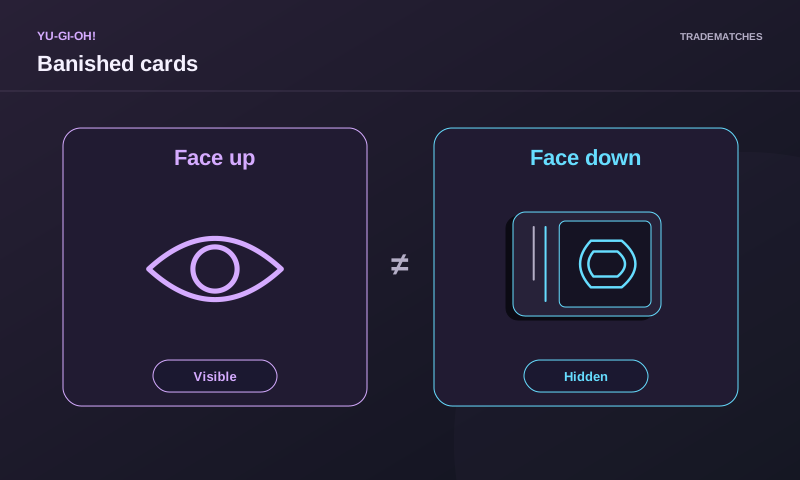
Face-down banishment adds another distinction. A face-up banished monster has visible information that a relevant effect can check. A face-down banished card does not normally provide those characteristics to an effect asking for a particular kind of banished monster.
Keep the banished cards physically separate from the Graveyard, and distinguish face-up from face-down cards clearly. This helps both players count and identify the objects that an effect can legally use without accidentally revealing hidden information.
Start with the recovery effect's nouns
The word “card” is broader than “monster,” and “monster” is broader than a monster with a specific Type, Attribute or name. Those differences become decisive when the relevant object is face-down. Do not shorten the effect to “recover something banished” and discard its qualifiers.
A generic effect referring to banished cards may be able to use a face-down banished card when its other conditions permit. An effect asking for a banished monster with a particular property generally cannot use a face-down card to establish that property unless its wording or a specific ruling permits it.
An explicit face-down instruction can create an exception. That is why the claim “face-down cards have no usable properties under any circumstances” is too broad. The exact text can authorise a check that an ordinary recovery effect does not.
| Wording to examine | Question before resolving |
|---|---|
| A banished card | Does the effect impose any additional face-up or other restriction? |
| A banished monster | Can the required monster information be established for this object? |
| A banished monster of a particular Type or name | Does the text or ruling permit checking that property here? |
| An explicitly specified face-down banished card | What additional conditions does that explicit permission impose? |
| A card in the Graveyard | Is the candidate actually in that zone? |
These are reading prompts rather than a replacement for the whole effect. Costs, targeting, timing and other restrictions can still make a proposed activation illegal even when the destination and object description seem suitable.
A verified exception: Gizmek Naganaki
The official database entry for Gizmek Naganaki, the Sunrise Signaler describes an effect recovering one of your face-down banished Machine monsters whose ATK equals its own DEF. Its wording explicitly addresses the otherwise hidden status and the required properties.
That example disproves a universal ban on recovery. It does not authorise every other card to make the same property check. Nor does it allow Naganaki to recover every face-down card: the specified Type, statistics and all the effect's activation requirements still matter.
For an unfamiliar interaction, compare the complete current database text with the intended target. Avoid copying a conclusion from Naganaki to a different effect that says only “banished Machine monster.” The extra words providing permission are part of the answer, not decorative reminder text.
Knowing the identity is not the same as eligibility
Suppose both players saw a monster on the field before an effect banished it face-down. Both may remember its Type and Level. That memory does not, by itself, change the face-down card into a face-up banished monster for another effect's requirements.
Likewise, the owner may be able to inspect their own face-down banished cards under the normal information rules. Inspecting an object and legally selecting it for a property-dependent effect are distinct permissions. Do not infer the second solely from the first.
This distinction is useful even in casual play. Players can agree about what the card was while still needing to determine whether the current effect can use it. The disagreement is about the effect's permitted check, rather than about whether someone remembers the artwork correctly.
Public and private knowledge in European events
For events in Spain, consult the applicable European documents through Konami's policy page. The current version linked there is KDE-E policy 2.5. All face-down cards are classified as private knowledge, including cards previously face-up, subject to the document's specific information rules.
The policy also distinguishes current-turn history from previous-turn history. Its examples require an answer about a card banished face-down during the same turn. That does not grant permission to pick up and inspect the face-down card; a judge or NEURON can clarify the known card's text.
Use these categories precisely. “Private” is not permission to give false information, and “I remember it” is not permission to expose cards. If the question concerns a specific tournament sequence, ask the judge which information must be answered before revealing anything.
Follow the complete sequence
Consider a hypothetical effect that banishes several cards face-down from your Deck. First identify the resulting objects and their status. If a later effect can return a generic banished card, examine its complete text and conditions. Do not automatically exclude all those objects because the first effect looked permanent.
Now change the later effect so it asks for a banished monster of a named archetype. The face-down status becomes a different eligibility problem. You cannot simply announce the desired identity and treat the requirement as satisfied because you privately inspected the card.
Finally, imagine an effect explicitly written to recover a specified kind of face-down banished card. That effect supplies a permission absent from the earlier hypothetical wording. You still check its qualifiers, but the analysis now starts from the explicit instruction rather than a blanket prohibition.
Targeting and recovery destination
When an effect targets, identify a legal target at the required time. A hoped-for result later in the sequence does not justify choosing an ineligible object now. Effects that do not target still have their own selection and resolution instructions; removing the word “target” does not remove every restriction.
Also check where the effect returns the card. Returning to the hand, returning to the Deck and sending to the Graveyard are different outcomes. A recovered card may become useful through one route but not through another, and its original type can affect how the particular instruction is applied.
Record the exact instruction rather than describing all movement as “unbanishing.” That informal word hides both the permitted object and destination. For a rules question, give the judge the recovering card, the banished object's status and the proposed destination.
Keep face-down objects clear on the table
Another common mistake is treating the number of banished cards as the number of usable monster targets. A pile containing six face-down cards can have a clear count while offering no legal target to an effect requiring a particular face-up monster characteristic. Count and eligibility answer different questions. When explaining the board, state both the pile's size and the status relevant to the proposed effect rather than assuming one proves the other.
Use a layout in which face-down banished cards cannot be mistaken for the Deck or Graveyard. Preserve any distinctions a resolving effect needs without exposing identities unnecessarily. Count the objects accurately when an effect or information rule requires the count.
Do not mix representatives or notes into the pile in a way that could resemble extra cards. If a complex effect creates confusion, pause and ask for help before manipulating the pile. Reconstructing which object moved after several further plays is harder than resolving one uncertainty immediately.
Frequently asked questions
Are face-down banished cards impossible to recover?
No. Some effects can use banished cards generally, and others explicitly permit face-down recovery. Read all qualifiers and current rulings.
Does remembering the card make it a legal banished-monster target?
Not automatically. Information about its former identity does not erase its current face-down status or provide a missing permission to check its properties.
May I show my opponent every face-down banished card at a tournament?
Do not reveal private knowledge casually. Follow the applicable policy and effect instructions, and ask the judge when current-turn history or another exception creates uncertainty.