Destroy vs send to the GY in Yu-Gi-Oh!
On this page
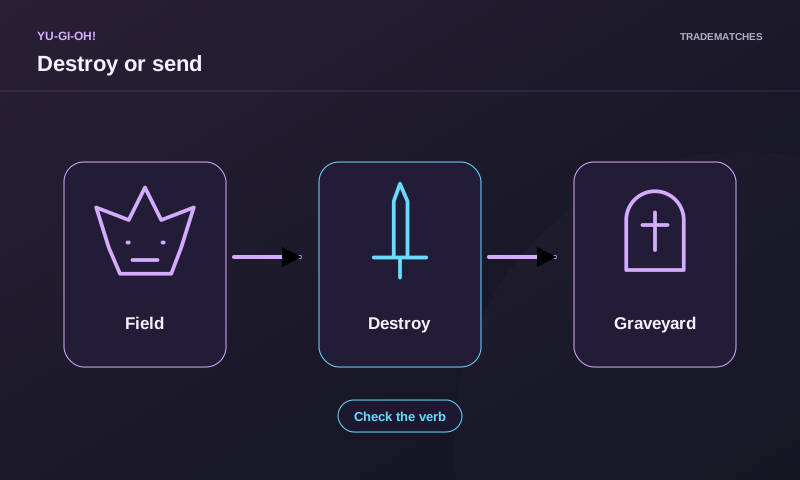
In Yu-Gi-Oh!, destroy and send to the Graveyard describe two distinct actions. Destroying is a specific way a card leaves the field; sending a card to the Graveyard describes a destination or action that may occur without destruction. The difference determines whether a protection against destruction applies and whether an effect specifically requires "if this card is destroyed." Reading only where a card ends up frequently leads to errors.
Two questions to resolve a card's departure from the field
When a card leaves the field, first ask what action caused it to leave and then where it went. A monster can be destroyed in battle and end up in the Graveyard. It can also be offered as a tribute, returned to hand, or sent to the Graveyard by an effect that does not use the word "destroy." In the first two cases of being sent to the Graveyard, the destination is the same; the cause is different. Cards that react to the cause are not equivalent simply because they share a destination.
The official rules include sending a card to the Graveyard as "destroyed" when it occurs as a result of battle or an effect that destroys it. They also clarify that sending a card via cost or tribute is not destruction. The wording of each effect matters: "destroy 1 monster" expresses a different action than "send 1 monster to the Graveyard." Although both may end up in the same physical pile of cards, you should not substitute one verb for the other when resolving them.
Destruction in battle
A monster can be destroyed after the damage calculation of a battle. That does not mean every monster participating in a battle is destroyed—compare the values and apply the relevant rules for battle positions and active effects. If the result does destroy it, effects that look for "destroyed in battle" have a clearly identifiable cause. A protection that prevents destruction in battle can change the outcome, provided its conditions are met.
Simple example: two monsters battle and the one with lower ATK should be destroyed according to the rules. If there is no protection or effect modifying the result, it is sent to the Graveyard by battle destruction. A card that asks whether that monster was destroyed in battle can recognize the fact. In contrast, a monster sent to the Graveyard as material or cost did not go through that battle, even though it ends up in the same zone.
Destruction by card effect
An effect that says "destroy" performs destruction when it resolves correctly. It can destroy a card of your own or your opponent, according to its restrictions. Not every card that leaves the field due to an effect has been destroyed: if the instruction says return to hand, shuffle into the Deck, exile, or send to the Graveyard, perform that instruction and retain its name. This precision affects both protections and abilities that expect destruction.
Suppose a monster has "cannot be destroyed by card effects." An effect that only attempts to destroy it will not succeed in eliminating it through that method. That does not make the monster immune to all effects. If another legal effect sends the monster to the Graveyard without destroying it, the protection against destruction alone does not satisfy that verb. Check other immunities, conditions, or text replacements before concluding the result.
Sending to the Graveyard does not imply destruction
The phrase "send to the Graveyard" can appear as a cost, part of a procedure, or as an effect. In none of these uses should you automatically add the word "destroy." The card may leave hand, Deck, Extra Deck, or the field, depending on the text. If it never was on the field, the idea of "leaving the field" does not apply. Two nearly identical triggers may request different facts: "if it is sent to the Graveyard" looks at that journey; "if it is destroyed" requires the cause.
To resolve a hypothetical example, imagine an effect that says "send 1 monster you control to the Graveyard." Choose a legal monster and send it according to the instruction. An ability that requires being sent to the Graveyard could check that condition, along with applicable other requirements. An ability that requires being destroyed cannot rely solely on this sending. The same distinction applies when checking summoning restrictions or effects that remember how a card arrived in a zone.
Tributes and costs: the cause occurs before the effect
Offering a monster as tribute for a Summon or to pay a cost is not destroying it. Likewise, discarding or sending a card to pay a cost does not transform the payment into destruction. If an effect requires the monster to have been destroyed, paying that cost does not satisfy the requirement. Identifying the two points and the comma in modern text helps distinguish what you do when activating versus what the effect does when resolving.
This difference also avoids sequence errors. A cost is paid when you activate, before your opponent responds in Chain; the effect resolves later if possible. If you sent a card to the Graveyard as a cost and your opponent denies the effect, the payment has already occurred. You cannot re-label that payment as destruction to activate another card. Consult activation rules and the official text of each card when an interaction depends on the precise moment of sending.
Return to hand, Deck, or Extra Deck
A card returned to hand or the Deck leaves the field without being destroyed if the instruction only says "return." It does not go to the Graveyard simply because it left the field. A monster from the Extra Deck that returns according to the effect and applicable rules is not treated as "destroyed and sent to the Graveyard." This is important if you thought activating an ability requiring either of those conditions.
It's helpful to note the full path: "Field → hand by effect" or "Field → Deck by effect" is clearer than saying "removed." This way, you can check whether an ability requires leaving the field, going to a specific zone, or being destroyed. The general term "leave" may include several procedures; the specific word "destroy" does not include all of them. Do not assume that the same practical result of losing presence on the field activates the same effects.
Exile is not synonymous with destruction
"Exile" is another instruction that must be read literally. An effect that exiles a card does not destroy it simply because it removed it from the field. A card that would have been destroyed may end up exiled by a replacement effect; in that case, the wording of the effect and the replacement effect determine what events occurred. Avoid a universal rule for all exiles: some change only the destination; others change the procedure itself.
To determine whether a "destroyed and sent to the Graveyard" effect activates, check each part separately. If the card was destroyed but did not reach the Graveyard, the destination condition is missing. If it reached the Graveyard without being destroyed, the cause is missing. Combined formulas are stricter than "destroyed" alone or "sent to the Graveyard" alone. The updated official text prevails over memories of an older print.
Protection against destruction has a specific scope
When a card says it cannot be destroyed in battle, by effects, or in any of those ways, identify exactly what source covers. Do not broaden "by effects" to "by any cause" or "in battle" to "by effects." A card can be protected against one procedure and still valid for another. There can also be effects that deny activation or make a monster unaffected; these are different questions from whether the action is called destruction.
The practical way to check a play is to first read the verb of the effect that removes the card and then the full phrase of the protection. If the prohibited action does not match, do not use that protection as an automatic response. If the monster has multiple protections, evaluate them one by one. In friendly games, this method avoids disputes; in tournaments, it allows a specific question to be raised with the judge without summarizing multiple mechanics as "cannot be removed."
Which effects activate afterward
Effects triggered use precise conditions. "If this card is destroyed" looks at destruction. "If this card is sent to the Graveyard" looks at a sending, with any additional limitations in the text. "If this card leaves the field" uses a broader category, although there may also be conditions about the previous zone, destination, or procedure. Simply finding a common word is not enough; read the full sentence and verify that the card was in the zone from which it can activate.
Example: a monster sent to the Graveyard as tribute for a Flip Summon may satisfy a condition written as "if this card is sent to the Graveyard" if the other requirements are met. It does not satisfy "if this card is destroyed." A monster destroyed in battle that does reach the Graveyard may satisfy both general conditions, if their texts allow activation. The example explains the difference in wording; it does not guarantee that a specific card activates without checking its additional clauses.
A useful check during gameplay
Before applying a protection or announcing a trigger, go through this sequence: read the current text; identify whether the card was on the field; note the verb that caused the departure; verify the final destination; check if a replacement occurred; and compare those facts with the exact condition. If the text says "destroy," do not change it to "send." If it says "send," do not imagine a destruction. The sequence may seem slow, but it usually resolves doubt in seconds.
Once the procedure and destination are separated, it's also easier to follow the Chain. The cost can be paid when activating, destruction can occur when resolving, and effects that trigger are checked at the moment the rules indicate. If the game changes the destination between those two steps, note it. For specific interactions, consult the official card rules and applicable tournament rules, in addition to the basic manual.
Summary to remember the difference
Destruction in battle or by an effect that destroys may end with the card in the Graveyard; that does not make "destruction" apply to any other path to the Graveyard. Tributing, paying a cost, returning, exiling, or sending to the Graveyard via a text that does not destroy are different procedures. When an ability or protection depends on the result, compare its condition with the actual cause and destination. This literal reading avoids both activating too much and failing to activate a valid effect.
Frequently Asked Questions
If a card says "send to the Graveyard," does it destroy the monster?
No, solely by that phrase. Sending to the Graveyard can be an effect or a cost without destruction. Review whether any applicable text changes the procedure and use the current official wording.
Can an indestructible monster be sent to the Graveyard?
No, a protection against destruction does not prevent a sending that does not destroy. The result depends on the specific instruction and any other protections or immunities of the monster.
Does offering a monster as tribute activate "if it is destroyed"?
No. Offering it as tribute is not destruction. A "sent to the Graveyard" condition requires a different check and may have additional requirements.
Official sources: Yu-Gi-Oh! TCG Official Rules and Konami's Official Problem-Solving Card Text Guide.