Yu-Gi-Oh! Forbidden Droplet: costs and responses
On this page
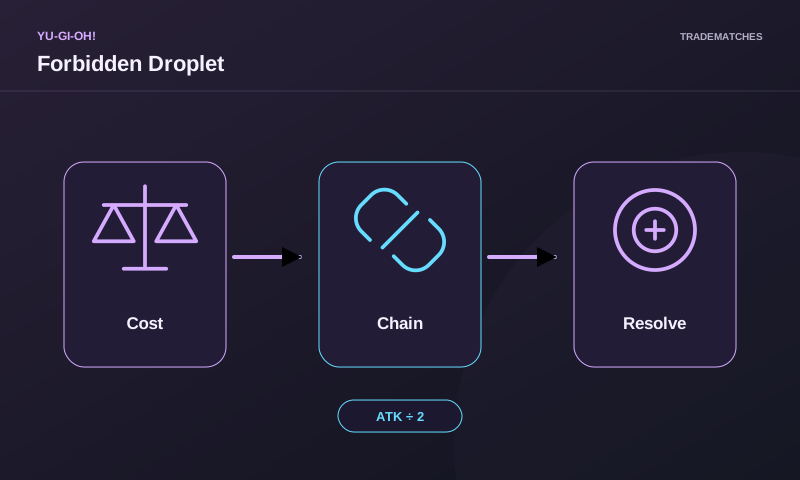
Forbidden Droplet sends other cards from your hand or field to the Graveyard as its activation cost. When it resolves, you choose the same number of opposing Effect Monsters, halve their ATK and negate their effects for the turn. The original types of the cards paid restrict which opponent responses are allowed directly to that activation.
Those three checks explain most mistakes: payment happens first, the affected monsters are chosen at resolution, and the response restriction is based on Monster, Spell and Trap types. Sending one Monster is not the same as making Droplet impossible to answer with every kind of card.
Use the current official card text
Look up Forbidden Droplet in Konami's TCG database rather than relying on a shortened deck note. Confirm the wording that separates the cost from the effect with a semicolon. The number of cards sent, their original types and the available opposing monsters all matter to the procedure.
Its Quick-Play Spell category determines ordinary activation timing. Holding it in your hand does not allow you to activate it freely during the opponent's turn. A Set copy has its own timing restrictions, and specialist windows such as the Damage Step require their applicable rules.
Also note the once-per-turn activation restriction by card name. Multiple physical copies do not each grant an independent unrestricted activation. Before considering an ambitious sequence, check whether you have already activated a copy and whether the current event permits another attempt.
Sending cards is a cost
Choose the eligible cards and send them to the Graveyard when activating Droplet. The payment is not delayed until the effect resolves, so the opponent sees the paid cards before choosing a permitted response. You cannot revise the payment after discovering that the opponent has a Trap available.
The cost uses other cards, so the activated Droplet cannot pay for itself. It can use eligible cards from your hand and/or field; it does not generally reach into your Deck, Extra Deck or the opponent's field to find payment. Keep that source-zone restriction separate from the opposing monsters the effect will later affect.
A card sent as cost is not sent by Droplet's effect. For an effect that specifically requires being sent by a card effect, check that distinction before expecting a trigger. “Reached the Graveyard” and “reached it by an effect” are different conditions, even if the physical movement looked identical.
The cards must actually reach the Graveyard
An instruction to send cards to the Graveyard as cost requires a legal payment that reaches that zone. A replacement effect that banishes those cards instead can prevent using them to pay this particular cost. Do not substitute a different destination because a separate spell can tolerate it during resolution.
Monster Tokens cannot pay this send-to-Graveyard cost. Their token rules prevent them from satisfying the required movement in the same way as ordinary cards. A field full of spare Tokens is therefore not automatically a free three-card payment package.
Before activating, count both payment resources and eligible opposing Effect Monsters. You cannot send an arbitrarily large handful merely to exclude every response category when the required number of affected monsters is unavailable. Use the complete activation requirements, not only the attractive response sentence at the end.
Original types determine direct responses
Droplet checks whether the paid cards originally belong to the Monster, Spell or Trap category. It does not care whether the Monster was a Dragon, whether the Spell was Quick-Play or whether the Trap had a particular archetype name for this category check.
| Original types sent as cost | Opponent's directly restricted categories |
|---|---|
| Monster only | Monster cards and Monster effects |
| Spell only | Spell cards and Spell effects |
| Trap only | Trap cards and Trap effects |
| Monster and Spell | Both of those categories |
| Monster, Spell and Trap | All three categories |
Use original type when a card is occupying an unusual role. A Monster placed in a Spell and Trap Zone does not necessarily become an originally Spell card. Establish what the physical card originally is, then apply Droplet's category restriction to that payment.
The restriction belongs to this activation
The wording restricts the opponent's cards and effects activated in response to this card's activation. It is not a permanent ban on that category for the rest of the turn. Once the relevant response point has passed, later legal activations need their own analysis.
If another legal activation is added to the Chain, an activation responding to that new Chain Link is not automatically the same as a direct response to Droplet. Do not shorten the rule to “the opponent cannot use Monsters anywhere in this Chain” without checking what the later activation actually responds to.
You also need to distinguish opponent restrictions from restrictions on your own responses. Droplet's response sentence names the opponent. That wording is different from Super Polymerization's prohibition on both players and can create different Chain-building possibilities.
Choose monsters when Droplet resolves
Droplet does not target the affected monsters at activation. You choose them during resolution from the eligible opposing Effect Monsters. You may explain your intended outcome to the opponent, but that explanation does not turn an intended monster into an official activation target.
This can make target-protection alone insufficient to stop Droplet. However, being unaffected by the relevant Spell effect is a different protection. A non-targeting effect is not automatically able to negate every protected monster. Read the precise protection and avoid treating “does not target” as a universal bypass.
The count still has to match the number of cards sent as cost. Konami's official card-specific explanation states that if fewer opposing Effect Monsters remain at resolution than the paid-card count, the processing does nothing. You do not silently reduce a two-card payment into a one-monster effect after the board changes.
Work through one changing-board example
Suppose the opponent has two eligible Effect Monsters and you send two cards, one Monster and one Spell, to activate Droplet. The opponent cannot directly respond with those two original categories, but a legal Trap response remains possible if no other restriction prevents it.
If that permitted response removes or turns face down one of the two eligible monsters before Droplet resolves, recheck the count. The effect cannot simply choose a face-down unknown monster as though it were still a face-up Effect Monster. With only one eligible monster remaining for a two-card payment, the required processing cannot happen.
This example explains why sending the maximum possible number is not always safest. You gain wider coverage but also commit more cards and require that number of eligible monsters at resolution. The decision depends on the board and plausible permitted responses, not on a universal rule to pay as much as possible.
ATK reduction and negation are not destruction
Droplet does not destroy the chosen monsters or automatically remove them from the field. Its temporary ATK change can make a battle favourable, while effect negation can prevent applicable effects from resolving successfully. Those consequences still require following later battle and effect procedures.
Do not describe its outcome as negating the activation of every chosen monster effect. Negating an effect and negating an activation are different operations. A monster's already activated effect and an effect activated from another location can require additional analysis, particularly when the card changes zones.
For a complex case involving a monster whose ATK is determined by its own effect, use that card's official rulings alongside Droplet's. A blanket arithmetic rule based only on the number printed in the lower corner can miss the way an ongoing ATK-setting effect interacts with negation.
Practise the payment before the tournament
Use three small examples: pay a Monster only, pay a Monster plus Spell, and pay all three original categories. For each, list the eligible direct responses and the number of opposing monsters required. Then change the board before resolution and check the new eligibility count.
For an event in Spain, use the current TCG card text and format restrictions rather than importing a digital client's list. The cited Japanese official clarification is supplementary card-specific evidence; a tournament judge resolves regional or unusual interaction questions using the applicable event rules.
Frequently asked questions
Can I send Forbidden Droplet itself as its own cost?
No. The payment requires other cards from your hand or field. Identify the actual paid cards before adding Droplet's activation to the Chain.
Does sending a Monster stop the opponent from using a Trap?
Not through Droplet's category restriction alone. Sending a Monster restricts the corresponding original category; a Trap remains a possible direct response when its own activation requirements are satisfied.
Does Droplet choose its affected monsters before responses?
No. The cost is paid at activation, but the monsters are chosen at resolution. Recheck eligibility and the required count against the board that exists then.