Infinite Impermanence: hand, column and resolution
On this page
Infinite Impermanence negates the effects of one targeted face-up opposing monster until the end of the turn. You can activate it from your hand only if you control no cards. Its column effect requires it to have been Set before activation and to remain on the field at resolution; successful monster negation also matters because the two parts are connected by “then.”
Those are separate checks. A card activated from the hand does not acquire the column effect just because you place it in a Spell & Trap Zone while resolving the Chain. Read the current official text rather than relying on the abbreviated name “Imperm.”
Check your field before using the hand permission
The permission says you must control no cards. It does not say no monsters or no face-up cards. A Set Spell, a Field Spell or another card under your control prevents this particular permission from applying, even if your Monster Zones are empty.
Your hand is not your field. Holding other cards does not by itself violate the condition. Likewise, the opponent can have cards; the condition concerns your own controlled cards. You still need a legal face-up opposing monster to target and an appropriate activation opportunity.
Imagine that you control no monsters but have a Set Trap. You cannot activate another Infinite Impermanence from your hand using its empty-field permission. If you instead control no cards at all, that permission can be available. Neither situation changes the requirement to select a legal target.
A Set copy uses the usual Trap framework
A copy that was Set follows the normal rules for activating a Normal Trap, unless another effect changes them. In particular, you do not normally activate a Trap during the turn you Set it. The hand permission and ordinary Set activation are different ways to access the same card.
Once a Set copy can legally activate, it does not need your field to be empty. Having your own monster or another back-row card does not automatically prevent it. That is one reason the hand condition should not be misread as a restriction on every activation of the card.
Check effects that restrict Trap activations or responses as well. The printed hand permission does not override every other rule of the Duel. It supplies one specific exception concerning where this Trap can be activated, not universal permission to interrupt any action.
Targeting happens when you activate
You select one face-up monster your opponent controls at activation. Announce the target clearly before the opponent decides whether to respond. The target is not chosen after you see all the other links in the Chain.
That distinction matters when the targeted monster leaves the field or becomes face-down before Infinite Impermanence resolves. Do not silently transfer the effect to a different monster. The original target and its status at resolution must be checked under the relevant rules.
Konami's explanation of Problem-Solving Card Text helps separate activation procedures from what happens when an effect resolves. The semicolon marks that boundary in this card's text. Paying or selecting something when activating is not the same as successfully applying the eventual effect.
Resolve the monster part before the column part
The card's two effect parts are connected by “then.” Konami explains that this conjunction makes the later action depend on successfully performing the earlier action. It is therefore inaccurate to claim that a previously Set copy always negates its column regardless of what happens to its monster target.
For an ordinary example, the targeted face-up monster remains on the field and its effects are successfully negated. You then check the additional conditions for the column effect. If the earlier action cannot be performed, do not apply the later one merely because a column exists.
Complicated interactions can involve a monster whose effects are already negated, immunity or changes in location. Use the official ruling for that interaction rather than extending the simple example into a universal answer. Identify which part actually happened before deciding that the dependent part applies.
Staying on the field is an independent requirement
For the column effect, Infinite Impermanence must also remain on the field at resolution. If a responding effect destroys it before it resolves, that specific condition fails. Its status as a Normal Trap does not make the printed requirement disappear.
The monster-negation effect can still resolve when the Trap itself has left the field, assuming the target and other relevant conditions allow it. The additional column condition is more restrictive. Removing the Trap and removing its target are therefore different responses with different questions to evaluate.
Be precise about timing. A Normal Trap ordinarily remains on the field while its Chain resolves and is sent away afterward under the normal procedure. That later movement does not mean it failed the on-field check at the moment its effect resolved.
| Activation and resolution situation | Monster effect | Column effect |
|---|---|---|
| Activated from hand with a legal empty field | Can negate the legal target | No: it was not Set beforehand |
| Activated after being Set, remains on field, first part succeeds | Target is negated | Applies for the rest of the turn |
| Set copy leaves field before resolution | Can still apply if otherwise legal | On-field requirement fails |
| First part cannot be performed | Evaluate the target interaction | Do not skip the “then” dependency |
A column crosses both players' field
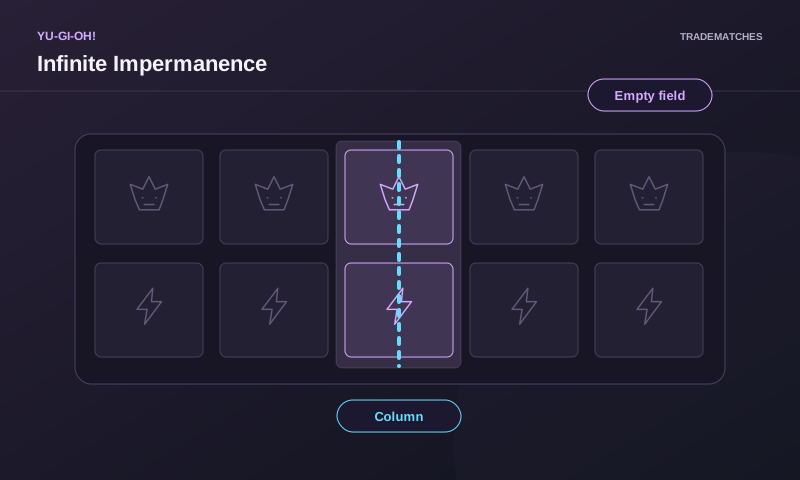
The relevant column includes aligned zones on both sides of the field. It is not restricted to your own back row. Make the alignment visible, especially when using a small mat or a layout without clearly marked zones.
The effect concerns other Spell/Trap effects in that column for the rest of the turn. It does not negate every monster occupying a Monster Zone in the same column. The targeted monster's negation comes from the first part and is not determined by its alignment with the Trap.
Place cards in actual zones rather than an informal pile. Changing a card's physical position for neatness must not disguise a change of zone. If players disagree about where a card was Set, clarify the placement before the next play rather than reconstructing it after an effect matters.
The column can affect later plays that turn
After the column effect has been established, sending Infinite Impermanence away at the end of the Chain does not automatically erase the already applied effect. Track the affected column through the remainder of that turn.
A later Spell played in that column can have its effect negated even though Infinite Impermanence is no longer sitting there. This is why a brief announcement such as “this column is affected until the turn ends” helps both players remember the state.
The effect does not last indefinitely. At the end of the turn, that duration ends. Do not keep avoiding a column in the following turn on the assumption that the Trap permanently disabled those zones or destroyed the cards in them.
Negating an effect is not destroying its card
Infinite Impermanence does not inherently destroy its monster target or the Spell/Trap cards affected by the column. Those cards can remain where they are, and costs already paid do not automatically return to their owner.
Similarly, effect negation is not a blanket prohibition on activating every affected effect. Activation legality and the outcome of resolution are separate matters. Another card's text or a game rule may impose a restriction, but the word “negate” alone should not be expanded into a different instruction.
When reviewing a Duel, record the actual Chain and actions. “The monster was stopped” is too vague to distinguish an activation that was illegal, an activation that was negated, an effect that resolved negated and a monster that was destroyed by some other card.
Plan around the exact response window
Infinite Impermanence is a Trap, not a way to rewind a completed effect. If you want to negate a monster before a particular effect resolves, identify the legal response window and announce the activation there. Do not wait until the opponent has finished applying the effect and then ask to retroactively insert it.
Some situations involve effects that do not start a Chain, protected response windows or other restrictions. The appropriate answer depends on the precise card and timing. The hand permission does not remove these considerations, and a memorable example from another Duel may not match the current interaction.
For tournament disputes, give the judge the target, Chain order, Set history and zones involved. Those concrete details make the question answerable. A request about “Imperm versus this board” without the sequence can conceal the very condition that changes the outcome.
Keep a short resolution checklist
Before activation, check the location of your Trap, any empty-field requirement, Trap timing and the target. At resolution, check the target interaction first, then whether the card was Set and is still on the field. If the column part applies, record its position and duration.
That sequence also helps when learning the card with a friend. Practise one hand activation, one successful Set activation and one response that removes the Trap. Compare which check changes in each example instead of treating the entire card as one undifferentiated negation effect.
Use the current official database text when inspecting an older printing or a translated explanation. The card's exact wording and official rulings take priority over a shorthand description in a deck list, a marketplace listing or a video caption.
Frequently asked questions
Can I activate it from hand if I control a Set Spell?
Not using its printed hand permission. That permission requires you to control no cards, and a Set Spell is still a card you control.
Does a hand-activated copy negate its column?
No. The column effect requires the card to have been Set before activation, in addition to the other resolution conditions.
Does destroying a Set copy prevent all of its effects?
It prevents that copy from meeting the on-field condition for the column effect. The monster-negation part can still resolve if its own interaction remains valid.