Yu-Gi-Oh! once per turn: per copy or per name
On this page
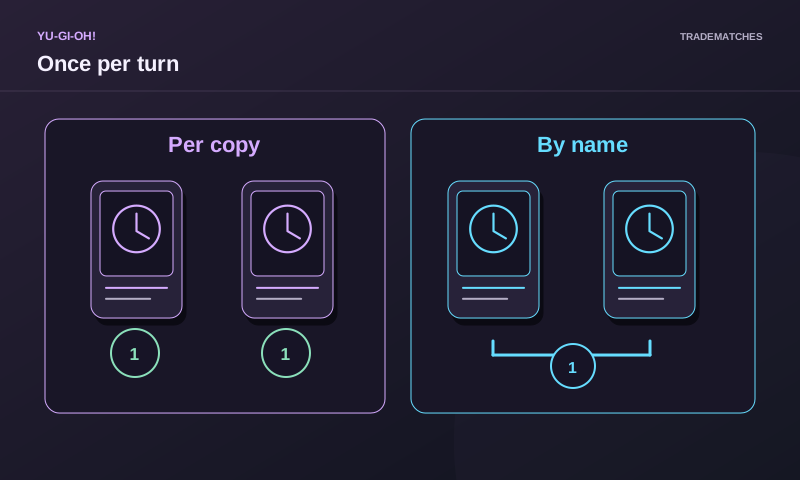
“Once per turn” can restrict one copy of a card, while a restriction naming the card can be shared across its copies. Read the full restriction, including whether it says use or activate. The informal labels “soft” and “hard” once per turn are convenient discussion terms; the actual Yu-Gi-Oh! text determines which limit applies.
Find the sentence that sets the limit
Do not stop reading at the first effect. A restriction near the end of a monster's text may apply to a named effect, to each named effect, or to only one effect from a group. These scopes produce different legal sequences even when the card has several attractive abilities.
For example, Copy Plant has an effect introduced by “Once per turn.” Konami's Lyrilusc teaching manual also explicitly explains that relevant Xyz monsters' limits apply per copy. A named restriction such as the current once-per-turn limitation on Dark Magician of Chaos instead needs its name-wide scope respected. Consult the official database and errata for the wording of the card actually being played.
To annotate a practice deck, record three things: the effect involved, the subject of the restriction and the word governing the attempt. “This copy's effect,” “this named effect across copies,” and “one of these effects” are more informative reminders than a generic symbol saying “once.”
Two copies do not always mean two uses
Imagine you control two hypothetical monsters, each with a per-copy “Once per turn” effect. If each is eligible, using the first does not normally consume the second copy's allowance. You should still distinguish the copies clearly when announcing the activation. Their shared name does not automatically turn that wording into a named restriction.
Change the final sentence to a restriction allowing you to use that effect of the named card once per turn. Activating the first copy consumes the shared allowance. The second copy does not offer another use of that same named effect. Summoning a third copy does not help, and passing control between copies is not a shortcut around your named limit.
| Wording pattern to inspect | What your practice record must distinguish |
|---|---|
| Once per turn, without a named shared restriction | The eligible copy or current instance |
| Only use this effect of a named card once per turn | The player's use of that named effect |
| Only use each effect of a named card once per turn | A separate record for each effect |
| Only use one specified effect per turn, and only once | The choice among effects plus its attempt |
This table describes reading patterns, not a replacement text for every card. A real card may combine restrictions, conditions and exceptions; preserve the complete sentence.
Returning to the field can change an instance
A card leaving the field and returning can be a new field instance for a per-copy limit. That is why returning and replaying a monster can sometimes allow a fresh activation of an ordinary “Once per turn” effect. It does not mean every movement resets every restriction attached to the player's actions.
Consider two teaching sequences. In the first, a per-copy effect is used, the monster returns to hand through a legal effect, and it is legally summoned again. The new instance may have a new per-copy allowance. In the second, a named effect was already used and its monster goes through the same movements. The player's named use remains consumed for that turn.
Do not equate every visible change with leaving the field. Moving control while a monster stays in place is a different event. Changing battle position is another. Turning a monster face-down creates its own rules questions. If your plan relies on a reset, identify the precise movement or state change and confirm the card-specific interaction rather than declaring that “the monster changed, so it resets.”
Use and activate are not interchangeable
A restriction on using an effect generally still counts the attempted use if its activation is negated. A restriction on activating a card can interact differently with activation negation. Negating the effect itself and negating its activation are also distinct. Our separate negation guide examines that difference; here it matters because it determines which allowance your record has consumed.
Suppose a hypothetical monster's named effect may only be used once per turn. You announce it legally and pay its cost. The opponent negates that activation with an applicable response. You should not immediately announce the second copy's same named effect on the theory that the first produced no result. The named use restriction does not ask whether you benefited.
Avoid the opposite blanket statement too. “A negate always stops every retry” ignores wording restricted to activation and card-specific rules. For an unfamiliar card, quote its exact restriction and identify what was negated. That pair of facts is more useful than the informal label hard once per turn.
Multiple effects require separate bookkeeping
A card can give you several effects with a shared restriction or several individually limited effects. These are different deckbuilding resources. If the wording allows each named effect once, using effect A need not consume effect B. If it allows only one of the listed effects, choosing A can prevent using B that turn even though B has a different trigger condition.
Build a practice row for each effect: A used, B used, or shared choice used. Add the card's name when the record is name-wide. For a monster with an effect in the graveyard and another on the field, movement between those zones does not make the text's scope disappear. The location determines whether an effect is available; the restriction determines whether its allowance remains.
This record also helps choose duplicate quantities. A second copy of a card can still be useful for drawing, summoning or paying costs even if it does not provide a second use of a named effect. “Limited effect” does not mean “second physical copy has no purpose.” Compare the actual roles of duplicates instead of assuming they are either always useful or always redundant.
Present a precise question at the table
When a dispute arises, show the current official text, identify the exact copy involved and explain the previous action. “I used effect A of this name, its activation was negated, then this different copy entered” gives a judge the information required to evaluate a named-use restriction. “It got negated; can I do it again?” omits the decisive details.
Keep track during play with permitted reminders and clear announcements. Do not infer permission from a digital game's animation, an old print lacking updated text or a different monster with a similar effect. The governing sentence belongs to the specific card, and current errata can change what an older physical printing appears to allow.
Frequently asked questions
Are soft and hard once per turn official text categories?
They are common informal labels. Apply the wording on the current official card text, especially the named scope and the distinction between use and activate.
Does summoning a new copy bypass a named once-per-turn use?
No. If you have already used the restricted named effect that turn, another copy does not create another allowance for that same effect.
Does a once-per-turn effect require a successful resolution?
Not necessarily. A use restriction can be consumed even when the activation is negated or no benefit is obtained. Check the exact wording and type of negation.