Yu-Gi-Oh! owner vs controller: where does a card go?
On this page
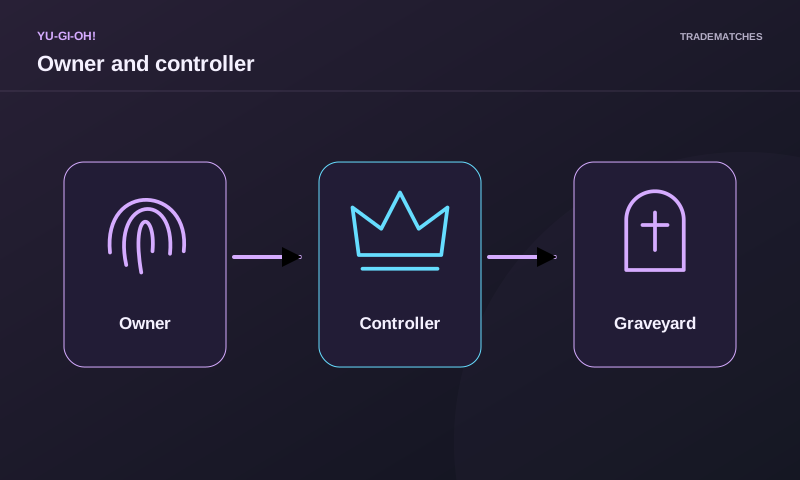
In Yu-Gi-Oh!, owner and controller can be different people. The owner is the one who started the Duel with the card in his deck; the controller is the one who controls it in the field at the time. If a rival card passes to your control, it does not become your property and, when leaving the field, its destination must respect the rules and the applicable text.
What it means to control a rival monster
An effect can allow you to control a monster that started in the opponent's Deck. As long as you control it, the actions and effects that check your monsters can consider it within that set, subject to its restrictions. But the change of control does not change who owns it or physically transfer the card to your collection.
To avoid confusion, place the monster in the area corresponding to its current controller and retain a clear identification of its owner. Don't mix it with a different sleeve during the Duel or mix personal cards to remember who controls what. Table location and effect recording are usually sufficient without altering the material.
Where it goes when it's destroyed
If a rival monster you control is destroyed and must go to the Graveyard, it goes to the Graveyard of its owner, unless an applicable effect changes that destination. It does not enter yours merely because it was on your field. The same principle prevents a temporary destruction from producing a permanent appropriation of cards.
Imagine that A started with a monster in his Deck and B takes over. Then that monster is destroyed in the field of B. The card returns to the A Graveyard in the ordinary situation. If there is a replacement effect that banishes it, that replacement will have to be applied, without treating the recent location as a change of owner.
Back to hand or Deck
An effect that returns the card to the hand returns it to the owner's hand according to the applicable rules. It doesn't become part of your hand just because you controlled it. A return to the Deck must also respect the correct destination and the rules of the type of card. Extra Deck monsters need a different check from those in the Main Deck.
Don't improvise a shared hand or a controller Deck. If the instruction has a specific destination, read how it applies to the type of card. A Fusion monster returned from the field is not treated as an ordinary monster of the main deck just because the effect uses a general return verb. Identify the card before you move it.
Changing Control Doesn't Restart Your Whole History
The card is not necessarily treated as a new Summon just by changing the controller. Do not trigger "when Summoned" abilities if the effect has only changed your control. Similarly, the relevant limitations of the card and the control effect continue to require a specific reading.
If you intend to attack, use it as material or activate its effect, consult both the text of the monster and the text of the card that took it. Some instructions impose limitations or a specific duration. The phrase “now is mine” is insufficient: you can control it and still not have permission to execute all the actions you had planned.
Use it as a material
If rules and effects allow, a controlled opponent monster can serve as a material for a Summon that checks your monsters. This does not remove its restrictions or change its destination when it leaves the field. You must also distinguish between material sent to the Graveyard, Tributed, banished or placed under an Xyz Monster.
Before declaring the Summon, check Level, Type, name or other criteria requirements and any prohibition of use as a material. Don't deduct permission just from the card being physically on your side. If the strategy depends on taking a specific monster, write down what effect allows control and why that monster meets the requirements of the subsequent Summoning.
What happens when temporary control ends
An effect granting control up to a specified time must be resolved with that duration. When it arrives, the card can return to the controller that corresponds to the text and rules. Do not extend the effect to the entire Duel because you forgot to return it at the end of the turn. Keep visible a reference of how long the change lasts.
If the card has already left the field or the return poses a special situation, do not automatically reconstruct the initial state. The response may depend on the area, restrictions and effects present. Check the rule of the card that generated the change. Owner rules help to follow the card, but do not replace all conditions of temporary control.
To whom an activated effect belongs
An ability and its card of origin do not always behave as a single object after it is activated. The change of control or exit of the card may require checking who activated the effect and how it is resolved. Do not transfer a Chain already built to another person for the mere fact of moving the monster physically.
For a specific doubt, retain the sequence: who controlled the card by activating, who added each link, and what changed before resolving. The judge needs that information, not just the final photograph of the field. If you make new decisions before you resolve the discrepancy, you could make it harder to rebuild the case.
‘Your Graveyard’ and ‘its owner’
Texts may refer to areas of a particular player or the card owner. Don't replace those expressions with an intuition about who last used it. After the rival monster goes to its owner's Graveyard, an effect that looks into your own Graveyard will not find it there.
That can change a combination that seemed to work during temporary control. If the plan requires that the material be recovered later, check that the recovery accesses the Graveyard where it will actually be. An effect that authorizes choice in any of the Graveyards may have another response, but that ability must be written. The initial change of control does not add access to the opposing zone.
A complete example of control exchange
A plays a monster from his Deck. B resolves an effect that controls it over a period. As long as the permit remains active, B studies a legal action using that monster. Then an effect returns it to hand. In the ordinary situation, the card returns to the hand of A, its owner; it does not remain in that of B waiting for the end of the period of control.
In another game, the monster is destroyed while B controls it and ends up in A Graveyard. If B tries to retrieve a monster from his own Graveyard, that copy is not an option. The two examples show that owner and controller answer different questions: who directs the card in the field and who it belongs to when changing zones.
Taking care of other people's cards while playing
Ask for permission before touching a rival monster and move it by holding the sleeve carefully. Upon completion, check both Graveyards, banished cards and materials to return any card that does not belong to that person. This physical check is especially useful when the decks use sleeves of the same color or several control changes have occurred.
A change of control during a game is not a collection exchange. If you want to negotiate those cards later, do it outside the game table and with a separate arrangement. Keeping the contexts separate protects the material and makes it easier to identify which cards to return to each deck.
Keep track of which copies must be returned
When several control changes occur, use a clearly agreed arrangement to track cards taken from the opponent without changing their legal zones or revealing hidden information. The arrangement is a reminder of ownership, rather than an additional game rule. Also retain the relevant text or marker showing how long temporary control lasts.
Before packing up, return each physical copy to its owner and check both players' sleeves. Players may use identical artwork and language, so recognising the character is insufficient. When testing with borrowed cards, record which copies were lent before starting. This simple organisation prevents control during the game from becoming confused with physical ownership when the decks are put away.
Frequently asked questions
Does a controlled opponent’s monster go to my Graveyard?
In the ordinary situation it goes to the Graveyard of its owner, except an applicable effect that changes the destination. Controlling it doesn't change its owner.
Can I use it as material?
Only if it meets the requirements of the Summon and no rule or effect prevents it. Also review the restrictions on the effect that changed its control.
Does taking control count as Summoning it?
Not for the change of control itself. A Summon-related trigger needs the event its text actually requires.