BGS subgrades, gold labels and Black Label
On this page
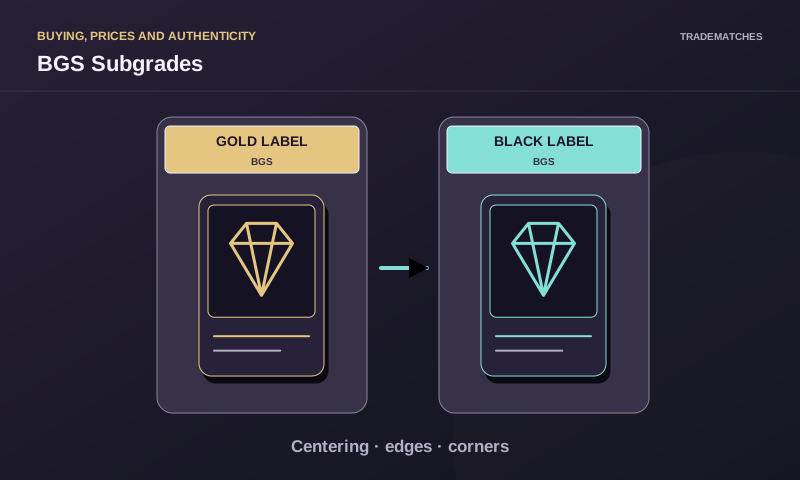
In BGS, subgrades describe four areas: centering, corners, edges, and surface. Black Label identifies the result of four tens in those areas. An overall ten does not alone prove that the card is Black Label, and the final grade should not be reconstructed by a simple average of the numbers you see on the label.
What are you reading on a BGS label
Separate identity of the card, overall grade and partial ratings. The first identifies game, edition and version; the second summarizes the assigned result; the partials show evaluations of certain areas when they appear. Reading only the large number can conceal a relevant difference between two copies of the same card.
A collection record can have columns for overall grade and all four subgrades. Add the certificate number and a photograph of the front and back of the holder. So you don't confuse two copies with the same grade that present different profiles. You do not need to give them an automatic price to make that information useful when comparing or describing a copy.
Centering and surface are separate areas
Centering evaluates alignment. Surface treats the surface, and Corners and Edges separate corners from edges. A defect in one category should not be described as belonging to another category. If a card looks well centered on a photo, that does not show that the surface is problem-free or that the corners deserve the same result.
When ordering images for a purchase, request views to help recognize each area and the entire label. A frontal photograph with reflections can show the center and hide superficial marks. A well-focused corner does not represent all corners. Subgrades provide an evaluation log, but inspection of the specimen and holder remains useful to find out what you are buying.
What Black Label requires
Beckett's official explanation for Black Label links the designation to four subgrades of ten. It is not enough for the overall score to be ten or for three areas to have ten and one to have a lower figure. Check the four values and the visible designation. The word Black in the commercial name of a card also doesn't credit that label.
This matters in product searches that already include "Black" in the name of a variant. An ad may refer to the finish or series of the card, not to BGS's Black Label. Read the grading service and holder results. A coincidence of words in the title of an advertisement does not resolve the category of the copy.
Golden label and grade ten
Beckett's documentation describes gold labels for high grades in its system, including 9.5 and 10. Black Label distinguishes the case from the four subgrades of ten. Don't identify a card as Black Label because the number is ten on a gold label, or treat 9.5 and 10 as the same grade for sharing a label look.
In addition, designs and services can change over time. Use the colour as a clue and confirm the text of the certificate and the specific label. If a photograph has a strange white balance, the gold can look dark or off. Identification should be based on what the holder states and verification, not only on the tone reproduced by a screen.
Why not make a simple average
Adding the four subgrades and dividing by four produces an arithmetic operation, not a new official rating. Beckett assigns the overall grade within its system. A home calculator does not replace that result or authorize the card to be announced with a different grade. Record the overall figure that appears in the verified evaluation.
If you see a profile with an area below the others, you can describe that difference factually. Do not convert the average into a promise of regrading or future improvement. A review may depend on the copy and the service, and its results are not guaranteed by a calculation. There could also be an error in the announcement that you need to clarify before discussing the potential of the card.
BGS, BVG and BCCG are not the same label
Beckett has used services with different names. Do not omit the service initials when comparing grades. A "Beckett 10" announcement needs to indicate what evaluation it represents. Black Label's original explanation distinguishes its application to BGS and does not extend it indiscriminately to other brand services.
For a comparison, write the full name of each service and its designation. Then check its own criteria. Equating every ten because it comes from the same company can make you compare results that don't represent the same system. If the seller does not show the part of the label that identifies the service, ask for a legible photograph before evaluating the copy.
The holder also needs checking.
Check the certificate using the official resource available and compare identity, grade and data with the item offered. An existing number does not by itself prove that every holder photographed is authentic. Check for consistency and condition of the physical holder, and avoid describing as validated what only partially matches a search result.
Do not open the holder to check the card during a purchase without understanding the consequences. Once removed, it is no longer the encapsulated item you evaluated. If you notice damage to the holder or inconsistent data, raise the issue with photographs and the appropriate channel. The correct reaction depends on the actual problem, not trying to repair the plastic at home.
Compare copies for collection
Start with the exact identity of the card: language, edition, variant and number. Then compare service, grade, subgrades and holder condition. Two copies of the same character may not be equivalent if one is another printing. That difference can matter more to your collection than a half-point variation in a different assessment.
Nor do you suppose a universal price multiplier for Black Label. The demand depends on the card, version and comparable operations, among other factors. If you do not have verified sales of equivalent copies, describe the designation and avoid promising profitability. A label reports an evaluation; it does not determine a minimum selling price for every card that receives it.
Before sending from Spain
This guide explains grading results; it does not quote Beckett submission fees or turnaround times. Before booking, check that the service is available, what options it offers, and what current conditions apply to round-trip transport. The general page can show maintenance; do not interpret a description of scale as confirmation that you can book a specific service option today.
If you use an intermediary, separate its quote from the grading service and retain the identification of each card delivered. Define which modality you want and if you need visible subgrades. The availability and presentation must be verified in the actual order. Choosing a modality for an old photo might give you a result with information different from what you expected to record.
Describe two results without inventing equivalence
Compare two hypothetical labels from the same service for the same card. The first shows an overall ten with four subgrades of ten. The second shows an overall ten with one lower subgrade. Do not describe both as Black Label merely because the overall number matches. Record the complete data and check the designation of the actual copy being offered.
An advert showing only an out-of-focus card front and an abbreviated title is insufficient for that comparison. Request a readable label and certificate, together with consistent photographs of the same slab. If the official certificate resource is temporarily inaccessible, record verification as pending. An access failure neither proves a fake nor allows you to claim the copy has been validated.
On 1 October 2026, the general Beckett pages consulted redirect to maintenance notices. The Black Label explanation was cross-checked against indexed official Beckett publications. Submission availability and verification of an individual slab require an operational check when the relevant service is accessible. Do not purchase a service using an old fee schedule or treat a grading-scale screenshot as confirmation of current availability.
Frequently asked questions
Is every BGS 10 a Black Label?
No. Black Label identifies four subgrades of ten. Check both partial ratings and label designation.
Is the overall score the average of subgrades?
You must not replace the official result with a homemade average. Keep the assigned grade and use the partials to describe the card’s profile.
Does a ten from another Beckett service equal BGS Black Label?
There is no such automatic equivalence. Identify the service and check its scale before comparing results.