PSA Authentic vs a numerical card grade
On this page
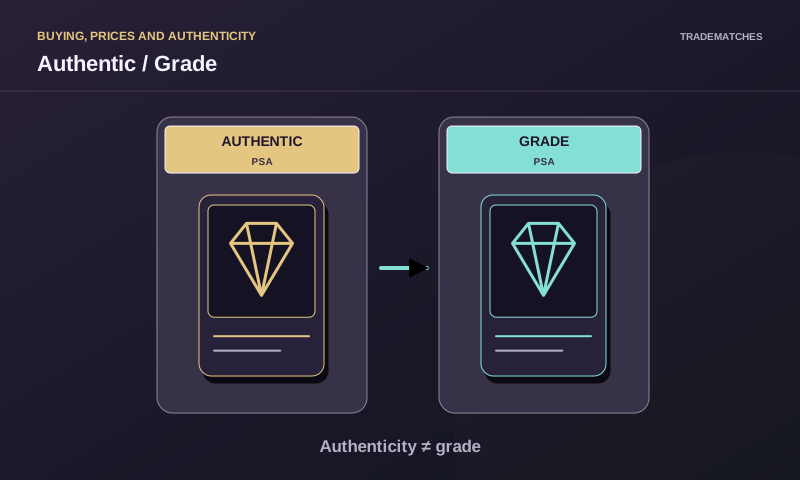
A PSA Authentic label indicates that PSA encapsulated the piece as authentic without assigning a numerical grade. It does not mean PSA 10, Mint, or a grade that can be deduced from the appearance of the case.
Authenticity and condition answer different questions
The PSA 1-10 scale evaluates condition under its standards. Authentic identifies a conclusion of authenticity without that score. In certain cases, such as some hand-cut pieces, PSA explains that it can encapsulate as Authentic when no numerical grade is applicable. Do not extrapolate that example to all cards.
Look at the full designation
PSA also uses designations and results for altered or ungradable pieces. Its guarantee warns that the label may not always reflect "Altered" due to space limitations. Verify the certificate number, the exact description, and any available notes; compare the card and the physical encapsulation as well.
Do not pay as if it were a high grade
Before buying, look for closed sales of the same impression and designation, not just PSA 10. An Authentic card may be desirable for rarity, but its label does not certify corners, centering, or surface at level 10. Request clear photos of both sides and the edge of the encapsulation.
Authenticity and grade answer different questions
A PSA Authentic label communicates that PSA treated the object as authentic, but it does not assign a numerical grade from 1 to 10. A PSA 10 label does include a specific evaluation of condition under PSA standards. The two expressions are not steps on the same scale. "Authentic" does not mean ten, nine, or one: it means the label does not present that grade. If you see a card encapsulated with that designation, do not try to deduce a number by looking at the plastic or comparing the surface with another card. The authenticity of the object and its preservation are separate issues.
This matters when buying because advertisements sometimes abbreviate too much. "PSA authenticated" can refer to a piece without a grade, while "PSA 10" describes an example that was assigned the highest grade. Request a clear photo of the full label and the reverse if you are evaluating a purchase. Read the exact designation, the name of the card, the edition, and the certificate number. Do not base an offer on a phrase in the title that does not match the visible label.
What does the numerical scale evaluate
PSA publishes standards for its condition grades. The numerical scale considers aspects such as centering, corners, edges, surface, and overall presentation according to the grade. For example, PSA 10 is described as Gem Mint with high requirements. An Authentic label does not claim that the card meets or fails all those criteria: it simply does not express a numerical grade. That is why you should not place it in a PSA 10 price table and apply an arbitrary discount. You need to look at the specific example and compare sales of equivalent designations when possible.
Imagine two copies of the same card. One label indicates PSA 8 and the other Authentic. The first communicates a numerical evaluation of condition; the second does not. The Authentic copy could show visible wear, particular manufacturing characteristics, or a reason for service that you cannot know just by looking at the front. Do not assume the exact reason. Consult the certificate card and, if the economic decision depends on it, ask for additional information from the seller. The absence of a grade does not become a "hidden grade" by the buyer's confidence.
Why might there be an Authentic label
PSA rules consider situations in which authenticating and assigning a grade are separate decisions. An example that appears in its standards are certain hand-cut cards from panels or boxes: if the cut exceeds the visible edge, PSA may encapsulate as Authentic without a numerical grade. This example illustrates the distinction, but it does not explain all Authentic labels in the market. Do not assume that a specific card is cut, altered, or perfect just because you see that word. The cause must be investigated in the data of the example and the applicable documentation.
There are also items that PSA may reject without encapsulating or grading when authenticity or manipulation issues arise. Do not mix "Authentic encapsulated" with any "No Grade" return code. They are results of different processes. If an offer shows only a partial number or a photo of a case without a clear label, request images before describing it as graded. The accuracy of the designation protects both the buyer and the seller.
Read the full label
In addition to the word Authentic, check the game, collection, year, card number, variant, and any additional mention that appears on the label. A TCG card may have several similar impressions with very different prices. The encapsulation does not eliminate the need to verify that you are looking at the version you are seeking. If the announcement name says an edition and the label says another, pause the purchase and clarify it. The same thing happens if the label contains a complementary designation that is not clearly visible in a small photo.
The certificate number allows you to consult the PSA registry. Compare the public information with the label and the images of the offer. A matching number does not completely substitute for examining the physical piece, but it helps detect description errors. If the registry shows a different designation or a pending correction, ask for clarification before paying. Use the official site, not a capture sent by the seller as the only test.
What does it mean for the price
An Authentic card may have demand because it is a genuine piece protected in a holder, especially if the base card is rare. However, it is not reasonable to assign it the price of PSA 10 simply because it has the PSA logo. The grade 10 adds specific information about condition that Authentic does not provide. Look for comparable sales of the same card and designation when they exist; if not, recognize that the estimation will have more uncertainty. Examine visible condition, variant, and presentation before accepting a suggested equivalence from an advertisement.
Example: you find an advertisement "PSA 10 or equivalent" and the photo shows Authentic. There is no official numerical equivalence that allows you to call it ten. Ask the seller to correct or explain the advertisement and decide the price based on the actual piece offered. A buyer who collects exclusively by numerical grades may not want that card, while another may value it for authenticity and rarity. The label helps decide, but only if read literally.
Authentic is not a guarantee of everything else
PSA authentication refers to the object subjected to its process. It does not prove by itself that the advertisement is correct in price, that the seller has the right to sell it, or that the package will arrive without damage. For a distance purchase, review the seller's reputation, the encapsulation photos, packaging, and shipping conditions. It also does not interpret Authentic as a promise that any surface defect is allowed or discarded. The designation does not describe the condition with the detail of a numerical grade.
If the card is being bought to resell or insure, document the exact designation. Writing "PSA graded 10" when the label says Authentic can be misleading and complicate a future dispute. A correct card should say "PSA Authentic, without a numerical grade" and describe the variant. Transparency reduces misunderstandings in exchanges between collectors.
A four-step purchase protocol
First, request clear images of both sides of the holder and the label. Second, look up the certificate number on PSA and compare the name, edition, and designation. Third, visually inspect the card without inventing a grade: note only features you see. Fourth, compare offers or sales of the same variant with an equivalent designation. If there are no comparables, do not fill the gap with the price of PSA 10. This process is slower than accepting the title of the advertisement, but it avoids paying for a grade that does not exist.
If you receive a card that does not match the description, save photos of the advertisement, the label, and the delivered piece. Contact the seller from the platform where you bought and explain the specific discrepancy. It is not necessary to discuss if "it looks like a ten"; it is enough that the label does not claim that grade. The difference between Authentic and a numerical grade is objective and can be verified by reading the encapsulation.
Common interpretation errors
One: reading Authentic as PSA 10. Two: mentally converting it into PSA 1 for not having a number. Three: assuming that all Authentic pieces share the same reason for not receiving a grade. Four: comparing prices with another impression of the same character. Five: consulting a label photo without verifying the certificate. To avoid them, separate authenticity, condition, variant, and price into four questions. The answer to one does not automatically resolve the other three.
PSA standards and its service may change, so it is advisable to consult PSA's current guidance for a specific designation. This article explains the basic reading of the label: Authentic claims authentication without a visible 1–10 grade. If the description of a piece adds "Altered," a qualifier or another designation, interpret that text as well and request the corresponding documentation before making an economic decision.
Common questions
Is PSA Authentic the same as PSA 10?
No. Authentic lacks a numerical condition grade.
Is consulting the certificate enough to buy?
No. Compare the card, photos, and the real object; a valid card by itself does not eliminate the risk.