Card trading table at events: how to set one up and use it
On this page
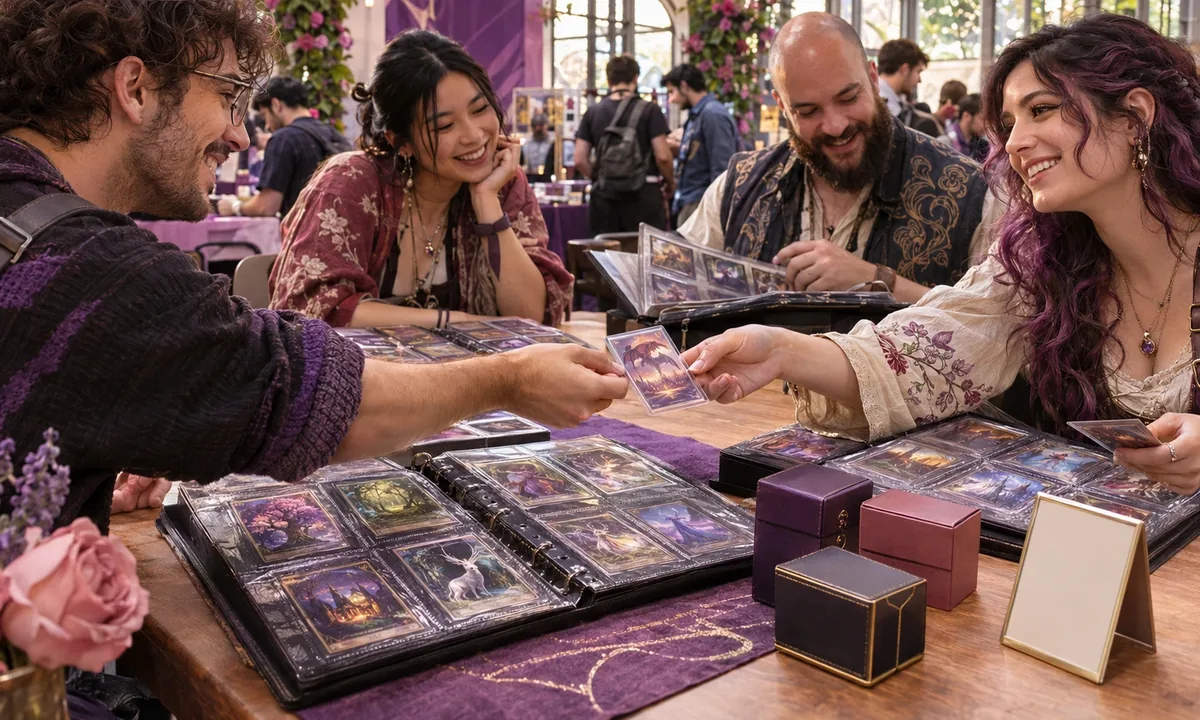
A card trading table is an area at a game store or TCG event set aside for trading cards, away from the tables where people play. It works when everyone knows in advance where and when trading happens, which price reference to use and what happens if a child wants to swap an expensive card.
What a trading table is
A trading table is a fixed spot at a store or event where players swap cards without taking up tournament tables or interrupting games. Players know where to find the people who came to trade, and the store keeps negotiations out of the middle of a round and out of the aisles between match tables.
It is not a vendor booth. At a trading table, two players exchange cards, sometimes with a little cash to even things out. Whether private sales are allowed is the organiser's call: a store that sells singles may want its table kept to swaps only.
How to set up a trading table at a store or event
To set up a trading table you need a well-lit table away from the games and in view of staff, set hours, a sign with a few short rules and one staff member people can go to with a problem. No special kit is required; what makes it work is having those decisions made before people arrive.
| Decision | Simple option | Why |
|---|---|---|
| Location | Near the counter or staff area, out of the walkway between tournament tables | Someone can see what happens and nobody negotiates over a live game |
| Hours | Before round one, between rounds and after the event | Players can trade without losing focus or delaying a round |
| Lighting | Bright, direct white light; avoid a spot under a window or a glaring lamp | Glare hides wear on foils and edges |
| Surface | Playmat or a clean, dry table with no drinks or food | An unsleeved card gets marked or bent easily |
| Supplies | Spare sleeves, paper and a pen | To protect a freshly traded card and write deals down |
| Cash | Decide whether cash top-ups are allowed or trades are card-for-card only | Avoids disputes with the store and between players |
| Children | A written rule for high-value trades | See the section on children below |
At a large event with vendors, keep player-to-player trading clearly apart from the dealer booths. Riot, for instance, announced vendors and community events for the Riftbound Regional Qualifier at Fira de Barcelona in August 2026. When the two are mixed, someone can mistake a player's offer for a dealer's, or the other way round.
Rules for the trading table sign
Trading table rules fit on a six-line sign: ask before touching, one binder at a time, only the owner unsleeves a card, deals are checked at the table, no betting cards, and any problem goes to staff. Here is a template to copy and adapt:
- Ask before you open or touch someone else's binder.
- Look through one binder at a time and hand it back before picking up another.
- Only the owner takes a card out of its sleeve.
- A trade is done when you both say yes and have checked the cards here.
- No playing for cards and no betting on the tournament.
- If something seems wrong or a card is missing, tell staff straight away.
Rule five matters. Riftbound's Tournament Rules disqualify anyone who wagers on any part of a tournament, match or game (rule 704.6), and other games have similar policies. Playing "for cards" in a tournament venue turns a trade into a bet.
Binder etiquette: looking through someone else's binder
Good binder etiquette means letting the owner open the binder on the table, turning pages from the top corner and pointing at the cards you want instead of pulling them out. A trade binder is the part of a collection someone has chosen to show strangers, and handling it carefully is what gets you shown it again next time.
- Clean, dry hands; wash them if you have just eaten.
- Keep the binder open flat on the table, not held up or on your lap.
- Do not stack binders on top of each other; rings and clasps dent the pages.
- Note the cards you like and the page number, so nothing needs to come out yet.
- Ask before photographing someone else's binder.
- If nothing catches your eye, say so plainly and hand it back closed.
If it is your binder, remove or flag any card you have already promised to someone before you show it. A reserved card left on display leads to the most awkward moment of the evening: pulling it from a deal the other person thought was settled.
Valuing cards at the table without arguing
At a trading table, agree on value before any card moves: pick one price source together, look up each card in the same printing, language and condition, and write down each side's total. Arguing over numbers from different sites is the quickest way to wreck an otherwise reasonable trade.
A worked example: Sam offers three cards and Alex offers one. They open the same price site on Sam's phone and search each card in the exact version on the table. Sam's cards come to €4, €3.50 and €2, so €9.50 in total; Alex's card is €12. The gap is €2.50. They can add a small card on Sam's side, settle the difference in cash if the table allows it, or walk away. All three are fine; what matters is that the gap is written down and nobody finds it later.
For the full method of judging whether a deal is worth it, see how to tell if a card trade is fair, and for checking reference prices, how to value TCG cards before trading. At the table, the useful part is arriving with that work done: the cards you brought already looked up and noted.
Checking card condition at the table
Check a card's condition at the table, before the deal is closed and under direct light: both sides and, if the owner agrees, out of the sleeve. Once it is in your binder, there is no telling whether a mark was there before or happened on the way home.
At the table, the owner unsleeves the card, over the playmat, one card at a time. If the other person spots wear that was not mentioned, the value is discussed again before going on. What each grade means (Near Mint, Lightly Played and so on) and what to look at on each part of the card is covered in our TCG card condition guide.
Children at the trading table
If children will trade, the table needs its own rule: high-value trades happen with the responsible adult present or aware, and no adult should push a child to swap an expensive card. In Spain this is more than common sense. Article 1263 of the Civil Code lets non-emancipated minors make contracts for everyday goods and services suited to their age, in line with social custom. Swapping two commons fits that easily; swapping a hundred-euro card, much less so.
Official programmes start from the same place. Play! Pokémon tells families that League locations and Professors are subject to background checks, that local tournaments are split by age division and that supervising adults are always present, and it describes League as a place where children get plenty of chances to trade. In Riftbound, rule 301.4 of the Tournament Rules requires a parent's or guardian's permission for players under 13.
- If a child wants to trade away a card that looks valuable, ask whether their family knows and, if in doubt, wait for the adult.
- If you see an adult pressuring a child to close a trade, tell staff.
- As a parent, go over what your child traded at the end of the day without turning it into a telling-off; that is how they learn to judge value.
Safety at the table: binders, bags and theft
At a trading table, cards are rarely lost to a bad deal and far more often to an unattended binder, so take it with you whenever you get up to play a round or buy a drink. At a Riftbound tournament, stealing or trying to steal from an attendee, spectator, vendor or organiser means disqualification (rule 704.7 of the Tournament Rules), but the penalty does not bring your card back.
- Keep expensive cards in a small box or mini binder that fits an inside pocket of your bag, not an outside one.
- Count your cards when you close the binder; if one is missing, say so there and then, not once you are home.
- Do not accept "I'll bring it next week": at a trading table, both sides hand over at the same time.
- If cash is involved, it is paid at the table before anyone leaves.
Warning signs of a dodgy deal and how to close a trade at a distance are covered in our guide to safe TCG card trading.
How stores and official programmes handle trading
There is no shared rule across games or stores: each shop decides whether it has a trading table, when it is open and whether sales are allowed, so ask before you turn up with your binder. What official programmes do offer are casual events where trading fits naturally: Play! Pokémon League, which Pokémon describes as a place to play and trade, or Riftbound Nexus Nights, casual weekly events each store runs on the day that suits it.
To find them, use the Pokémon event locator or Riftbound's own; our guide to Riftbound stores in Spain explains how the latter works. If it is your first tournament, our guide on preparing for your first TCG event covers what to bring.
If you are the one running the table, settle these questions with the store first: when the trading area opens and closes, whether cash top-ups are allowed, what the rule for children is, which staff member handles problems and whether the table stays open during rounds or only between them.
Before the event, TradeMatches "have" and "want" lists show you which nearby collectors match your cards, and the chat lets you arrive at the table with trades already sketched out.
FAQ
What is a trading table at a card event?
It is a fixed area, separate from the play tables, where attendees swap cards before, between or after rounds. The store or organiser sets it up and decides the hours and rules.
Can a store ban card sales at its trading table?
Yes. It is their venue, so they decide whether the table is swaps only or cash is allowed; check before offering a sale so you do not put staff in an awkward spot.
Can a child trade cards without their parents?
In Spain, children can make the everyday deals normal for their age under Article 1263 of the Civil Code. For a high-value card, the sensible approach is to wait until the responsible adult is there or knows about it.
What should I do if a card goes missing after I showed my binder?
Tell staff immediately, describing the card and roughly when it happened. Theft means disqualification at Riftbound tournaments, and the store can check the room while everyone is still there.