Digimon Alliance: adding DP without a second attack
On this page
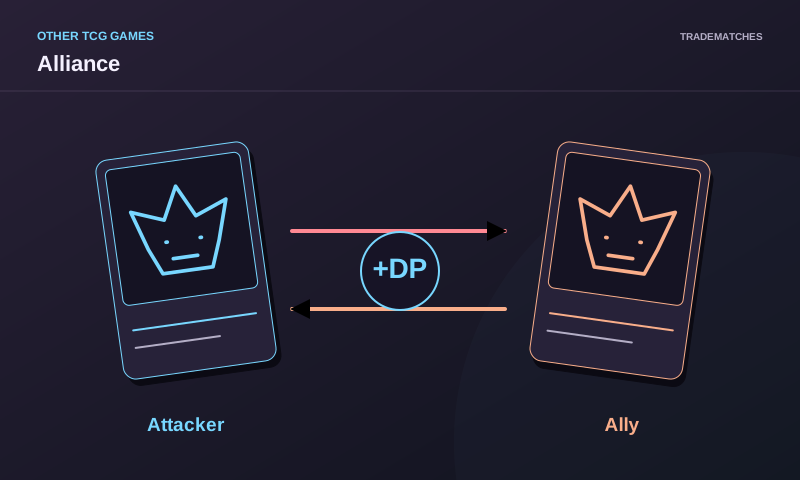
Alliance lets an attacking Digimon suspend one of your other Digimon to add that Digimon's current DP and gain Security Attack +1 for the attack. Only the original attacker attacks. The ally is supplying a cost and a DP value, not joining as a second attacker or making its own security checks.
The added DP is fixed when the ally is suspended. Later changes to the ally's DP or its removal from the battle area do not undo that already granted bonus. Keep the attacker and supporting ally separate when tracking damage, effects and the remaining board.
Alliance triggers when its Digimon attacks
Alliance is a triggered keyword effect associated with the Digimon declaring an attack. That attack must already be legal through the ordinary rules or an applicable exception. You cannot begin with an ineligible attacker and rely on the supporting Digimon to make the declaration legal afterwards.
Identify which Digimon actually has the active Alliance effect. A lower card showing the keyword in a non-inherited text area is not automatically granting it to the current Digimon. Read the top card and active inherited effects before claiming the keyword.
Once the attack is declared, process the relevant pending effects through Digimon's timing rules. Alliance does not authorise an immediate unannounced adjustment before all other attack-triggered effects are considered. Clear sequencing becomes important if another effect changes available allies or their DP.
The ally must be one of your other Digimon
The payment uses one of your other Digimon. You do not suspend the attacker again, a Tamer, an opposing Digimon or a card in your hand to supply the Alliance condition. The chosen supporting object must fit the actual category and be available in the appropriate area.
It must be possible to perform the required suspension. An already suspended ally cannot pay a new suspension simply by being selected again. If another effect prevents that Digimon from suspending, the desired support is unavailable even if its DP would be ideal.
For a simple board, imagine an attacker with Alliance and two other Digimon: one ready with 4000 DP and one suspended with 9000 DP. The large suspended Digimon is not automatically the better legal payment. Without an effect making it available first, the ready 4000-DP ally is the relevant candidate.
Supporting is not attacking
The ally's suspension does not create its own attack declaration. Its When Attacking effects do not trigger merely because it helped pay for Alliance, and it does not choose a separate target. You still resolve one attack using the actual attacker.
This also explains why a supporting Digimon's own Security Attack modifier is not simply added to the attacker. Alliance grants the bonus stated by Alliance. It does not copy the ally's entire text box, inherit all its keywords or transfer its previous effects onto the attacker.
The restriction on attacking in the turn a Digimon was played is different from a requirement to suspend it as support. A newly played ally is not declaring an attack by paying Alliance. Check whether it can legally suspend for that purpose rather than treating every suspension as an attack.
| Part of the sequence | What happens |
|---|---|
| Attack declaration | One Digimon is the attacker |
| Alliance payment | One eligible other Digimon is suspended |
| DP bonus | Add the ally's DP at the suspension moment |
| Security modifier | Attacker gains Security Attack +1 for this attack |
| Ally's attack effects | Do not trigger solely from supporting |
| Ally leaves later | Does not by itself remove the granted Alliance bonus |
Calculate DP at the moment of suspension
Suppose your attacker has 7000 DP and the chosen ready ally currently has 5000 DP. Alliance adds that 5000 to the attacker, giving 12000 under those stated conditions. Include other applicable effects when establishing each current value; do not use printed DP if the ally is already modified.
The value is taken when the suspension happens. If the ally later gains or loses DP, the already granted addition does not continuously follow its new value. This distinguishes Alliance from a continuous effect that repeatedly recalculates from another permanent's current characteristics.
For practice, let the 5000-DP ally lose 2000 DP after the Alliance bonus has been established. The original addition remains 5000 for the attack, assuming no other effect changes the attacker. Record the snapshot beside the attacker rather than repeatedly rereading the ally's modified number.
Removing the ally does not remove the bonus
The comprehensive rules expressly preserve the granted DP and Security Attack +1 if the suspended supporting Digimon leaves the battle area during that attack. The attacker does not need the ally to remain visibly present as a continuous source of its added DP.
Imagine the ally being removed by an eligible effect after support. Continue tracking the attacker's established bonus. Do not clear it just because the supporting card moved to trash. Conversely, the ally's departure can create other legitimate effects that still need their own processing.
This is a useful distinction when considering interaction: disrupting the ally before it can pay Alliance can change the available support, while removing it after the snapshot does not automatically reverse the grant. The exact timing and applicable effects determine whether the attempted disruption addresses the bonus at all.
Security Attack +1 modifies the existing attack
An ordinary player attack normally starts from its normal security-check count, then applies relevant modifiers. Alliance supplies an additional Security Attack +1 for that attack. If no other modifier changes the example, that ordinarily increases one security check to two.
This is not a promise that both checks will necessarily occur. The attacker must survive and the attack must remain valid through the security procedure. A security effect or battle can remove the attacker or otherwise stop further processing before you complete the expected number.
If security runs out during those checks, the remaining modifier does not create a second independent direct attack that automatically wins. Follow the player's attack and security rules. Alliance makes one attack stronger; it does not manufacture an extra declaration after that attack has consumed the remaining security.
Choose an ally with the next board in mind
The supporting Digimon becomes suspended and remains a separate vulnerable board object. Adding the largest DP can improve the current battle, but it may expose a valuable ally to later attacks. Compare the immediate security pressure with what you need to keep available on the following turn.
For a hypothetical choice between a 3000-DP expendable ally and a 7000-DP important evolution stack, ask what DP threshold the attack actually needs. If the smaller addition already meets the intended threshold, using the larger ally may spend defensive flexibility without changing the attack's practical result.
This is a decision example, not a universal ranking of small and large supporters. The security cards are unknown and actual threats matter. Use the example to state your objective clearly: survive a likely battle, add a security check or preserve a key Digimon for later.
Several effects can share the attack timing
An attacker may have Alliance alongside other When Attacking effects. Resolve the actual pending effects under the game's ordering rules. If an earlier legal effect changes the ally's DP before the Alliance suspension, the snapshot can use that changed current value.
Do not assume the same value applies if the change happens after the suspension. Write the order explicitly during a practice turn: attack declared, DP-changing effect resolved, Alliance paid, bonus fixed. Reversing the middle two events can produce a different result when the effects are legally orderable that way.
Multiple granted instances and complicated interactions deserve the exact current text rather than a shortcut. If you are unsure whether another suspension or another pending effect is available, identify each source and the condition it asks you to perform. A single large “Alliance active” marker can hide separate requirements.
Track the duration as one attack
The added DP and security modifier are for the attack. Do not leave them as permanent upgrades on the Digimon for the rest of the game. Remove the appropriate reminders when that attack and its relevant effects have ended through the normal procedure.
If a later effect unsuspends the attacker and permits another attack, repeat the new declaration's checks. An ally still suspended from the first Alliance cannot automatically pay another suspension. The second attack is a new situation, with current available allies and any current Alliance effects evaluated again.
For a tournament, announce which ally is suspended and its current DP when paying. That gives both players a shared snapshot and makes later changes much easier to resolve accurately without reconstructing an earlier board from memory.
Frequently asked questions
Does the ally make a second attack?
No. Alliance supports the existing attacker. The ally's suspension is not its own attack declaration and does not create a separate target or set of security checks.
Does lowering the ally's DP later reduce the bonus?
Not by itself. The added amount is fixed from the ally's current DP when it is suspended for Alliance. Later modifications to that ally do not recalculate the established bonus.
Does deleting the ally cancel Alliance?
If the bonus was already granted, the ally leaving the battle area does not remove the DP addition or Security Attack +1 for that attack. Effects acting before the payment can present a different situation.