Blocker in Digimon: when can it block?
On this page
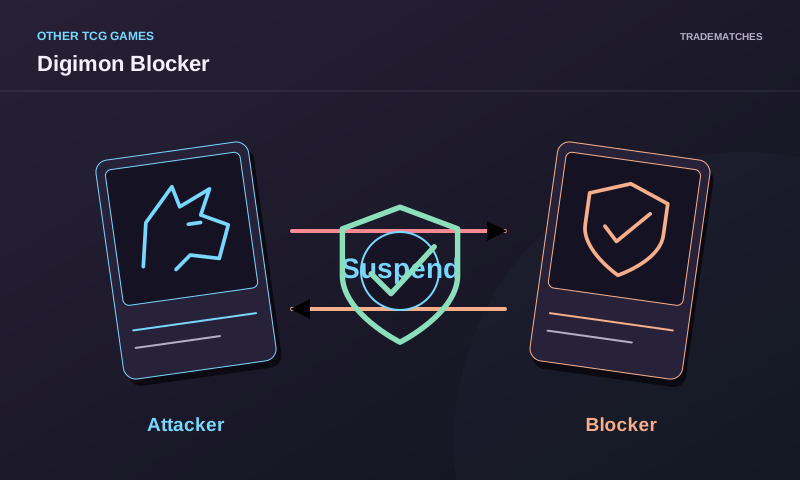
Blocker in the Digimon Card Game allows a Digimon in the battle area to be suspended to redirect an attack toward itself. The block is declared in the corresponding window and can only be used once per attack. Simply having the word "Blocker" printed on a card is not sufficient—the Digimon must be in the battle area, able to suspend, and eligible at that moment. Understanding these conditions clarifies why a prepared Blocker can defend, while a previously suspended Digimon typically cannot.
What changes with a block
The attacker declares a legal target, such as a Digimon or the opponent's security. If the defender performs a valid block, the attack's target changes to the Digimon with Blocker that was suspended to block. The attack is not canceled or restarted from scratch; it continues with a new target according to the procedure. Effects that were already activated when the attack was declared are managed based on their timing, and then the battle proceeds with the new defender.
Example: A Digimon attacks your security and you have a Digimon prepared with Blocker in the battle area. In the block window, you can suspend it and redirect the attack. If the block is completed, the battle is resolved against that Digimon instead of performing the security check on that attack—unless another rule or effect changes the result. Blocker does not heal the attacker nor automatically prevents damage to your defending Digimon.
Must be in the battle area
The rules state that a block redirects the target to a Digimon with Blocker in the battle area. A breeding pile with the "Blocker" keyword cannot block from there. The breeding area is separated from attacks and many ordinary abilities. Before announcing "block," indicate which battle Digimon will perform the block and verify that it remains in the battle area when needed.
Example: You prepare a Digimon with Blocker in breeding. The opponent attacks now. The "Blocker" keyword may be visible, but it does not serve as immediate defense from breeding. When that breeding pile is legally moved to the battle area in a later phase, it can block future attacks if it meets all other conditions. Movement is not made as a reactive response to an attack unless specifically permitted by a card.
Must be able to suspend
To block, the defender declares the block and suspends the chosen Digimon. If that Digimon cannot suspend, it cannot perform the block. The most common situation is that it is already suspended, but there may also be an effect that prevents suspension. Blocker does not automatically reorient the Digimon to allow defense. The check is made based on the actual state in the block window.
Example: You attacked with your Blocker on your turn and it remained suspended. If it remains suspended when the opponent attacks, you cannot suspend it again to block. If an ability reoriented it before the appropriate window, you could evaluate the block again. Some cards have Reboot or other effects that change their orientation; read their text and the exact moment of that change. It is not enough to assume that "it has Blocker, so it always blocks."
When is it declared?
The block window appears within the attack procedure, after the corresponding prior steps. You cannot wait to know the result of a battle or a security check before announcing a block. You also cannot declare a block before an attack exists. Following the order of the attack allows the defender to know the declared target and decide whether to use their prepared Digimon to change it.
In a physical game, pausing briefly in the window helps: the attacker announces the target, applicable abilities are resolved, and the defender decides whether to block. If yes, the chosen Digimon is suspended and the attack continues with the changed target. A "chain" style is not required; Digimon has its own attack procedure, windows, and pending effects.
One block per attack
The rules limit blocking to one use per attack. Multiple Digimon cannot block simultaneously, nor can a second block be declared after the first has changed the target. This prevents forming a line of defenders or repeatedly changing the target during the same attack. If an effect produces a new attack later, that new attack will have its own block check.
Example: You have two Digimon prepared with Blocker and the opponent attacks. You can choose one of them to block if both are legal; you cannot suspend both so the attacker fights against both. If the first is eliminated during the battle, the second does not block the original attack. Reserving it may be useful for a future attack, but not as a late replacement within the same attack.
The original target is not blocked itself
The rules state that the Digimon that was already the target of the attack cannot perform a block on that same attack. The practical reason is that the block redirects the target to another Digimon that is suspended to defend. If the attacker already declared your Digimon with Blocker as a legal target, you cannot announce a "block" with that unit to generate an additional event of suspending or altering the battle.
Example: Your Digimon with Blocker is prepared and the opponent declares an attack directly against it, if possible. The battle already has it as the defender. You do not declare a block with that same unit. Another Digimon with Blocker prepared could be chosen to change the target if the rules are met, subject to the one-block-per-attack limit. The "Blocker" keyword does not obligate acceptance of an attack nor create an automatic reaction.
Blocker is optional
Having the "Blocker" keyword does not require you to block every possible attack. You can keep your prepared Digimon if you prefer to receive a security check or protect it from a more dangerous attacker. Once you decide to block and suspend it, you cannot undo it because you don't like the battle result. The strategic value of blocking depends on DP, inherited effects, remaining security, and other defensive options.
An exception may exist for a card whose text requires blocking or grants a special rule. In that case, the card's text must be followed, not a general assumption. Blocker is a permission to perform a defensive action. Reading it as an obligation may cause a player to sacrifice a key piece against their intention and alter the outcome of a game.
Blocker versus attacks on security
An attack on security does not immediately reveal a card if there is still a legal opportunity to block. The defender can redirect the attack to their Digimon with Blocker in the corresponding window. If blocked, the ordinary security check for that attack does not occur because the target has changed to the Digimon. If the block is illegal or the player chooses not to perform it, the attack proceeds to security as per the rest of the procedure.
Do not confuse this with a reduction in the number of security checks. Blocker changes the attack's target, and effects that modify how many security cards are checked are evaluated within the resulting path. If the attacking Digimon has abilities such as Security Attack +1 or Piercing, the interaction may require additional steps. For the basic principle, focus on the decision to redirect before revealing security.
Blocker versus attacks on Digimon
The attack may have chosen another of your Digimon as its target. A legal Blocker can redirect it to itself. This allows protecting a key unit, even if the Blocker might be eliminated in battle. The new battle uses the current characteristics of both Digimon and applicable effects. The attack does not "fail" by not reaching the original target; it is resolved against the defender that takes its place.
If the original target of the attack was precisely the Digimon with Blocker, the earlier limitation applies: it cannot block itself. If you have another Blocker, evaluate whether it can intervene. If no prepared Digimon meets the requirements, the attack continues against its original target. This distinction helps separate the "Blocker" keyword from other effects that cancel attacks or prevent elimination.
Multiple copies of Blocker on the same Digimon
A unit can obtain Blocker from multiple sources. This does not allow it to block twice in the same window or suspend twice for one attack. The rules state that multiple instances of Blocker on a Digimon still allow only one block at that time. The duplicated ability may remain relevant for other texts that count abilities, but it does not increase the normal number of blocks.
Example: An effect grants Blocker to a unit that already had it. When the opponent attacks, that prepared unit can block once. It cannot declare two consecutive blocks to activate two instances of a "When Blocking" effect. If an external ability reorients it later and there is a different attack, it could block that new attack if all requirements are met again. These are two separate attacks, not two uses within one.
Common mistakes and quick check
The most common mistakes are blocking from breeding, blocking with a suspended Digimon, changing the target after revealing security, declaring two blocks on one attack, and using the original target as its own Blocker. A quick check asks: Is there an ongoing attack and are we in its block window? Is the Digimon with Blocker in the battle area? Can it suspend? Is it different from the original target? Has this attack already been blocked?
If all answers allow the action, suspend the Digimon and redirect the target to it. Then resolve the attack using normal battle rules and effects. If a card adds an obligation or exception, apply it exactly as written. Maintaining this order prevents Blocker from appearing as a vague and infinite defense; it is a concrete defensive action with a defined cost and moment.
Summary
Blocker grants permission to redirect an attack toward a Digimon in the battle area that is suspended during the block window. Only one block is allowed per attack, and a Digimon that cannot suspend or that is already the original target cannot perform that block. The ability is normally optional and does not function from breeding. Identify the window and the defending unit before continuing with the battle to resolve it correctly.
Frequently Asked Questions
Can a Digimon that is suspended with Blocker block?
No, if it cannot be suspended again. The declaration of a block requires suspending the chosen Digimon.
Can I block a single attack with two Digimon?
No. The limit is one block per attack, even if you control multiple prepared Blockers.
Can a block be used on an attack directed at another Digimon?
Yes, a legal Blocker can redirect the target to itself. The Digimon that was originally targeted cannot block itself.
Official Source: Digimon Card Game Comprehensive Rules Manual, Blocking and Blocker sections.