Digimon Reboot: unsuspending on the opponent turn
On this page
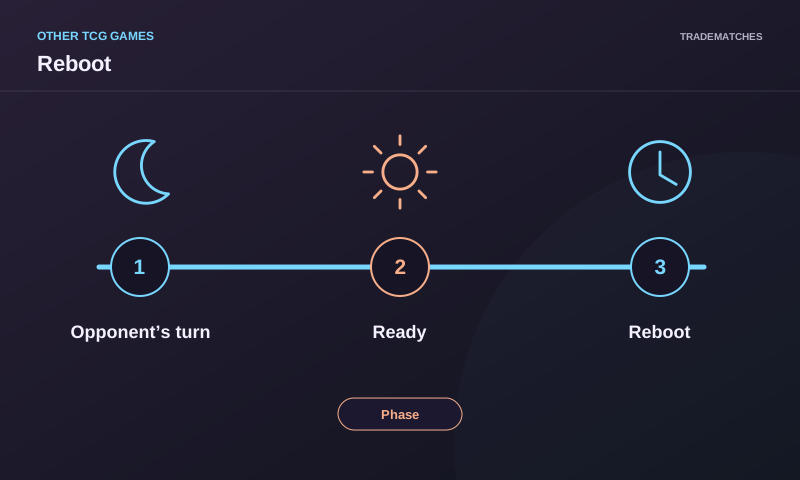
Reboot unsuspends its Digimon during the opponent's unsuspend phase. It does not grant an extra attack, immunity or a chance to act whenever the opponent plays a card. The keyword changes the Digimon's state at a defined phase. You can therefore attack on your turn and potentially begin the opponent's turn with that Digimon active again.
Locate the phase rather than the next action
The current Digimon comprehensive rules describe Reboot as a persistent effect, make its unsuspending mandatory and place it alongside the opponent's normal unsuspending. It does not use a generic “whenever your opponent does something” timing. If the opponent is already in the main phase when your Digimon gains Reboot, that earlier unsuspend phase does not happen again.
Start-of-turn effects and the unsuspending actions have their own order. Do not flatten them into a single moment called “the beginning.” If a start-of-opponent-turn effect changes the Digimon before normal unsuspending, the actual state at the relevant action matters. The rules manual's phase procedure is the appropriate reference for a complex sequence.
Draw a simple timeline: your attack, your remaining turn, opponent's start and unsuspend procedure, their draw and later phases. Put the Reboot preparation on that timeline. The exercise shows both the useful readying and the interval in which your attacker may remain suspended.
Active status is useful but not protective by itself
An active Digimon normally is not an ordinary opposing Digimon attack target without a relevant permission. Becoming active can therefore change which attacks the opponent can declare. It does not stop deletion effects, DP reduction, suspension effects or abilities allowing a different target selection.
Imagine a hypothetical attacker that ends your turn suspended and has Reboot. It becomes active in the opponent's unsuspend phase if the preparation is allowed. The opponent cannot treat it as a suspended target merely because it attacked on the previous turn. But an applicable effect that suspends it during the opponent's main phase can make it vulnerable again.
This sequence makes the value of Reboot concrete. It changes a board state once at a defined point; it does not promise that the state will remain active throughout the opponent's turn. A defensive plan should identify what the opponent can legally do afterward instead of declaring the unit untouchable.
| Situation | What Reboot provides |
|---|---|
| Suspended Digimon at the relevant opponent unsuspend procedure | Mandatory unsuspending, subject to applicable restrictions |
| Digimon already active | No second attack or stored readying |
| Digimon gains Reboot after that phase | No rewind to the earlier phase |
| Opponent later suspends the Digimon by an effect | No immediate Reboot response |
| Digimon also has Blocker | Active status may help use Blocker; its own requirements still apply |
Reboot and Blocker solve different problems
Reboot changes whether the Digimon is suspended. Blocker changes a legal attack through its own defensive procedure, typically requiring the appropriate active Digimon. Combining the two can let a Digimon attack on your turn and later be available for a block, but neither keyword supplies the other's text.
For a hypothetical Digimon with both abilities, finish your attack suspended. If it reaches the opponent's unsuspend procedure with Reboot applying and no relevant prohibition, it becomes active. When a qualifying attack reaches the Blocker window, inspect whether the Digimon can legally block then. A intervening suspension, deletion or effect restriction can change that answer.
A Digimon with only Reboot does not acquire Blocker. A Digimon with only Blocker does not automatically unsuspend in the opponent's phase. When buying a card for this combined role, check both actual effects rather than the artwork, level or colour. If one ability is inherited, check that its source is in the stack and its conditions apply.
Multiple copies of the keyword do not bank preparations
The current rules explain that multiple instances of Reboot do not create additional unsuspending in the same phase. A Digimon is either prepared by the relevant procedure or not. You cannot store an unused preparation and spend it later after blocking or being suspended.
Consider a hypothetical Digimon with printed Reboot and an inherited Reboot. It is suspended at the start of the opponent's normal preparation. Becoming active once is the relevant state change. After it later suspends to use Blocker, the second instance does not give a spare mid-battle unsuspend. Its timing remains the opponent's unsuspend phase.
This is an important distinction when evaluating duplicate inherited effects. A second source may help maintain the keyword if one source is removed, depending on the actual stack. That redundancy is different from doubling how often you can prepare. Record whether you are adding reliability of access or genuinely adding a new action.
A prohibition can matter at the preparation point
An effect that prevents the Digimon from unsuspending at the relevant time needs to be read alongside Reboot. The keyword is not a blanket override of every “cannot unsuspend” instruction. Check whose phase the restriction mentions, its duration and whether it applies to the attempted preparation.
For practice, compare two imaginary restriction clauses: one concerned only with the affected player's next unsuspend phase, and another forbidding unsuspending for an entire stated duration. They may interact differently with the opponent-phase preparation. Do not copy an outcome from one wording to another just because both cards use the word unsuspend.
If the precise interaction is unclear, preserve the Digimon's state and ask a judge with the complete effects. Include when the restriction began and which player's phase is occurring. Those details are necessary to evaluate the rule; saying only “Reboot beats the effect” omits its scope.
Practise the board plan with two separate checks
First ask whether Reboot will be present and able to apply at the opponent's preparation. Then ask what actions the prepared Digimon can take or what attacks can select it later. Separating these questions prevents planning a block with a card lacking Blocker or assuming immunity from active status.
For a simple drill, draw three rows: suspended attacker with Reboot, active defender without Reboot, and suspended blocker without Reboot. Advance to the opponent's unsuspend procedure, update states using only applicable effects, and then evaluate legal defensive options. The differences come from keyword text and timing, not from a general rule that every friendly Digimon prepares each turn.
Frequently asked questions
Can I choose to leave a Digimon suspended instead of using Reboot?
Reboot's unsuspending is mandatory under the current rules. An applicable prohibition may prevent it, but the keyword is not an optional “may” preparation.
Does Reboot let a newly played Digimon attack immediately?
No. Reboot does not grant Rush or another attack permission. It changes preparation during the specified opponent phase.
Does a second Reboot prepare a Digimon after it blocks?
No. Multiple instances do not create stored unsuspends. They use the same phase timing rather than a new post-block window.