Attack vs Defense Reactions in Flesh and Blood
On this page
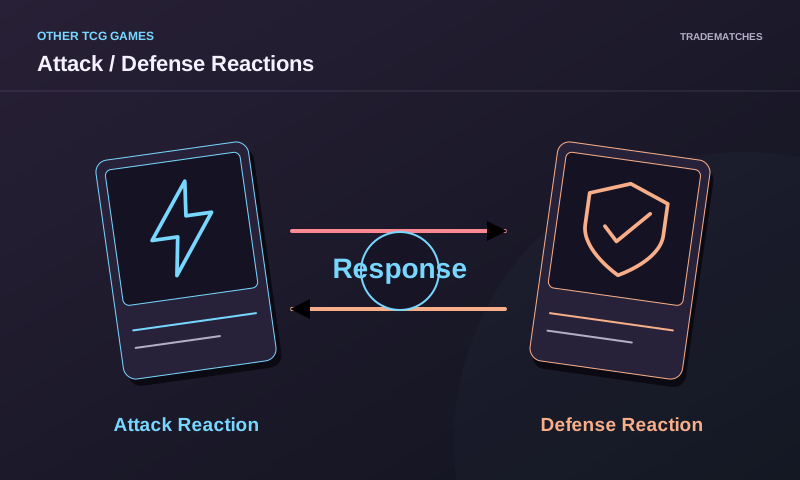
In Flesh and Blood, Attack Reactions and Defense Reactions are played during the Reaction Step of a combat chain. The attacker's controller may use Attack Reactions when they receive priority; the player whose hero is the target of the attack may use legal Defense Reactions when they receive priority. The difference is not just the card icon—each type intervenes from a different side, and a Defense Reaction that resolves becomes a defensive card. Before damage is calculated, both players have opportunities to respond; announcing the total too early can forfeit a decisive window.
The Short Sequence of an Attack
In a standard combat, the attack is placed in the chain and reaches the Defend Step. The defending player declares the cards that will defend according to the rules: appropriate cards from hand and/or public equipment they control. This declaration is not "playing" cards as actions and does not require paying their play costs. After priorities and effects of that step, the Reaction Step opens, where allowed reactions are played or activated. When the stack is empty and all players have passed in sequence, the Damage Step occurs and attack power is compared to defense.
This order explains why a Defense Reaction from hand is not placed alongside normal defense cards during the initial declaration. Current rules explicitly separate cards that are not Defense Reactions that can be declared during the Defend Step from reactions that are played afterward. If you reveal a Defense Reaction too early, you reveal information you might have wanted to keep hidden, and you also alter the attacker's opportunity to respond. When learning, use three phrases: "I declare defense," "we move to reactions," "we calculate damage."
What an Attack Reaction Can Do
An offensive reaction typically modifies the attack, increasing its power or adding an effect that complicates the defense; the specific text determines the result. The player controlling the attack may play or activate it during the Reaction Step when they have priority. It is not reserved for the moment immediately after declaring the attack—its usual place is after seeing the initial defense declaration. That's why the attacker can wait to see if the opponent blocks with one, two, or no cards before deciding whether it's worth spending the reaction.
For example, your attack has four power and the opponent has declared four defense. An Attack Reaction that adds two power can turn a completely blocked attack into two damage, unless countered later. But perhaps the opponent still holds a Defense Reaction that adds three defense and neutralizes the investment. The sequence does not resolve with a simultaneous announcement of hidden cards—priority is granted and each player decides whether to respond. The information revealed at each step modifies the tactical value of the next card.
What a Defense Reaction Does
A Defense Reaction is played or activated during the Reaction Step by a player whose hero is being attacked, if it is legal to do so. When a Defense Reaction resolves, it becomes a defensive card for the active link of that hero. Its defense value is added to the defense values of all applicable defending cards when calculating damage, except for effect changes. If a rule or effect prevents the card from defending, it may not be legal to play it or may fail to resolve, depending on when the restriction appears.
This is important because a Defense Reaction is not simply a spell that says "prevent damage." Many physically enter the chain to defend and can interact with effects that look at how many cards are defending or when a card defends. The current rule states that a resolved reaction is considered a new defensive card in its own event. It is not retroactively grouped with cards declared together during the Defend Step. If a skill activates when multiple cards defend together, check the exact moment of incorporation.
Priority and Alternate Responses
At the start of the Reaction Step, the player with priority receives priority. After each reaction, the stack rules determine who may respond and when resolution occurs. A player may choose to pass to see if the other player uses a reaction, but passing does not always mean the combat ends immediately—the step ends only when the stack is empty and all have passed in sequence. If the other player adds something to the stack, priority returns according to the procedure. At the table, clearly announce "passing in reactions" to avoid the opponent interpreting silence as consent to calculate damage.
If multiple reactions affect power, defense, or legality, resolve in the order set by the stack, not in the order that is most favorable to you. An increase in power may change if another effect meets its condition; a Defense Reaction may prevent the attack from causing damage, but only if it resolves and adds defense before the Damage Step. Do not note damage while a reaction remains pending. The moment a hit is determined is when the attack causes damage to the target according to the calculation, not when the attacker declares an offensive reaction threateningly.
Restrictions Like Dominate
A Defense Reaction must be able to legally become a defensive card. The rules provide the example of Dominate: the attack cannot be defended by more than one card from hand. If you already declared a card from hand during the Defend Step, you typically cannot play a Defense Reaction from hand to defend that same attack under Dominate. You do not save the restriction by claiming the reaction "is played" rather than "is declared"—once resolved, it would still become a hand-derived defensive card.
The source of the reaction and the specific text can create nuances. A team ability that is a Defense Reaction does not necessarily consume a card from hand, but you must check its requirements, cost, and result. Similarly, a card that makes another card defend can interact with limits in particular ways. The simple rule for beginners is to ask: "if this reaction resolves, can the resulting card legally defend here?" If the answer is no due to an active restriction, do not assume that the name Defense Reaction allows you to bypass it.
How to Calculate Damage Afterward
When the Reaction Step ends, the Damage Step compares the final attack power to the sum of defense values of the cards defending the target. If attack power is greater, the difference causes physical damage to the target; if not, that attack causes no physical damage through this calculation. An attack of six against final defenses of three and two causes one damage, unless prevented or other effects apply. If an offensive reaction raises power to eight, the same block would leave three. If a defensive reaction adds two defense, the total becomes seven and could cancel the damage. Numbers are taken at the time of calculation, not from cards printed before responses.
An attack may also have effects that trigger "on hit." In Flesh and Blood, hitting requires the attack to cause damage to the target through the hit event according to the rules. Increasing attack power via an Attack Reaction may force this result; a Defense Reaction can prevent it by raising defense. Do not declare a hit effect simply because attack power exceeded initial defense. A delayed response can change the comparison. If an effect prevents all damage after calculation, analyze its specific interaction with the hit condition according to the rules.
Practical Decisions for Each Side
As an attacker, ask whether spending the reaction changes a significant outcome: moving from zero to some damage, activating a hit effect, or forcing the opponent to spend more defense. A one-point increase may be excellent if it crosses a critical threshold; it may be irrelevant if the opponent already blocked well above your power. As a defender, ask whether the Defense Reaction prevents damage, avoids the hit effect, or preserves hand cards you need for your next turn. The best defense is not always the one with the highest printed number.
Also observe resources. Some reactions require paying a cost and may require pitching a card to do so. Spending a card on pitch and another on reaction may be too costly to avoid a single damage, but valuable to prevent a skill that would destroy your next hand. Do not confuse the defense value shown in a card's corner with its play cost: when you declare it as normal defense, you do not pay that cost; when you play a reaction, it follows its own cost procedure.
Common Mistakes
The first is declaring a Defense Reaction during the Defend Step as if it were a normal block. The second is attempting to play an Attack Reaction after closing the Reaction Step and calculating damage. The third is believing that Dominate only limits the initial declaration and allows free use of a second hand card as a reaction. The fourth is treating a resolved Defense Reaction as if it had defended jointly with the initial cards. The fifth is resolving hit effects before finalizing the attack and defense values.
To practice, leave an explicit pause before damage: the attacker announces their current power, the defender their declared defense, and both confirm whether they will use reactions. Only after that is the difference calculated. There's no need to reveal hidden cards when passing, but you must communicate yielding priority. This ten-second routine creates clear games and avoids having to undo multiple actions due to a reaction played outside of window.
Frequently Asked Questions
Can I play a Defense Reaction after seeing an Attack Reaction?
There may be an opportunity to respond during the Reaction Step if you have priority and the reaction is legal. Respect the stack and any attack restrictions, such as Dominate.
Does a Defense Reaction add to the already-declared defense?
When it resolves and becomes a defensive card, its applicable defense counts in the link's calculation. It is not considered declared simultaneously with the cards from the Defend Step.
Are resources paid when defending with a normal hand card?
No, when declaring it as defense during the Defend Step. Playing a reaction is a different procedure and may require paying its cost.