Dominate vs Overpower in Flesh and Blood
On this page
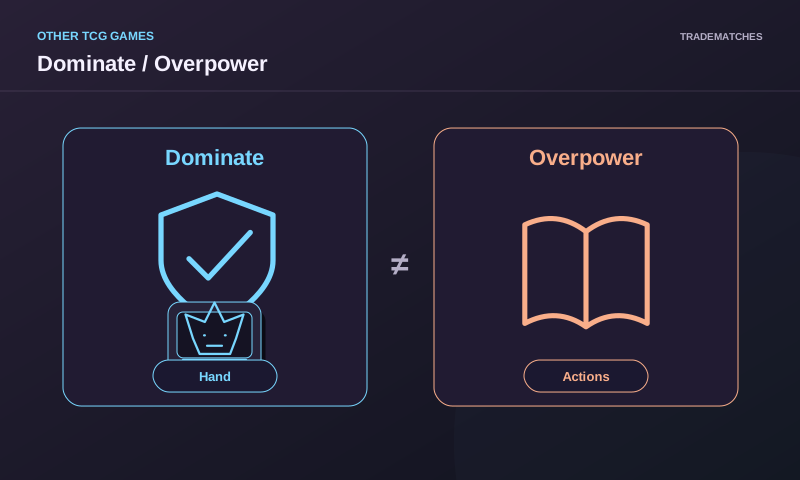
Dominate limits to one the number of cards from hand that can defend the attack. Overpower limits to one the number of Action cards that can defend it, regardless of its zone of origin. The two abilities restrict different things: one looks at the source zone and the other at the type of card. That is why they are not resolved by simply counting the total number of defenders.
| Ability | Restriction | Additional check |
|---|---|---|
| Dominate | At most one card from hand defending | A Defense Reaction from hand also counts |
| Overpower | At most one Action card defending | Card type matters regardless of originating zone |
| Both | Both limits apply simultaneously | Check the origin and type of each contribution |
Dominate: the limit comes from the hand
Against an attack with Dominate, the defending hero cannot defend with more than one card from their hand. That restriction affects a card used to block and also a Defense Reaction played from the hand when you have already used your only card there. Waiting for reactions does not open a second hand-card allowance.
If you block with a card from hand, check where any additional defenses would come from. A card in arsenal doesn't come from the hand at the time. Equipment doesn't turn into a hand card either because it's yours. These options still have their own permissions and windows, but they do not consume the same limit as Dominate imposes on cards coming out of hand.
An example of defense with Dominate
Consider an attack for eight. You have one hand card with defense three, equipment that can provide one and a Defense Reaction in arsenal that can contribute four when played legally. Dominate does not automatically prohibit such a combination by adding three elements. Only one of those cards comes from your hand.
The total defense of eight depends on whether each element can defend and whether you can pay and play the reaction in its window. It does not guarantee that the combination survives a opposing Attack Reaction. The example only shows why "Dominate allows a single total block" poorly describes the ability. You need to check zone, type, cost and sequence separately.
Overpower: the limit comes from the Action type
Overpower prevents you from defending with more than one Action-type card. It does not add ‘from the hand’ to that restriction. A second Action used from another zone is still another Action for the limit. Conversely, a Defense Reaction does not become Action because you play it during an action phase or because it provides points of defense.
Read the card type line. The expressions "defensive card" or "block" describe their use in that play, but do not replace its printed and current type. Equipment or a Block card needs its own check; don't count them as Action just because you're adding up defense. The keyword rules set the category that Overpower restricts.
An example of defense with Overpower
Faced with an attack with Overpower, you choose an Action from your hand as a defender. You can't add a second Action to defend that same attack. However, the Action-card limit is not by itself a ban on playing legal Defense Reactions. If you have one, check its cost and the corresponding window instead of automatically discarding it.
For example, one Action provides three defense and one legal Defense Reaction provides four. Overpower's restriction does not eliminate the reaction by adding a second card. If the attack also has another ability or effect that prevents reactions, you will need to apply that additional restriction. Do not attribute to Overpower a restriction on reactions that comes from another part of the text.
What changes when both appear
If an attack has Dominate and Overpower, both limits must be met. Having permission under one does not eliminate the other. A single Action from hand could simultaneously consume the hand-card allowance and the Action-card allowance. Then you must examine each new defense against the two restrictions and against ordinary permissions.
An arsenal reaction may avoid the restriction on cards from hand, but you still need to check its type and any other restrictions. A second card from hand that is not an Action might not violate Overpower and still violate Dominate. Write two separate counters if you're learning: used hand cards and used Action cards. One counter does not track both restrictions.
The defensive reaction does not erase its origin
Disagreements can arise when "defend from the hand" is understood as the initial act of blocking and subsequent reactions are excluded. Dominate doesn't offer that shortcut. If you've already defended yourself with a card from hand, playing another Defense Reaction from your hand would make a second card of that origin defend the attack.
The arsenal may retain a tool for that situation, but preparing a card there implies an earlier decision. You can't move a hand reaction to the arsenal midway through the attack to change its origin without an effect that allows it. Planning the arsenal helps against Dominate; changing the zone informally during defense is not a legal solution.
Gaining the ability after blocks
The rules cover an attack gaining Dominate or Overpower after several defenders have been declared. These abilities do not retroactively remove cards already defending. You must still apply the new limits to later decisions. The timing of the restriction is important, in addition to its text.
If the opponent adds Dominate after you defended with two cards, do not pick up one of them on your own initiative. Maintain the correct state and review what additional defense is still possible. The same is true of Overpower and several Action cards already declared. In a tournament, identify the ability and precise timing of its acquisition before correcting the table.
Choose which card to commit
Dominate makes the efficiency of the only card you can commit important: how much you defend and what you give up for your next turn. Overpower forces you to choose which Action you use, but it can allow for other categories of defense. The best choice is not always the card with the largest defense value if keeping it preserves a decisive response or attack.
Make two calculations. First, calculate the legal defense and the damage that could happen. Then look at the hand you'd keep. If blocking with the strongest card prevents you from generating resources or performing a useful action, compare a smaller defence with a better following turn. These are strategic criteria, not guarantees: the opponent can still modify the attack or threaten an effect on hit.
Review an interaction clearly
Before asking if a defense is legal, state the ability of the attack, when it got it, which cards are already defending, their originating zones and their types. Include the reactions you want to play and any additional restrictions. These details often resolve the difference between a hand limit and an Action limit without rebuilding the entire game.
To practice at home, classify five cards by type and place one in arsenal. Simulate an attack with each ability and check which combinations change when that card changes zone. The exercise teaches the structure of the rule. It is not dependent on learning a fixed list of valid cards that may cease to apply when you change your deck.
Check two apparently identical defences
Two defences with the same total can satisfy different restrictions. One uses an Action from hand and a Defense Reaction from hand. The other uses an Action from hand and a Defense Reaction from arsenal. Against Dominate, the reaction's origin matters: the first combination would use a second card from hand to defend. Counting only one Action is insufficient.
Against Overpower without Dominate, check the number of Action cards defending rather than automatically applying a hand limit. A Defense Reaction does not become an Action because it contributes to the same defence total. When both abilities apply, both restrictions must be satisfied.
Before committing, classify each contribution by card type, originating zone and the point at which it joins the defence. Then check any other restrictions on the attack. This prevents you from spending a hand card during blocking and discovering that the reaction intended to complete the defence is no longer available. It also lets you explain a legal combination without confusing card count, card type and defence points.
Frequently asked questions
Does Dominate allow only one defending card in total?
No. It limits cards from your hand. Equipment and a legal reaction from arsenal still need checking, but neither is a second card from hand.
Does Overpower prevent Defense Reactions?
Not on its own. It restricts the Action cards used to defend; a Defense Reaction has a different type.
Will the blocks be removed if the ability appears later?
Not retroactively by Dominate or Overpower. Check the restrictions that affect the decisions you still want to make.