Cold Foil vs Rainbow Foil in Flesh and Blood
On this page
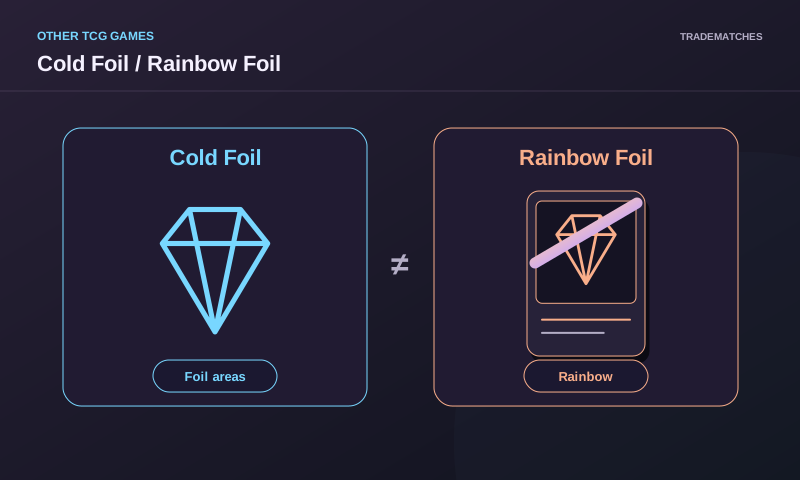
Cold Foil and Rainbow Foil are not two names for the same shine in Flesh and Blood: they are distinct printing techniques. For a purchase or trade, the safest check is the official Collectors Centre, which lists the technique available for a specific printing.
Start with printed details
Record your copy’s code, name, set and edition. Find that reference in the official catalogue and read “Printing Technique”. Some numbers exist in more than one technique; others do not. Code alone may be insufficient, especially where print runs or reprints used different finishes.
Use shine as a clue, not your only proof
When tilted, Rainbow Foil often shows multicoloured reflections; Cold Foil tends to look cooler and metallic. Lighting, a sleeve or photo compression can greatly change the impression. Ask for pictures of the actual copy in side light and a clear view of its code. A silvery photograph by itself does not prove Cold Foil.
Edition, finish and condition are separate
A Cold Foil from one print run and a Rainbow Foil from another may share a name and be equally playable, but they are not the same collectible printing. Legend Story Studios states that a Cold Foil card may be reprinted with another technique. After confirming finish, inspect edges, corners and surface separately: “Cold Foil” says nothing about Near Mint or Played condition.
Example listing: “UPR000, Uprising, English, Cold Foil per official catalogue; front and back photographed.” If the technique remains uncertain, write “foil to verify” rather than pricing an assumed variant.
Start with the exact print, not the card name
In Flesh and Blood, a card can exist in several expansions, languages, and print techniques. The same name does not identify a single collectible item on its own. Before comparing Cold Foil with Rainbow Foil, write down the set, the printed code, and any indication of edition or special version. Then search for that reference in the Collectors Centre of Legend Story Studios. The table of each product includes a column for print technique; there you can check if the specific print is documented as Cold Foil, Rainbow Foil, regular, or another option. In some cases, a single reference may appear with more than one treatment, so the code reduces possibilities, but it does not always complete the identification.
If you find a card from another expansion with the same name, do not use it to classify your copy. A reprint can preserve the game function while changing the finish and the collection context. The official reprint policy explicitly states that a card published in Cold Foil can return with another technique, such as Rainbow Foil or without foil. Therefore, "this card had Cold Foil at some point" does not prove that the card in front of you is Cold Foil. The verification needs the print data and an observation of the actual copy.
What to look for on the surface
The multicolored reflection is usually the visual clue of Rainbow Foil; Cold Foil tends to have a different metallic effect. That description serves to start the inspection, but not to close an important purchase based on a mobile photo. The light source, white balance, and case can alter colors. A shiny plastic on a regular card creates highlights, while a compressed image can erase the authentic effect. Request a front photo and a short video or two images with different lighting angles. If the seller prefers not to remove the card from a case, at least request images that allow distinguishing the reflection of the plastic and the card.
Also observe where the treatment appears on the illustration, the edges, and the design elements, comparing it with reliable photos of the documented print. There is no simple visual rule that replaces the catalog for all sets and promotions. Some special cards use combined techniques or more specific labels; classify them as the official card description names rather than forcing them into two categories. The goal is to describe the example accurately, not to win a discussion about whether "it seems more silver" than another copy photographed in a different room.
Edición, idioma, acabado y estado are four things
An offer can hit the name correctly and fail on any of the other attributes. Edition indicates which product the card comes from. Language affects the physical print received. Finish distinguishes Cold Foil, Rainbow Foil, regular, and other treatments. Condition describes wear: marks, scratches, curvature, corners, or surface. None of those fields are automatically deduced from the others. A Cold Foil with scratches does not become Near Mint just because it is rare, and a perfect Rainbow Foil does not become Cold Foil just because it is sold alongside an old edition.
To evaluate condition, use side light and examine the front, back, and edges outside the strongest reflective area. Foil cards can curve or show superficial scratches difficult to capture from the front. A photo only of the art does not show corners or back. If there is a mark, the advertisement must indicate where it is and show it. When buying online, request photos of the same copy that will be sent. The promotional image of a store identifies the product, but it does not demonstrate the preservation of an individual card.
The official catalog as a method of rejection
Open the Collectors Centre corresponding to the expansion and search by code. Check the name, rarity, and technique. If the table shows only Rainbow Foil for that reference, an offer labeled as Cold Foil deserves an explanation and photos; perhaps the seller has selected the wrong variant, or perhaps it is showing a promotional print with another code. If both techniques appear, move to visual comparison. For promotions, consult the specific section of the catalog instead of extrapolating what appears in regular expansion sleeves. Save the link to the row or a screenshot of the card when you agree on a transaction of value.
If you don't find the code, try with the full name and check if there is a promotion suffix, edition, or alternative art. Do not change the code mentally to match an enticing offer. Sometimes the commercial information of a marketplace groups variants that the editor separates; in those cases, the photo of the example and the official card description weigh more than the automatic title of the ad. If both data continue in conflict, leave the finish as "unconfirmed" and avoid paying as if it were the more expensive version.
Why the finish can matter to the price
Collectors value origin, print run, and technique, as well as the utility of the card in a deck. The reprint policy of Legend Story Studios treats Cold Foil of sleeves and promotional prizes with different conditions. This allows understanding why two cards with the same function can interest different audiences. However, the policy does not provide the price of your copy nor guarantees that all Cold Foil have more demand than all Rainbow Foil. Condition, real offer, edition, and market timing influence. Compare sales or ads of the exact print and document clearly the differences.
If you only want to play, determine first if you need a specific version or if any of the prints legally work for you. If you complete a set or a collection of finishes, the technique is a central requirement. Say it when asking for a swap: "I need Uprising Cold Foil of this reference; not Rainbow Foil." For a flexible search, phrase the opposite: "I accept any finish, but I need this code and this language." Both phrases avoid proposals that do not meet your goal. Do not pay a premium for an attribute you have not verified with the catalog and photos.
Examples of ads that avoid confusion
A solid description would be: "Code UPR…, expansion Uprising, English, Cold Foil according to Collectors Centre; real photos front, tilted, and back; slight mark on the lower edge." Replace the dots with the full code of the actual copy. If the table shows multiple techniques and the photo does not allow distinguishing them, write "foil pending confirmation" and provide another image. Avoid "first edition Cold Foil perfect" if you have not verified each of those statements. A list of brief and verifiable data is often more useful than adjectives about rarity or beauty.
Before accepting, the buyer can respond with a simple check: "Can you confirm the printed code and send me a tilted photo of that same copy?" If it is a high-value card, ask for details on corners, edges, and back, and agree on the shipping method and coverage. When it arrives, compare the card with the description before closing the deal. Save the identification in your inventory with set, code, finish, and condition separated; this way you won't have to investigate the same thing again when you decide to swap it months later.
Common mistakes
The most common is using the card name as if it designates a single print. Another is relying solely on the color of a photo. Also, people confuse rarity labels with print techniques: a card can have a specific rarity and multiple treatments. Finally, some ads mix reprints and promotions under the same abbreviated code. The solution is always the same journey: exact reference, official card, observation of the copy, and condition. If one stage is missing, admit uncertainty in the description and do not complete the data by assumption.
Frequently asked questions
Does Cold Foil mean first edition?
Not necessarily. Check edition and printing technique separately in the catalogue for that product.
Can one card number have both finishes?
Yes. The official catalogue lists cases with Cold Foil and Rainbow Foil under the same reference.