Flesh and Blood Boost: paying without getting go again
On this page
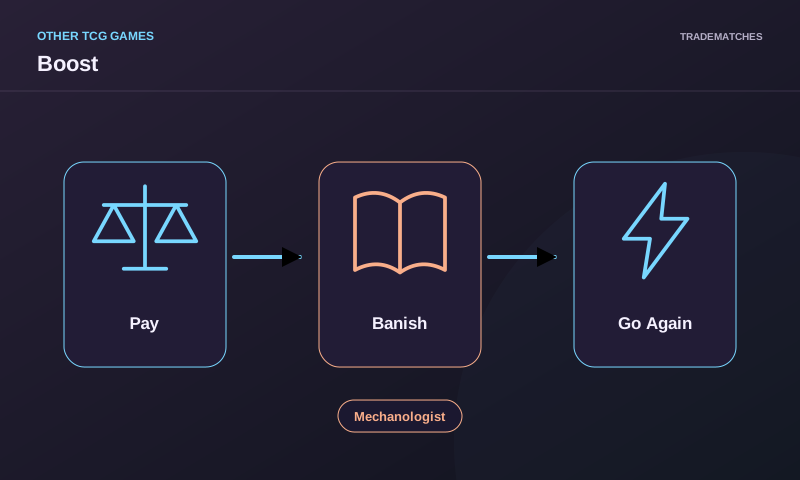
Paying Boost and receiving Go Again are different results in Flesh and Blood. Boost is an optional additional cost that banishes your deck's top card. If that card is a Mechanologist card, the played card gains Go Again. You have still boosted when you pay that cost and reveal a non-Mechanologist, even though that conditional bonus is absent.
Make the decision while playing the card
The current comprehensive keyword rules define Boost as an optional additional-cost ability. Decide whether to pay it as part of playing the card; it is not an ability you may activate later after learning whether the attack hits. Its top-card banishment is the cost you are agreeing to perform.
You need a card available on top of the deck to pay that cost. An empty deck does not allow you to declare Boost and pretend that revealing nothing is the same as revealing a non-Mechanologist. Failing the bonus check after successfully paying is different from being unable to pay the additional cost at all.
For a practice turn, announce the card, its normal play costs and whether you are boosting. Banish the required top card through the correct play procedure and identify the class needed for the bonus. Clear sequencing prevents a player from adding Boost retroactively when they realise they need another action.
The class check is not the pitch colour
The conditional Go Again check concerns whether the banished card is a Mechanologist card. A blue pitch strip does not establish that class. Nor does a card's apparent machine-themed artwork or the hero you are playing. Inspect the actual type and class information.
Likewise, a generic card in a Mechanologist deck does not become a Mechanologist card merely by being included there. Its role may be useful, but it can change the composition relevant to a random top-card check. Record the actual class of every included card when evaluating how often Boost can meet its condition.
| Top-card outcome in a hypothetical Boost | Was Boost paid? | Conditional Go Again from Boost |
|---|---|---|
| Mechanologist card banished | Yes | Gained, subject to applicable rules |
| Generic card banished | Yes | Not gained from that check |
| Another non-Mechanologist card banished | Yes | Not gained from that check |
| No card exists to banish | Cannot pay that cost | Boost cannot be chosen on that basis |
This table isolates the keyword. The played card might already have Go Again or receive it from another applicable effect. A failed Boost bonus is not proof that every other source of Go Again disappeared.
A failed bonus can still satisfy “boosted”
The rules explicitly distinguish paying the additional cost from receiving its conditional reward. If a card or ability checks whether you boosted, check whether that cost was paid. Do not change the answer to no just because the banished top card lacked the required class.
Consider a hypothetical ability whose condition is “if you boosted this turn.” You paid a legal Boost cost earlier and banished a generic card. The Boost bonus did not provide Go Again, but that history can still satisfy a condition about having boosted. A different condition might require banishing a Mechanologist card or a particular count; read its actual wording.
In a training ledger, use separate columns: Boost paid, top card's class, Go Again source and other effects checking Boost. Four columns seem more detailed than one success tick, but they capture the independent facts. This is useful when reviewing why an effect worked even though the attack did not continue the way you expected.
Go Again does not refund every resource
Go Again supplies an action point under its rules when the relevant action resolves. It does not return the banished card to the deck or refund pitched resources simply because Boost enabled it. The card sacrificed from the deck as the additional cost remains subject to the banishment rules and other actual effects.
For an imaginary starting state with one action point, playing an attack action uses the normal action point. If it legally receives and resolves with Go Again, that keyword provides an action point for later actions. You still need resources and legal cards for those actions. “I got Go Again” does not mean “I can play my next card for free.”
Additional instances of Go Again do not simply multiply points. Its current rules address the ability's redundancy. When the played card already has Go Again, Boost's conditional gain needs to be distinguished from other payoffs for boosting. Do not assume you receive two points because two sources use the same keyword.
The banished card is a cost to the deck's future
Boost removes a card that would otherwise have remained in the deck until another movement occurred. That can matter in a long game. The extra action opportunity is immediate; the lost future draw or pitch option is a separate consideration. A deck built to use banishment may value that movement differently from one trying to preserve every card.
Use an original simple model to inspect composition, without claiming a real deck's win rate. In an unknown, uniformly shuffled remaining deck with 30 Mechanologist cards and ten others, the next top card has a 30/40 chance of matching the class check. That is 75% under those assumptions. If known ordering or prior reveals affect the top card, the model no longer describes your actual knowledge.
Do not transplant that percentage to every game or published list. Count the remaining eligible cards, not only the original list, when you have relevant information. The model helps explain why including generic tools has a composition consequence; it does not declare that every such tool should be removed.
Evaluate a Boost line before committing
First identify how the turn continues if Go Again is gained. Then identify what happens if it is not gained. If the first attack consumes your only action point and no other continuation is available, a missed class check can end your planned action sequence even though you have cards and resources left.
In another hypothetical turn, you already have an extra action point from a separate effect. A failed conditional Go Again may be less disruptive, although the banished card is still spent. Comparing these two lines is more useful than labelling Boost universally safe or risky. The current board and actual continuation decide its practical cost.
When acquiring cards for a Mechanologist deck, distinguish “has Boost,” “is a Mechanologist card” and “rewards Boost.” Those are three different roles. A card can serve one without serving all three, and a vague request for “Boost cards” may produce the wrong trade for your intended list.
Frequently asked questions
Did I boost if the banished card was generic?
Yes, if you legally paid the Boost additional cost. You do not receive its conditional Go Again from that generic card, but the boosted event still occurred.
Can I Boost after seeing whether the attack hits?
No. Boost is chosen and paid as an additional cost while playing the card. It is not a later attack-reaction option.
Can I Boost with an empty deck?
No. You cannot choose the additional cost if you cannot banish the required top card. This differs from paying the cost and missing the class condition.