Go again and action points in Flesh and Blood
On this page
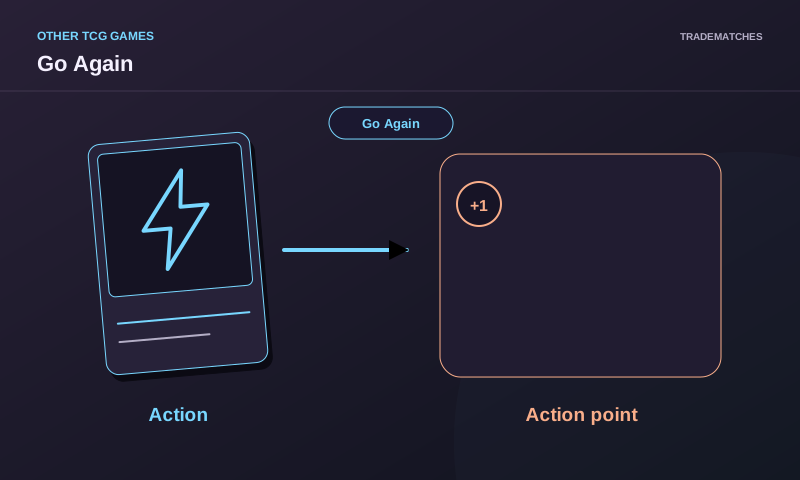
In Flesh and Blood, go again means "gain 1 action point" when its resolution step arrives. That point allows you to play another action card or activate another action ability during the same turn. It does not automatically return the used card to your hand nor does it grant resources to pay for the next play. The difference between action points and resource points is key to understanding why an offensive chain continues or stops.
How many action points do you start with?
At the beginning of your action phase, the player on turn has 1 action point. An action card or an action-type ability typically requires spending one action point to play or activate. If you use that point in an action that doesn't return another, you may no longer be able to perform another ordinary action during the turn. This does not mean all cards are forbidden: instants and other windows follow their own rules.
Example: You have an action that costs zero resources but has no go again. "Zero resources" does not mean "zero action points." When you play it, you spend your initial action point, and after resolving, you don’t receive another because the resource cost was zero. In contrast, an action that costs resources and has go again may allow you to gain a new action point after resolving, as long as you pay the cost and the ability continues to apply.
Action points versus resource points
An action point is used to perform actions that require that type of cost. Resources are used to pay resource costs of cards and abilities. You can gain resources by pitching cards according to the rules, but pitching itself does not add an action point. Likewise, go again grants an action point, but it does not automatically generate the resources needed for the next card.
Imagine your second action costs two resources. The first card had go again and left you with an action point available, but your hand and resources aren’t sufficient to pay two. Your second action still cannot be played. In the opposite case, you might have surplus resources but no action point. Evaluating both counters before declaring an attack avoids impossible plays and allows for better pitch planning.
When do you gain the point from go again?
The timing depends on the type of object. If go again belongs to a card or ability that is not an attack in the stack, its controller gains the point after all other resolution abilities of that object. If it belongs to an attack in the active link of the combat chain, the point is gained at the start of the combat resolution step. It is not granted at the moment of declaring the card, before the corresponding interaction resolves.
This precision matters if your opponent responds or if an effect modifies the card before resolution. Do not spend a future action point that hasn’t yet been earned. After the attack, when the resolution step and the chain state permit it, you can use it for another legal action. A basic guide might say "go again lets you go again," but to respond to a reaction or interruption, you must follow the actual steps.
Go again in an action without an attack
Many actions prepare an offensive turn without attacking themselves. If one of them has go again, after resolving its other instructions, it grants you a point of action. That point typically allows you to play an attack afterward. The first action might have given you a boost, a card, or a continuous effect; go again only provides the ability to take further actions, not a guarantee that the next one is in your hand.
Example: You play an action that improves your next attack and has go again. You spend the initial action point to play it, pay its resource cost if applicable, and let it resolve. You then receive a point of action and can play a legal attack, paying its cost as well. If the action had no go again or another way to give you a point, the improvement might go unused during that turn without an immediate attack to take advantage of it.
Go again in an attack
An attack with go again can generate a point of action during the resolution phase of combat. Once the steps are managed and the chain allows for another action, that point helps you continue with another attack or play. It does not prevent the defender from blocking the first attack. Nor does it mean the attack resolves twice: each attack has its own link and its own defense decisions.
Example: You play a card of action that is an attack with go again. The opponent decides how to defend and both players use any allowed reactions. Damage is determined according to the rules; when the go again moment arrives, you receive a point. If you still have a legal attack card and the necessary resources, you can continue the offensive chain when the window allows. If you don’t have a card or resources, the point may go unused.
The combat chain is not the stack
Flesh and Blood uses a stack for pending cards and abilities, and a combat chain for attack links. Go again does not mean "respond immediately in the stack with any action." Ordinary action cards have time restrictions: generally, they are played when the stack is empty and outside of certain combat steps, unless specifically permitted. The point earned is spent only when a legal opportunity exists.
In a sequence of attacks, the combat chain may remain open between links. The rules allow new offensive actions in the corresponding step, but do not permit skipping the defender's windows or introducing a normal action mid-damage. If you're learning, fully resolve one attack and then announce the next action. This practice preserves your opportunity to react and makes it clear which point of action you're using.
Go again does not stack with itself
The current rules state that an object cannot have more than one go again ability. If an effect attempts to grant go again to a card that already has it, that part of the effect fails. Therefore, two sources that say "gain go again" on the same attack do not generate two action points for the same ability. This contrasts with other numeric modifiers that can stack.
Example: An attack card already has go again printed, and an effect attempts to grant go again again. When it resolves, it receives only the point corresponding to its single go again ability, not two. If another independent effect explicitly says "gain 1 action point," evaluate it separately according to its text: it is not automatically a second instance of go again. Reading the specific source prevents losing or creating action points incorrectly.
What happens if a card loses go again
A card may lose abilities due to an effect. If it loses go again before the moment when that ability would grant a point, you cannot rely on it for a point without reviewing the applicable rules and text. Similarly, a card that gains go again during combat may be entitled to a point if the ability is present at the corresponding moment. What matters is the state of the object during its resolution window, not your original intent when playing it.
This situation arises in advanced games involving reactions and effects that modify attacks. To avoid anticipating actions, keep a provisional note: "if this attack retains go again, I will have a point when resolving." Then confirm whether it actually gained go again. Do not announce the next card as if it were already paid. The official rules provide specific resolution moments for attacks and non-attacks.
A full turn example
You begin the action phase with one action point. You play an action without attack that costs a resource and has go again; you spend the point, make pitch if needed, and resolve the card. You gain a point from go again. With that point, you play an attack that costs two resources and also has go again. Your opponent defends, reactions and damage resolve, and at the corresponding moment, you receive another point. If you have a third legal attack and sufficient resources, you can use it.
The sequence does not freely multiply actions: each step requires cards, costs, legal windows, and the ability present when it's due. If the second attack did not have go again, the standard action chain could stop after it, even if you still have cards in hand. If you lack pitch for the third play, the remaining point does not cover its resource cost. This example illustrates why both counters must be tracked separately.
Instants and special permissions
An instant does not follow the same action point cost as a regular Action card; it has its own windows and costs. An Action card played "as if it were an instant" may also receive a specific exception regarding action points, according to the applicable rule. Therefore, "I have no action points" does not mean "I cannot do anything at all." It only means you cannot pay an action cost that requires that point.
Conversely, having an action point does not grant you the right to play any card outside its proper moment. A defense reaction is played in its window, and an attack action is played in its own. If a card offers a special permission, read it literally. Go again does not replace priority rules or card type rules; it only grants the point that such actions may need later.
How to avoid errors when planning
Before your first action, mark your initial action point. After each card, ask whether it consumed a point, whether it retains go again, and when it grants it. Perform a separate count of resources, hand, and cards in Arsenal. If you plan to attack multiple times, announce the end of each link before spending the next point. This sequence helps the defender know when they can block or react and prevents an imaginary point from becoming an extra attack.
The summary is precise: go again grants an action point when the card resolves at the moment of its object type; an object does not accumulate multiple copies of go again; the point does not include resources nor remove time restrictions. When any of these components is missing, the turn may stop even if the card appears designed to chain actions. For specific interactions, consult the current Comprehensive Rules and the card's official text.
Frequently Asked Questions
Does Go again allow me to play another card for free?
No. It grants an action point, but the next card may still require resources and meet its gameplay window.
Do two Go again effects on the same attack grant two action points?
No. An object cannot have more than one Go again ability; granting it again to an object that already has it does not duplicate its effect.
When does an attack with Go again receive its action point?
At the start of the resolution step of the corresponding combat action, according to current rules.
Official source: Flesh and Blood Comprehensive Rules, Go again and Game Action Phase Structure.