Flesh and Blood Intimidate: temporary hand banishment
On this page
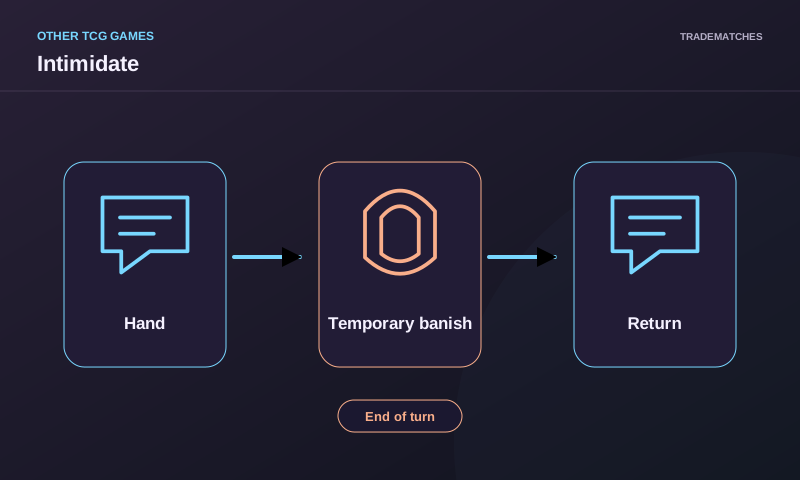
Intimidate temporarily banishes a random card from a player's hand face-down and returns that card at the beginning of the end phase. It restricts the cards available while they are away; it does not discard them permanently. Multiple Intimidate effects create separate returns, and the random choice is not permission for the attacking player to select the best defence card.
Separate the removal from its later return
Flesh and Blood's current keyword rules define Intimidate as a discrete effect with a delayed return trigger. Resolve the applicable Intimidate effect, move the chosen random hand card face-down to banishment, and keep track of which effect caused that movement. The later return belongs to that effect.
The beginning of the end phase is the specified timing, not whichever informal moment players call “end of combat.” Ending an attack chain does not automatically return intimidated cards early. A turn can contain other actions after a chain closes, and the delayed return is still waiting for its own phase.
For a practice record, label an intimidated card with a removable table marker beside it, not on its sleeve. Mark “Intimidate 1” and “Intimidate 2” separately if several effects occur. The markers identify the return relationship without exposing hidden card information to the opponent.
Random means genuinely random
The affected player cannot choose to hide their least useful card, and the attacker cannot choose the card they think blocks best. Use a fair method that keeps the hand private: randomise its face-down cards and select through an agreed random procedure. At an event, follow the judge's direction if a randomisation method is disputed.
Avoid selecting by sleeve damage, known hand order or the position of a card just returned to hand. If those clues make the choice predictable, it is not a reliable random procedure. A clear method protects both the game's randomness and the collector's cards: do not scatter unprotected cards or let another person handle them roughly.
In an imaginary four-card hand, every card should have the same chance of being selected by a uniform first Intimidate. That is a probability model for the random method, not evidence about which card will be taken in a real turn. You cannot guarantee removing a defence reaction simply because one is known to be present.
Two effects change availability, not ownership
Suppose the defender begins with four cards. One Intimidate resolves and leaves three in hand; a second resolves and leaves two, if both can banish a card. The two away cards remain identified with their respective return effects. Neither becomes the attacker's property or a new arsenal card.
| Stage of a hypothetical sequence | Hand cards | Intimidated cards away |
|---|---|---|
| Before two resolving effects | 4 | 0 |
| After the first | 3 | 1 |
| After the second | 2 | 2 |
| Beginning-of-end-phase returns, absent changes | 4 | 0 |
If the defender plays, pitches, draws or otherwise moves cards during the turn, the final hand size will differ. The table isolates the Intimidate movements; it is not a promise that every real defender finishes with four cards.
Intimidate is different from Dominate
Dominate constrains how a particular attack can be defended from hand. Intimidate changes which hand cards are available while they are banished. A card no longer in hand cannot be used from hand merely because the defender would otherwise be allowed to defend with it.
Arsenal and equipment are separate resources. Intimidate taking a card from hand does not remove a card already in arsenal or destroy equipment. The legal use of those resources is still governed by their cards and the current attack's restrictions. A defender with few hand cards can still have relevant defensive options elsewhere.
For a planning exercise, list hand, arsenal and equipment in separate rows. Cross out only the hand cards actually banished by Intimidate. Then apply Dominate or another attack restriction if present. This prevents treating several intimidations as the same as a blanket prohibition on all defending and reactions.
Timing decides which cards are available
A triggered Intimidate associated with playing an attack must be resolved through the game's layer and priority procedure. Do not make the random selection simply because you revealed the attack if the relevant effect is still waiting to resolve. Players' legal responses can change the state before that effect happens.
Equally, a defender cannot use an already banished hand card as though the removal is still pending. Distinguish “the effect has been generated,” “the effect is resolving,” and “the card is away.” For an unfamiliar interaction, present the actual source and the point in the procedure rather than assuming every card with Intimidate produces it at the same moment.
A separate card might intimidate after a different event, or more than once under a condition. Read the complete instruction and count the effects that actually occur. The keyword's standard process does not supply an extra trigger condition absent from the source card.
An empty hand does not produce a hidden substitute
If the affected player has no hand card available, there is no card to banish from the hand. Do not take a card from arsenal, the deck or another zone as a substitute. The keyword's rules can still classify the player as having been intimidated even where no card was banished, which matters if another effect checks that event.
This distinction resembles the separation between attempting an effect and its visible result. A condition that asks whether a player was intimidated may not be the same as a condition asking whether a card was banished. Read the condition on the other card instead of deriving it from how many cards you can see away.
In a hypothetical test turn, reduce a defender's hand to zero and resolve another Intimidate. Record that no new hand card moved. If a separate ability checks intimidation, consult that ability and the keyword definition. Do not fabricate a face-down placeholder card just to make the board look consistent with earlier intimidations.
Keep the end-phase return complete
Before advancing through the end phase, identify the delayed return effects and the cards they actually banished. A return does not let a player choose a different card from banishment. If the tracked card has changed zone through a separate legal effect, handle the return according to that changed state rather than substituting another object.
Clear tracking is particularly useful in turns with several banishment mechanisms. Keep temporary intimidated cards distinguishable from cards banished for other costs or abilities. Their face-down appearance alone does not tell you which ones should return.
Frequently asked questions
Do intimidated cards return when the combat chain closes?
Not from Intimidate's normal return timing. They return at the beginning of the end phase through the delayed effect, not simply at the end of a chain.
Can the attacker pick the defender's strongest block?
No. The card is selected randomly from the hand. The process is not a targeted choice of the card the attacker prefers.
Does Intimidate remove arsenal cards too?
No. The standard instruction concerns the hand. Arsenal cards remain in their own zone and have their own legal-use checks.