Flesh and Blood Ward: damage prevention and auras
On this page
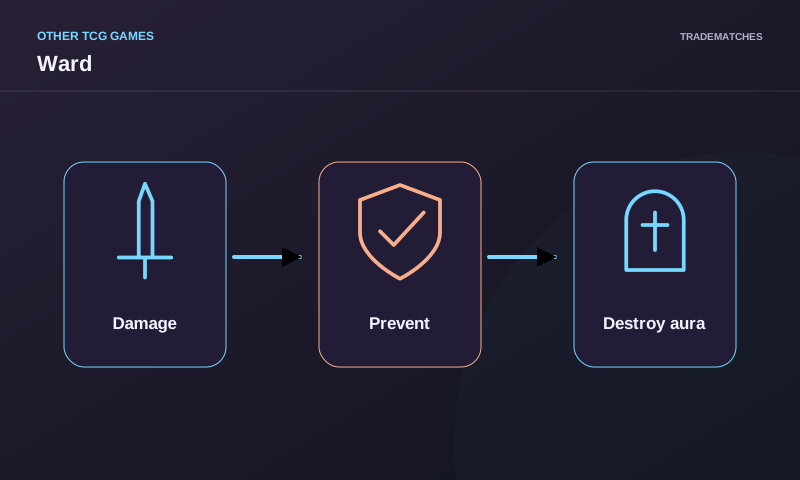
Ward in Flesh and Blood prevents an amount of damage by destroying the object that has the ability. The keyword's number describes how much of that damage it can prevent. It is not optional armour that you can always preserve for later, and it is not a pool of spare prevention that remains after its source is destroyed.
Understanding Ward requires following the damage event and the applicable replacement effects. This guide explains small and large damage events, multiple Ward sources, unpreventable damage and the difference between taking damage and losing life. The numerical situations are illustrative and do not assume any particular deck list.
What Ward does at a damage event
The official keyword rules, section 8.3.20, define Ward as a static ability. When the relevant damage would be dealt, the source is destroyed and its prevention applies to that damage event.
Unlike abilities explicitly containing “may,” the ordinary Ward wording does not offer a decision to decline merely because you would prefer to keep the source. You can have choices about ordering applicable effects, but that is different from treating the keyword itself as optional.
Suppose an illustrative Ward 2 source is your only applicable prevention and you would take three damage. Ward destroys its source and prevents two, leaving one damage to be dealt, assuming no other effect changes the situation. The source does not remain because the incoming event was larger than its value.
Small damage can consume a larger Ward
If one damage would be dealt and an applicable Ward 3 source is used, the source is still destroyed. Preventing that one damage does not preserve an unused balance of two for a later event.
The official effect rules distinguish fixed prevention from prevention that can persist across future events. Ward's source destruction and fixed amount belong to the current event; do not treat its printed value as a running counter on a surviving card.
This matters when considering a small incoming event before a larger one. A player might wish to take the first point and retain a useful aura, but the ordinary Ward wording does not simply grant that choice. Inspect other applicable effects and their ordering if they could change the event before Ward applies.
| Illustrative situation | Result from the stated Ward alone |
|---|---|
| Ward 1 against one preventable damage | Source destroyed; damage prevented |
| Ward 2 against three preventable damage | Source destroyed; one damage remains |
| Ward 3 against one preventable damage | Source destroyed; no balance carried forward |
| No positive damage event remains | Do not invent damage to consume Ward |
| Damage cannot be prevented | Prevention fails, but relevant destruction still occurs |
Defending and preventing are different stages
Reducing an attack's prospective damage through defence is not the same as applying Ward to a positive damage event. If the attack does not produce damage to be dealt after the relevant calculations, do not manufacture a one-point event just because a Ward source is present.
For a simple attack example, suppose an attack's power and the total relevant defence leave no damage to be dealt. Ward is not a mandatory tax on every attack declaration. Its condition concerns the damage event that would occur.
Now change the defence so that one damage remains. That positive damage brings applicable prevention into the analysis. Keep the attack calculation and prevention steps distinct; otherwise a player may destroy a Ward object too early or incorrectly preserve it after damage remains.
Multiple Ward sources: order can matter
When several replacement effects could apply, follow the game's replacement-effect ordering procedure. Players order the applicable effects they control within that procedure; they do not freely order every effect controlled by everyone else.
Suppose you control an illustrative Ward 1 source and a Ward 3 source, with one preventable damage incoming and no other complication. Applying the smaller appropriate prevention first can remove the damage event's remaining amount, potentially leaving the larger Ward source unused. Applying the larger one first spends that source on the same single point.
Now suppose four damage is incoming. Applying one of those sources still leaves damage for the other to address. The final amount and surviving objects depend on the actual event and any other applicable effects. Calculate the modified event after each step rather than declaring that every visible Ward source must always disappear.
Unpreventable damage still matters to Ward
An effect stating that damage cannot be prevented does not mean prevention abilities are absent. The current effect rules explain that such prevention can still apply while failing to reduce the damage, and additional modifications such as source destruction still occur.
For Ward, the practical consequence can be particularly severe: the object is destroyed without removing the unpreventable damage. Other Ward sources may also remain applicable because the damage has not been reduced away. Read the complete event and replacement sequence rather than preserving all Ward objects on the theory that prevention “did nothing.”
This is also why “cannot be prevented” is different from simply producing more damage than one Ward can cover. In the latter case, Ward can reduce part of the event. In the former, the restriction prevents the reduction itself.
Arcane and physical damage are not the same as life loss
Ward's ordinary definition is not limited to arcane damage. Check the damage type and any additional relevant restrictions, but do not treat the keyword as a synonym for Arcane Barrier or Spellvoid. Those abilities have their own payment and prevention instructions.
A separate instruction to lose life is a different operation from being dealt damage. Ward does not automatically prevent it merely because both operations reduce a life total. Read the exact verb on the card.
For an illustrative comparison, “deal two damage” can create a damage event for prevention. “Lose two life” does not become that same event through casual paraphrasing. When explaining the life-total change, name the operation before deciding which defensive abilities apply.
Ward can affect whether an attack hits
An attack that would deal damage can have that damage prevented. If no attack damage is actually dealt to the relevant target, do not assume an on-hit ability has triggered just because the attack was larger than the declared defence before prevention.
Suppose the attack would deal two damage after defence and Ward prevents those two points. That result is different from taking two damage and recovering two life afterward. Prevention changes whether damage occurs; later recovery changes a life total after another event.
For a real card's hit condition, inspect the precise wording and relevant combat rules. A visible attack card, an unblocked portion and an actual damage event are not interchangeable evidence. This distinction helps both players resolve the next ability correctly.
A familiar token example
The keyword rules identify Spectral Shield as a token with Ward 1. Its role is a convenient reference for learning the basic operation: an applicable one-damage prevention event destroys that source, rather than leaving a Shield token with a depleted counter.
Do not import the behaviour of similarly named Shield tokens from another game. A token's name does not determine its rules. Its actual abilities do, including how it is created, destroyed and represented after it leaves the arena.
With several such tokens, keep their number clear and update the board as each relevant source is destroyed. A cluster of decorative markers can be sufficient representation only if both players can accurately tell how many objects remain.
A practical damage-resolution habit
State the prospective damage after the appropriate calculations, identify applicable prevention and replacement effects, and resolve them in the required order. After each modification, establish what damage remains and which sources still exist.
Do not change the order retrospectively after seeing a later outcome. If the interaction is unfamiliar, pause before moving the life counter or revealing more information. In organised play, ask a judge to confirm the sequence and provide the actual card texts involved.
For practice, compare one, three and five damage against the same set of illustrative Ward sources. Record the remaining damage and surviving objects in each case. That small exercise makes the difference between a fixed prevention amount, source destruction and a persistent shield much easier to remember.
Frequently asked questions
Can I choose to take damage and save Ward?
The ordinary Ward wording is mandatory when it applies. Choices about other replacement effects or their order do not convert it into a general optional ability. Check the complete situation before assuming the source can be preserved.
Does unused Ward carry over to another attack?
Not after that Ward source has been destroyed for the current event. A larger printed number does not leave a stored remainder. Persistent prevention effects use different wording and should be evaluated separately.
What happens if damage cannot be prevented?
The prevention does not reduce that damage, but the relevant source-destruction modification can still occur. Follow the current replacement-effect rules rather than treating unpreventable damage as permission to keep all Ward objects.