Gundam legal attack targets: rested Units and players
On this page
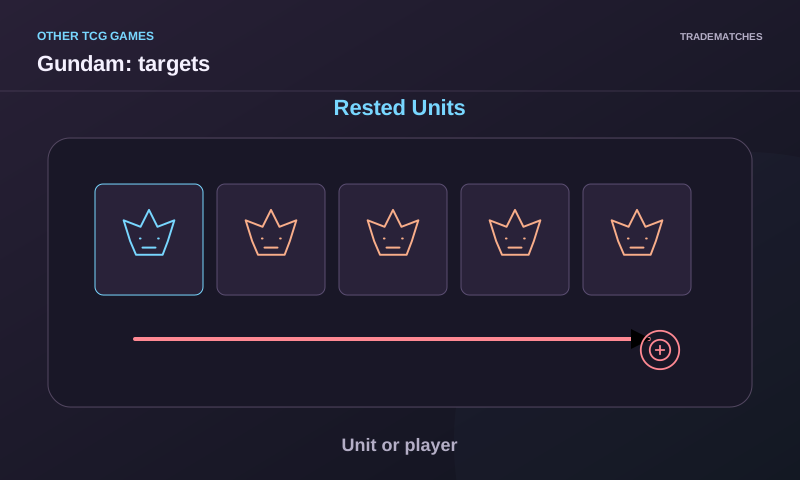
In Gundam Card Game, an ordinary attack can target the opposing player or a rested enemy Unit. An active enemy Unit is not normally an initial attack target. Blocker can later change the target to an eligible active blocking Unit through its own window. These are separate checks: declaring the initial attack and redirecting it after declaration.
Start with the attacker and the original target
The current comprehensive rules describe the normal main-phase attack as resting an active friendly Unit and declaring a target. The chosen target must be allowed at that point. Being able to win a damage comparison does not make an otherwise illegal target legal.
Before comparing AP and HP, inspect the attacker's state, the permissions or restrictions affecting it and the enemy Unit's state. An ordinary non-Link Unit also needs to respect the rule on attacking in its deployment turn. A Link Unit has a relevant immediate-attack permission, but that does not abolish every other attack requirement.
For a simple hypothetical board, your eligible active Unit faces one active enemy Unit and one rested enemy Unit. You can consider the rested Unit or the opposing player as ordinary initial targets. You cannot simply pick the active Unit because its HP is low or it is the most valuable card on the board.
| Hypothetical initial target | Ordinary attack check |
|---|---|
| Opposing player | Permitted target category, subject to current restrictions |
| Rested enemy Unit | Permitted target category, subject to current restrictions |
| Active enemy Unit | Needs a specific applicable permission |
| An individual Shield chosen from the stack | Not an ordinary chosen initial target |
| Enemy Base selected instead of the player | Use the actual player-attack procedure rather than inventing a direct target |
Attacking the player is not selecting a Shield
After an attack on a player succeeds, the rules examine the player's shield area. A Base and Shields are handled through their prescribed procedure. You do not choose whichever Shield you believe holds the weakest card, nor do you bypass a Base simply because you announced the player as your target.
This distinction is useful when learning from another game. The initial target category is the player, while the subsequent damage recipient is determined by the shield-area state. “I attack your third Shield” does not describe the ordinary attack declaration. If a card supplies a special instruction, use that instruction explicitly rather than importing it into all attacks.
For an original practice diagram, draw an enemy player, a Base and a face-down Shield stack. Draw the declaration arrow to the player. Only after the attack reaches its successful damage procedure should you draw the appropriate damage arrow using the current shield-area rules. Two arrows prevent confusing declaration with the later recipient.
Blocker changes a legal attack rather than authorising an illegal one
During the block step, an eligible active enemy Unit with Blocker can redirect the attack to itself. That unit may have been an illegal ordinary initial target because it was active. Its Blocker permission is a specific later procedure, not proof that every active enemy Unit was targetable from the start.
Consider a hypothetical attack declared against a rested enemy Unit. The defender has another active Unit with Blocker. If that Blocker is legally used, the second Unit becomes the attack target. The first rested Unit does not keep receiving the same battle damage as an additional target. The attack has been redirected, not copied into two attacks.
Our separate Blocker article covers that window in detail. For target selection, the important boundary is that an opponent's possible block does not repair your illegal initial declaration. Choose a legal initial target and then handle the defensive decision. Do not rest your attacker and rely on the defender to supply legality afterward.
Resolve the actual battle target, not a preferred replacement
The comprehensive procedure checks whether the attacking Unit or the Unit target has been destroyed or moved at several points. If the relevant Unit disappears, you do not automatically select another nearby enemy or send the planned Unit battle damage to the player. Follow the battle-end instruction that applies to the current step.
Imagine a hypothetical attack targeting a rested enemy Unit. An effect in the attack step removes that target before the block step. The attack does not become “unblocked,” with damage flowing to the player as in a mistaken import from another game. The rules specify how to proceed when the relevant attacker or target is no longer present.
For a teaching record, keep two fields: original target and current target. Add a third field for “left the relevant location.” These fields make a redirection and a disappearance distinguishable. They are not identical events and need not produce the same remaining battle procedure.
The later action window is not the declaration window
Gundam's battle procedure separates attack, block, action, damage and battle-end steps. The later action step allows the relevant Command cards and abilities through its alternating procedure. It is not a general permission to insert any card before the attacker's declaration has been completed.
An effect used in the action step can change characteristics or the board before damage. The legal initial target was still checked earlier. Do not declare an illegal active-Unit target on the assumption that an action will rest that Unit later. If your plan needs to rest an enemy before targeting it, establish a legal earlier action that does so before the declaration.
This timing difference helps evaluate cards that change readiness. A card that can legally act during your main phase before the attack can create a target opportunity. A card restricted to a later battle window cannot retroactively create the declaration permission. Read the timing icon as carefully as the numerical effect.
AP and HP answer a later question
Attack power and remaining HP help predict the damage result after a legal battle is established. They do not determine the target category. A rested high-HP enemy may be a legal target even if your Unit cannot destroy it in one battle. An active low-HP enemy may remain an illegal ordinary initial target.
Use hypothetical examples with no extra effects. Your eligible 3-AP Unit considers a rested enemy with five HP remaining and an active enemy with one HP remaining. The tempting one-HP target is not made legal by its vulnerability. The five-HP target can be legal despite surviving the prospective three damage.
To plan a turn, mark legal targets first, then calculate prospective results. Include current damage, pilots, characteristic modifiers and damage-order abilities only in the later calculation. Separating those stages avoids purchasing an impressive damage card that cannot legally reach the target your deck needs to remove.
Frequently asked questions
Can I normally attack an active enemy Unit?
No. Ordinary attacks select a rested enemy Unit or the opposing player. A specific applicable permission is required to change the initial Unit-target rule.
Can I choose a particular face-down Shield as my attack target?
Not through an ordinary player attack. You declare the player, and the later shield-area procedure determines how that attack is handled.
Does a vanished Unit target make the attack hit the player?
No automatic redirection occurs. Follow the current battle-step rules for the missing attacker or target rather than choosing a replacement recipient.