Gundam Blocker: changing the target of an attack
On this page
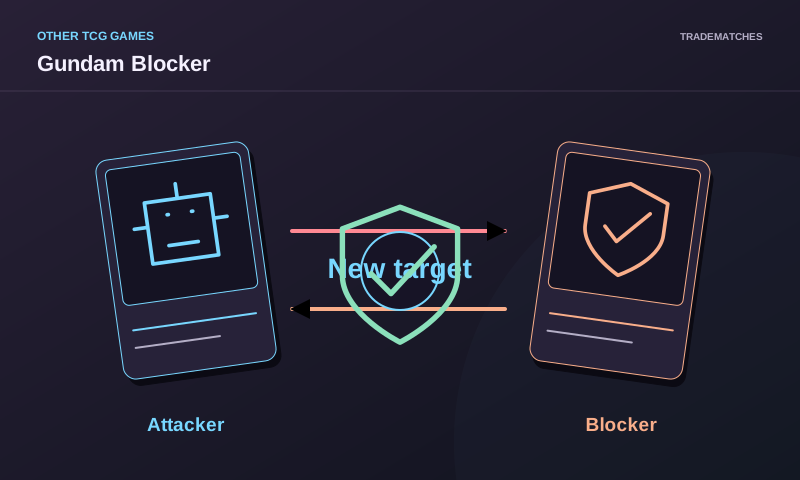
Blocker in Gundam Card Game lets the defending player rest an eligible active Unit during the block step and redirect the attack to that Unit. You can activate Blocker only once for an attack, and the Unit originally targeted cannot activate its own Blocker for that same attack.
Blocking changes the attack target; it does not cancel the battle or guarantee the blocking Unit survives. After the block step, the normal action window and damage procedure still matter. Plan the intercept using current AP, remaining HP and relevant effects rather than treating Blocker as a free shield.
Find the block step in the attack sequence
The attack begins with an eligible active attacking Unit being rested and a legal target declared. Relevant attack effects are processed through the attack step. The block step is the defending player's opportunity to use an eligible Blocker, subject to the actual board and restrictions at that point.
Do not wait until battle damage has been applied and then announce a block because you dislike the result. Blocker has a specific window. Likewise, an attack effect may alter the available board before the block step, so the defender should not assume a Unit visible at declaration will necessarily still be eligible later.
At a learning table, announce the transition clearly: attack declared, attack effects handled, block decision. This gives the defender a real opportunity to respond through the legal procedure without turning every pause into an invitation to activate a keyword at an unspecified time.
The blocking Unit must be active
Activating Blocker requires resting the eligible Unit. An already rested Unit cannot pay that rest by being selected again. The official FAQ explicitly confirms that a rested Unit cannot activate Blocker, so a large defensive card can be unavailable despite still occupying the battle area.
If an applicable effect prevents the Unit from resting, the intended payment is also unavailable. Check its current state rather than relying only on the printed keyword. A permission to intercept does not bypass the cost used to activate that permission.
For a simple board, imagine two Blocker Units: one active with three remaining HP and one rested with six. The rested Unit does not become a legal choice merely because it would survive more easily. Your immediate options come from the eligible active Unit or choosing not to block.
The original target cannot block its own attack
The comprehensive rules exclude a Unit originally targeted for that attack from activating its own Blocker. Being attacked and possessing the keyword are insufficient to use a pointless self-redirection. Choose another eligible active Blocker if you want to change the target.
This matters when the attacker selects a rested Unit. The attacked Unit might carry Blocker but be unavailable both because it is rested and because it is the original target. Restoring readiness through a relevant effect would not automatically erase the separate original-target exclusion.
For practice, label the original target A and your active Blocker B. B can be evaluated as the possible intercepting Unit; A cannot simply announce its own keyword for that attack. Keeping the target identity visible prevents confusion when both cards share the same printed name or artwork.
| Blocking situation | Resulting check |
|---|---|
| Active eligible Blocker not originally targeted | May rest to change the target |
| Rested Blocker | Cannot pay the rest requirement |
| Original targeted Unit | Cannot activate its own Blocker for that attack |
| One Blocker already activated | No second Blocker activation for that attack |
| Attacker has applicable High-Maneuver | Enemy Blocker activation is prevented |
| Defender declines | Continue against the original target if the attack remains valid |
Only one Blocker activation per attack
Once a Blocker has been activated for an attack, you do not repeatedly redirect that same attack through other Blockers. The one-activation limit is attached to the attack, not a separate allowance for each Unit on your board.
If a later effect removes the chosen Blocker or changes the situation, follow the attack sequence from that state. Do not treat its disappearance as an automatic reset granting another activation. Check whether the attacker or target remains where required and whether the procedure advances to the battle end step.
This distinguishes an intercept from a chain of replacements you can revise after every response. Make the block decision with the information available at its legal window, and account for the remaining action step before assuming that the eventual combat will look exactly like the initial choice.
The new target receives the battle
When Blocker changes the target, the attack is directed at the blocking Unit. Evaluate the resulting Unit battle with the current values and relevant rules. The original intended target does not automatically receive the same ordinary damage as well.
Suppose the attacker has four AP and the Blocker has five remaining HP, with no other effects relevant to the example. The Blocker can survive that four battle damage, while its own AP contributes to the applicable exchange. Recalculate if an action changes AP or HP before the damage step.
If the Blocker instead has only three remaining HP, the intercept can still protect the original target while costing the Blocker its survival. That may be a deliberate decision, particularly when preventing an attack on an exposed player, but it is not a claim that Blocker prevents all damage to itself.
The action step follows the block decision
Gundam's procedure includes an action step after blocking. The players can use eligible Action Commands or Activate: Action effects under the proper alternating sequence, beginning with the standby player. An intercept therefore does not immediately lock every combat value beyond possible modification.
This is important for cards that change AP, recover HP or remove a Unit. Check legal timing and costs for the particular action. A card being useful during battle does not mean it may be played during the block declaration itself or after damage when its window has passed.
For a hypothetical test, choose a Blocker that initially survives, then apply a legal AP increase to the attacker during the action step. Re-evaluate survival using the new AP at damage. The initial block was legal, but its strategic outcome changed through a separately legal action.
High-Maneuver can prevent the intercept
The High-Maneuver keyword stops enemy Units from activating Blocker while its condition applies to the attacking Unit. Inspect the attacker's current abilities before offering a block. The defender's readiness alone does not override a restriction on activating the keyword.
Multiple Blocker instances on one Unit do not create an answer to that restriction. The rules do not allow giving the same Unit several independent copies of Blocker to repeatedly bypass a prohibition. Use the keyword's actual rules rather than assuming a larger stack of reminders is stronger.
If an action or effect changes the attacker's abilities, pay close attention to when that change occurs. Removing a restriction after the block window has ended is not automatically a retroactive permission to make a new block decision. The timing sequence determines what opportunity remains.
First Strike belongs to the attacking case
First Strike has its own Gundam definition involving the Unit's attacking role. Do not import another game's universal first-strike interpretation and assume a defending Blocker with the keyword always deals battle damage first. Check which Unit is attacking and what the actual keyword says.
If the attacker has an applicable First Strike, its earlier battle damage can destroy the Blocker before the usual return damage occurs. The original target is still protected by the redirection, but your expectation of trading Units may fail because of the damage order.
For deck testing, compare the same block against an ordinary attacker and an attacker with applicable First Strike. This isolates the target-change benefit from the separate damage-order question. A useful defensive keyword does not guarantee every resulting exchange is favourable.
Decide whether preserving the original target matters more
Before blocking, identify what you are protecting: a player, a valuable rested Unit or a board position needed next turn. Compare that value with the blocking Unit's remaining HP, offensive role and the chance that a legal action changes the battle.
You are allowed to decline a block. Keeping an active Blocker for a later attack can be useful, but only if the current attack's consequence is acceptable. A later plan is irrelevant if letting the current attack through meets the game's defeat conditions.
Record whether a poor outcome came from an illegal activation or a legal but unfavourable choice. The first calls for a rule correction; the second can improve through better threat assessment. Both are easier to diagnose with a clear attack-step record than with a general claim that Blocker failed.
Frequently asked questions
Can a rested Unit use Blocker?
No. It must be able to rest to activate the effect. The official FAQ confirms that already rested Units cannot use that activation.
Can I block again if my first Blocker is removed?
Do not assume so. The rules permit Blocker activation only once for that attack. Follow the remaining attack sequence and its target-presence checks rather than resetting the activation limit.
Does Blocker prevent damage to the blocking Unit?
No. It changes the attack target to that Unit. The resulting battle still uses current AP, remaining HP and applicable effects, which can destroy the Blocker.