Gundam Repair: recovering HP at the end of your turn
On this page
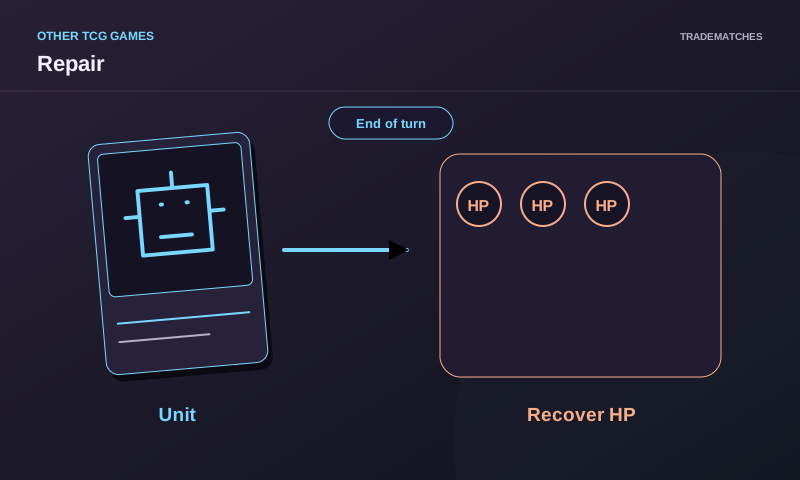
Repair in Gundam Card Game makes the Unit recover the stated amount of HP at the end of your turn. Recovery removes damage counters already on that Unit; it does not increase maximum HP. Multiple Repair amounts add together, and an undamaged Unit does not activate Repair. A Unit destroyed earlier cannot wait for Repair to return it to the field.
The keyword is useful because damage persists, but its timing is specific. Plan around surviving until your turn ends rather than treating Repair as immediate damage prevention.
Read the end-of-your-turn timing
Rule 13-1-1 defines Repair as an effect that activates at the end of your turn. “Your” refers to the Unit's controller in the relevant game state. It is not an instruction to recover at the end of every player's turn.
If your Unit takes damage during the opponent's turn, ordinary Repair does not automatically activate when that opponent finishes. The Unit needs to remain available until the relevant end of your own turn, unless a different effect provides recovery sooner.
Likewise, resolving a battle during your Main Phase is not itself the Repair timing. Do not erase damage counters after each attack simply because the Unit has the keyword. Apply damage and destruction normally before reaching the end-of-turn effect.
Damage remains until an instruction removes it
Gundam damage counters represent damage received by the card. Ordinary turn progression does not make Repair irrelevant by silently clearing all unit damage. The keyword supplies a specific recovery instruction at its stated timing.
For a simple example, a Unit has 5 HP and has received 2 damage. If it survives until the end of your turn and has Repair 1, remove 1 damage counter under that effect. One damage remains afterward.
Use a clear counter system rather than mentally subtracting from the printed card. Visible damage makes it easier for both players to check destruction thresholds and the amount that recovery actually removes.
Recovery removes damage rather than adding maximum HP
Rule 5-6 explains HP recovery by removing the appropriate number of damage counters. If the recovery amount exceeds the damage present, remove all the counters; the excess does not increase HP.
Suppose a Unit has 1 damage and Repair 3. The recovery removes that 1 damage, leaving it undamaged. It does not give the Unit 2 additional HP, a protective buffer or stored recovery for a later turn.
A separate HP-boosting effect can change the current value, but that is a different instruction. Keep modifiers to HP separate from counters representing damage, so the final state remains understandable after both effects have been applied.
Add Repair amounts on the same Unit
Bandai's Q52 and the comprehensive rules give the additive procedure. A Unit with Repair 2 that gains Repair 1 is treated as having Repair 3. The keyword amounts combine rather than creating an arbitrary number of independent repair opportunities.
Check which grants are currently active. If a temporary effect has ended or an attached card supplying an effect is no longer relevant, do not keep its amount merely because you counted it earlier in the turn.
Also distinguish one Unit with a combined amount from two separate Units. Repair does not create a shared pool that you can redistribute among your board. Each Unit's keyword concerns recovery for that Unit under its own relevant state.
| Simple state at your turn's end | Ordinary outcome |
|---|---|
| Unit has two damage and Repair 1 | One damage remains |
| Unit has one damage and Repair 3 | All damage removed; HP is not increased |
| Repair 2 plus a current Repair 1 grant | Combined Repair 3 |
| Unit is undamaged | Repair does not activate, according to Q51 |
| Unit was already destroyed | It is not present to recover through ordinary Repair |
An undamaged Unit does not activate it
The official Q51 directly addresses a Unit with no damage at the end of your turn: Repair does not activate. This is more precise than saying the effect always activates and then heals zero.
The distinction can matter if another ability cares about effect activation. Do not invent an activation for a pristine Unit simply to obtain a secondary benefit from another card. Use the official clarification and the exact interaction.
If another end-of-turn effect changes damage, the order and timing may require a specific analysis. The simple undamaged example does not determine every combination of simultaneous or pending effects. Identify the relevant cards rather than guessing from the final counter total.
Repair does not rescue a destroyed Unit
A Unit whose damage reaches the destruction threshold is processed under the game's destruction rules. You do not leave it on the field with a note saying it will heal at the end of the turn. Repair is not an exception that postpones required destruction.
Consider a 4-HP Unit that has already received 3 damage. If it takes another qualifying point of damage and is destroyed, ordinary Repair 2 will not later recover it. The Unit must survive the intervening game events to benefit at the specified time.
A separate card that returns or deploys a Unit can have its own instructions, but that is not the ordinary Repair keyword reviving the destroyed object. Keep the source of each movement and recovery effect explicit.
Prevention and recovery are separate mechanics
Prevention changes a damage event before or as the relevant damage would occur. Repair removes existing damage later. Those procedures can lead to different outcomes even if both seem to improve a Unit's chances of surviving.
For example, preventing lethal damage could keep a Unit present, while delayed Repair cannot help once the Unit has already been destroyed. Compare the timing rather than simply subtracting the repair amount from incoming damage.
This distinction also matters when describing a card for another player. “Takes two less damage” is not an accurate shorthand for Repair 2. The Unit receives damage normally and may recover later if the keyword's conditions and timing are reached.
Repair is not a shield-area instruction
Ordinary Repair concerns the Unit carrying it. It does not restore shield cards, put a destroyed Base back into the shield area or let you distribute recovery among several objects. Those actions need their own printed instructions.
Gundam's rules also describe recovery for Units and Bases through other effects. That broader vocabulary does not change Repair's stated object. A Base-healing card and a Unit with Repair can coexist while performing different operations.
When reading a full card, separate the keyword from additional text. If it also recovers another object, credit that result to the additional effect rather than teaching it as a hidden feature of Repair.
Decide whether a damaged Unit can safely keep attacking
Repair can make a surviving damaged Unit useful over several turns. Before choosing another attack, compare its current HP, damage already received and the damage it is likely to take. The end-of-turn recovery cannot compensate for a battle that destroys it first.
An attack that leaves the Unit damaged but alive may be more attractive when recovery will occur soon. However, other opposing effects can still intervene before the end of your turn, and the keyword is not a guarantee of safe aggression.
These are tactical considerations using the actual board. Do not turn Repair into a universal instruction to attack whenever possible. Preserving a blocker, link or important effect can matter more than recovering a small amount afterward.
Keep a counter history for repeated turns
Track damage received, recovery applied and any HP changes separately. A simple record such as “received two, repaired one, one remains” is clearer than rewriting an assumed health number without showing why it changed.
That history helps when a Unit survives several battles across both players' turns. It prevents automatic end-of-opponent-turn healing and makes the next destruction calculation use the actual damage still present.
For learning games, practise one Unit that survives to repair and another that is destroyed beforehand. Comparing the two sequences shows why timing is part of the keyword's value, not just an incidental detail printed after the number.
Confirm the current rule and any card-specific exception
Read the keyword amount, verify that the Unit is still present and damaged, and identify whether it is the end of your turn. Apply the combined current amount by removing damage counters, capped by the damage actually present.
Then resolve any other relevant effects under the proper timing rules. Do not use the recovery example to skip pending instructions or to decide a complicated sequence from memory. The exact card texts can add conditions beyond the basic keyword.
Bandai's current comprehensive rules and Repair Q51/Q52 support the ordinary procedure. For an event dispute, provide the Unit, damage history, current keyword grants and timing. Those details let a judge distinguish a recovery calculation from a destruction or effect-order question.
Frequently asked questions
Does Repair activate at the end of the opponent's turn?
The ordinary keyword activates at the end of your turn. A different card can provide another recovery effect at another time.
Do Repair 1 and Repair 2 produce Repair 3?
Yes, if both amounts currently apply to the same Unit. The rules and Q52 state that the amounts add.
Can Repair bring back a Unit that was destroyed in battle?
No. Ordinary Repair recovers the Unit at its stated timing; it does not return a destroyed Unit to the field.