How Lorcana locations and moving characters work
On this page
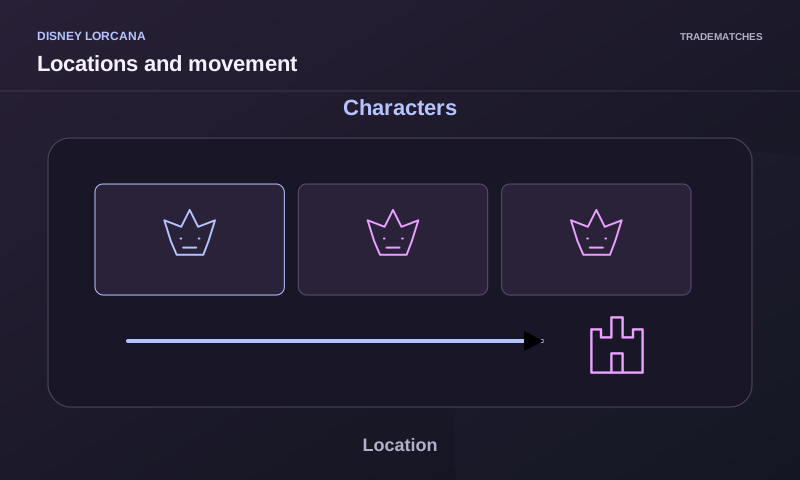
A location is a card type that stays in play and can hold your characters. To move one, choose your own character and your own location, pay the move cost printed on the location and place the character there. You cannot move it to an opponent’s location.
Playing a location does not move anyone
First you play the location for its normal ink cost. Later, at an appropriate action opportunity, you may move characters to it if you can pay the move cost. These are separate payments and decisions. Merely controlling both cards does not grant benefits that require a character to be “at a location”.
What a location does
Read its numbers separately: play cost, move cost, Willpower and lore value. Some locations produce lore at the start of your turn even without characters there; other cards add effects when a character is at a location. Locations can take damage and be banished when it reaches their Willpower. Their lore value is different from a character questing.
When the location leaves
Characters there remain in play and are no longer at a location. They do not automatically go to discard or move for free to another place. To move a character from one location to another, choose another location you own and pay the applicable cost unless an effect changes that rule.
For example, you play a location, move a character by paying two ink if that is its move cost and gain an effect requiring “a character at this location”. If the opponent later banishes the location, the character remains in play but no longer meets that condition.
Location is a unique card
In Disney Lorcana, a location remains in play after paying its ink cost. It is not a character or an object, and has values that you must read separately: cost to play it, resistance, movement cost, and, in some cases, knowledge value. Playing it does not automatically place any character there. You can have an empty location that already provides an effect or knowledge, depending on its text. To use a location-based list correctly, differentiate the moment you place the card on the table from the moment you move characters toward it.
When looking at a new location, search for its four data points before deciding if it goes into your deck. A cheap card to play can be expensive to occupy if movement requires a lot of ink. Another may not generate knowledge by itself, but reward characters that arrive. The drawing of a castle does not explain the function; the text and icons do. Comparing these data points avoids buying a card just because it seems to fit a theme.
Playing and moving are separate costs
First, you pay the printed cost to play the location. If you later want to move a character, you pay the movement cost of the destination location unless an effect indicates otherwise. You do not pay that movement when playing the location by default, nor is it automatically included in its initial price. If you plan both actions in a turn, add both costs and consider how much ink remains for other plays. A card can be efficient in one deck and too demanding in another because of this second number.
Example: A location costs three inks and moving a character to it costs one. With three inks available, you can play it, but not do an additional ordinary movement that requires a fourth ink. With four inks, you could pay both if the conditions are met and the turn sequence allows. If a skill offers free movement, check which character and destination it allows. A specific exception does not eliminate the movement cost of all other cards in your deck.
Only your characters go to your locations
In regular play, you choose a character you control and a location you control. You cannot send your characters to the opponent's location to take advantage of a favorable text or move opponents' characters as if they were yours. The physical association must be clear on the table, especially if there are multiple locations together. Place each character near the card where they are and announce the destination. If a specific effect allows a different movement, read exactly what authorizes it.
A character can move to a location even if it is occupied, according to the basic explanation of the rules, and can do so in the turn it was played if the movement conditions are met. Moving is not the same as daring or challenging, so do not automatically transfer the restrictions of those actions to movement. Nevertheless, a specific card can impose additional conditions. For a doubt, separate the general rule of movement from the specific text first.
What happens with the knowledge of the location
Some locations show a amount of knowledge that is obtained during the corresponding phase at the beginning of your turn while the location is in play. Others have abilities that generate knowledge under different conditions, such as the presence of characters. Do not assume that every card with a knowledge icon requires having a character inside. Read its value and its text. Nor confuse that knowledge with the action of daring a character: a location can provide points without exercising a unit for quest.
Example: A location with printed knowledge value remains in play and the moment to obtain knowledge comes during your turn. Follow its value and any applicable effect even if the card is empty if the card does not require occupation. Another location says it gains knowledge only if there is a character in it; in that case, an empty location does not meet that condition. The reading of a specific card always overrides the general idea that "locations give points".
Resistance, damage, and challenge
Locations can receive damage and be challenged by rival characters according to the rules. Their resistance indicates how much damage they can withstand before being discarded. A location does not return damage to the character that challenges it simply because it has resistance; that number measures endurance, not combat strength. If a rival card inflicts direct damage on a location, check if its text can affect that type of card. Do not automatically convert an effect that chooses a character into an effect that can choose a location.
When protecting a location that generates knowledge, calculate if it will survive until your next beginning of turn. A location with high resistance can give you several opportunities to score; a fragile one may provide less than its icon suggests if the rival can attack it immediately. This is a tempo decision. It is not resolved simply by counting the inks it cost to play it.
If the location leaves the game
Characters that were in a discarded location are not automatically discarded because they were there. They remain in play and stop being in that location, unless a specific card or effect says otherwise. This rule prevents accidentally discarding two or three characters along with the place. Move the location card to the discard, separate the characters, and keep their respective states. If the location had an ability affecting those present, that relationship ceases when the card leaves.
Example: Two of your characters occupy a location that the rival destroys. You discard the location, but you do not place the two characters in the discard just because of that. Continue the game checking their individual states. If one had damage, that damage does not disappear automatically by changing their relationship with the place. The 2026 rule update clarified this point; use the current document if an old guide described it differently.
Movement between two locations
A character already in a location can move to another you control by paying the cost of the new location according to regular play. It does not have to "go to the center" and pay twice for an imaginary route. Identify origin, destination, and destination cost. If an ability triggers when someone moves, check if it matters entering, leaving, or simply being there. These phrases seem similar, but produce different results.
When preparing a turn with multiple locations, indicate which character will occupy each one after movements. Do not use the same ink twice when planning. A card that reduces or eliminates the cost of a movement may allow a special sequence; apply its text only to the movements it covers. Maintaining visible positions avoids disputes about where a character was when an ability was triggered.
How to build around them
A location deck needs reasons to occupy them or to keep them in play. If you include many without enough characters, you may not take advantage of abilities that require presence. If you include many characters with benefits "in a location" but few locations, those abilities may remain inactive. Try initial hands and note how many times you could play location, move, and get the benefit before the rival eliminated it. A useful proportion depends on the cards, not a universal number.
When buying a location, evaluate play cost, movement cost, resistance, and knowledge separately. A costly card with good knowledge can serve for a slow plan; another cheap card can activate character abilities quickly. The official Ravensburger guide shows that there are different designs. Comparing only the largest icon on the card hides the real cost of starting the plan.
Common mistakes
One: believing that playing the location moves a character for free. Two: sending a character to an opponent's location. Three: treating resistance as damage that returns in challenges. Four: discarding characters when the location leaves the game. Five: requiring occupation for all printed knowledge even if the card does not say so. To correct these, read the four values and the text, separate play from movement, and physically indicate which characters are in each location.
Frequently asked questions
Can a character be at two locations?
No. Move it to the new destination under the normal rules.
Is a character banished with its location?
No. It remains in play but is no longer at a location.