When can a newly played Lorcana character act?
On this page
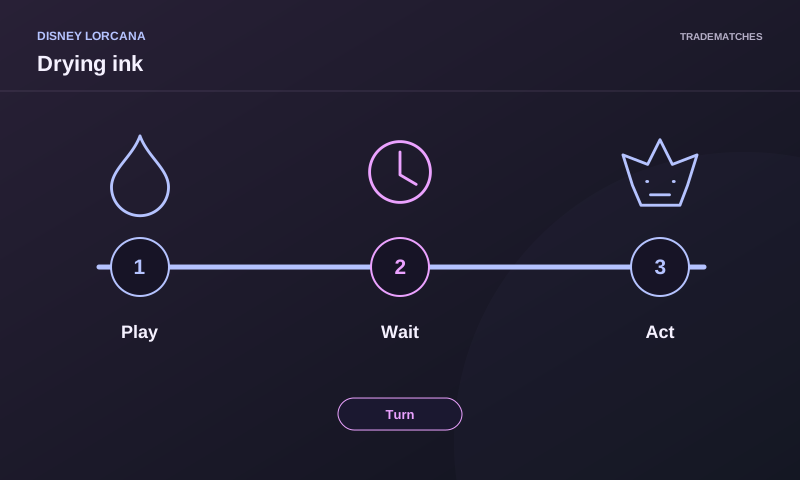
In Lorcana, a character newly played is drying during that turn. While drying, it cannot make a quest, challenge, or exhaust itself to pay an ability or a song. It stops drying at the start of your next turn, during the Set step, if it remains in play. This does not nullify all its abilities: an ability that does not require exhausting or a triggered ability can still function according to its text. The keyword Rush allows challenging before, but not making a quest.
What does it mean for a character to be drying?
The rules use "drying" to describe a character played after the start of a player's turn. It is a temporary restriction on specific actions. It is not damage, it is not represented by counters, and it does not equate to the character being exhausted. A character can be ready, upright, and still be drying. It can also be exhausted by an effect and continue drying. Orientation and in-game time are separate data points.
The useful question is not "Is it ready to play?", but rather "Was it in play from the start of my turn?". If you just paid ink and placed the card into play during your main phase, the answer is no. Except for an applicable exception, do not exhaust it to make a quest or declare it as a challenge. You also cannot use it to pay a cost that shows the exhaust symbol. The rule exists even if you played the character at the start of your main phase and many other actions have occurred since.
Making a quest requires the character to be dry
To make a quest, you exhaust a character and gain the lore indicated by its value. A character that is drying cannot make a quest on the turn it was played by the general procedure. Having a high lore value does not change the restriction. It also doesn't matter if you're just one point short of twenty: your desire to win the game does not alter the legality of the action. If another card grants lore through its own effect, analyze that effect separately; it is not automatically a quest for the new character.
Example: you play a character with two lore icons and have eighteen lore accumulated. You cannot exhaust it on that same turn to make a quest and gain the remaining two, because it is still drying. You can perform other legal actions and keep it for your next turn. At the Set step of the following turn, it will stop drying if it remains in play; then you can evaluate the quest, as long as it is ready and no other rule prevents it. This waiting protects the importance of turn order.
Challenging is also limited
A character that is drying cannot challenge under the general rule. Challenging is a different action from making a quest, but both are covered by the same time-based limitation. To challenge, you also need a legal target and must follow combat damage rules. Simply having the opponent with an exhausted character or a vulnerable location is not enough: your character must be able to be declared a challenge. This check occurs before selecting the target.
Suppose you play a character with high Strength and the opponent has an exhausted character. Without an ability that creates an exception, your newly played character cannot challenge on that turn. You can leave it ready to defend a future situation, use another character already in play, or prepare ink and cards for the next turn. The page on quest versus challenge explains how these two actions differ; here the common point is when a new character gains permission to perform them.
Rush allows challenging, not making a quest
Rush is a specific exception. According to the rules, a character with Rush can challenge as if it had been in play from the start of your turn. The keyword does not say that it can also make a quest or exhaust itself to pay any other cost. Therefore, if you just played a character with Rush, first check whether the challenge you want to declare is legal, and then follow the combat sequence; do not use it to gain lore through a quest simply because "it can act now".
Example: you play a character with Rush and the opponent has an exhausted character you can challenge. Rush satisfies the time requirement for that challenge. If instead of fighting you want to exhaust your character to make a quest, the exception does not cover that action and it continues drying. A specific card might grant another permission, but it would have to be read explicitly. Naming the exact action prevents a narrow exception from being intuitively interpreted as permission for everything.
Exhausting for an ability or to sing
The drying rule also prevents exhausting a character as part of the cost of an activated ability or a song card. If an ability shows the exhaust symbol, the newly played character cannot pay that cost while it is drying, except for applicable exceptions. To sing a song, exhausting the character is the way to pay an alternative cost; therefore, it also cannot be used to pay that ordinary cost while still drying.
This limitation is not resolved by having sufficient ink. You might play the song by paying its normal ink cost if the card and situation allow it, but that is a different way of paying. To sing with a character, in addition to the song cost, that character must be able to exhaust legally. Consult the TradeMatches guide on songs for detailed rules about singing. On this page, the central test is temporal: was that character in play when your turn began?
Abilities that can still function while drying
The drying rule does not erase the text of the card. The rules clarify that unactivated abilities of a character that is drying—including those triggered "when you play this character"—can still function. A ability activated whose cost does not require exhausting the character is also not prohibited by the drying rule for that reason, although it must still meet its own timing and other restrictions. This distinction avoids wasting a useful effect by assuming a new card is completely inert.
Example: a character has an ability that triggers when played and allows you to look at cards. If you meet its conditions, it can activate even though you cannot make a quest that turn. Another character has an ability cost requiring ink payment but not exhaustion; the drying rule does not automatically add the exhaustion symbol. In both cases, you must read the exact text and the effects in play. The drying rule applies to three types of action, not to every interaction possible with the card.
When does drying end?
The start of a turn in Lorcana includes the steps Ready, Set, and Draw. During Set, characters that remain in play stop drying. After that, they can make a quest, challenge, or exhaust themselves to pay costs when a legal window occurs during your main phase and all other conditions are met. Do not wait until the end of that second turn or until you have drawn an additional card to declare them "dry": the rules fix the change at Set.
The sequence helps to remember this. You play a character during your Turn A. You finish, the opponent takes their turn, and you can see if your character remains on the board. At the start of your next turn, cards are prepared in Ready; during Set, the character stops drying; during Draw, you draw a card, except for the first turn of the game for the initial player. Then, during your main phase, you can use the character according to the rules. If it was banished before, naturally it will not be there to act.
Ready, exhausted, and drying are different data points
A ready character is upright and, in principle, can pay an action that requires exhausting it. An exhausted character is horizontal and usually needs to be prepared to pay it again. Being drying or drying describes from when it has been in play relative to your turn. Therefore, a character can be ready but still drying, or exhausted but drying. Looking only at orientation does not answer all legal questions. Many first-turn errors arise from equating "upright" with "can make a quest".
Imagine a newly played character that enters ready: its orientation allows identification, but the drying prevents quest and challenge. If an effect exhausts it, it does not become "dry" for that reason; it remains subject to the same timeline. If a character already in play exhausts itself to make a quest, it continues drying, only now it is exhausted. At the start of your next turn, it will be prepared in Ready and will remain a playable character by time. This separation of variables is also useful for determining which opponent characters can be challenged.
Objects and locations do not dry like characters
The drying rule applies only to characters. An object can exhaust during the turn it is played if its ability and other requirements allow it. A location can also have an activated ability usable on the turn of entry according to applicable rules. Do not automatically transfer character drying delays to all card types. Likewise, the fact that an object can be used immediately does not mean a newly played character can exhaust itself to sing.
The difference matters when choosing what to play with your ink. If you need an immediate effect, compare the text of an object with that of a character that would require waiting to pay an exhaustion cost. If you need a lore source for future turns, playing the character now may still be correct even if it hasn't yet made a quest. The Lorcana Objects guide explains how to play and activate those cards; here it is sufficient to keep card types separate when applying the drying rule.
Example of a turn with several options
You begin your turn with a character A already in play and play a new character B. A has passed the start of your turn and can make a quest or challenge if it is ready and the rules are met. B is drying. You can use a "when you play" ability of B if its text triggers, but you cannot exhaust it to make a quest. If B has Rush, it could challenge a legal target; it would still not be able to make a quest through that permission. If you want to sing a song, A could pay it if it meets the requirements; B cannot exhaust itself to do so while it is drying.
This scene shows why it's important to note which character entered which turn. On a table with multiple versions of the same character, the name is not enough: one might be dry and another newly played. If you use stacked cards via Shift, consult the specific rules for that mechanic to know what happens to the resulting pile; do not automatically apply the example of two independent characters. The goal is to determine the legality of each action before paying ink or rotating cards.
Common mistakes and quick check
Common mistakes include making a quest with a newly played character because it is upright, using Rush to sing or gain lore, forbidding a "when you play" ability due to drying, or waiting an extra turn after Set. It is also common to confuse drying with being exhausted. Every time a character attempts an action, ask whether it was played after the start of your current turn and what type of action it proposes: quest, challenge, cost with an exhaust symbol, or another ability.
If it is drying and the action is restricted, look for a specific exception such as Rush for challenging. If there is no exception, wait until the Set of your next turn. If the action is an ability that does not require exhausting the character, continue reading its text instead of banning it by routine. This sequence of questions avoids both illegal plays and missed opportunities. In an event, a Shift interaction or simultaneous effects must be resolved using the current text and, if needed, with the help of a judge.
Frequently Asked Questions
Can a newly played character make a quest if it is ready?
No, by general rule. Being ready does not eliminate drying; it must remain in play until the start of your next turn, except for a specific exception that authorizes that action.
Does Rush allow singing a song on that same turn?
No, on its own. Rush allows challenging as if the character had been in play from the start of your turn; it does not authorize exhausting it to pay for singing.
Does a "when you play this character" ability function?
Yes, the drying rule does not prevent triggered or static abilities. Read the specific conditions and text of the card.