Lorcana mulligan: changing your opening hand
On this page
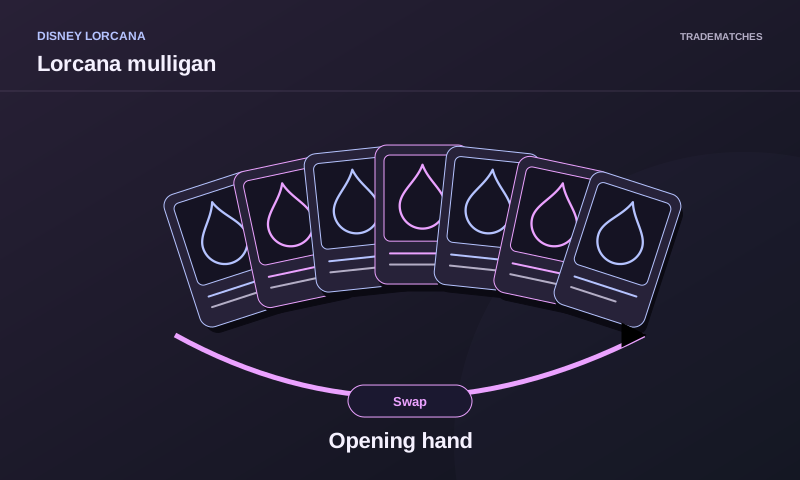
The "mulligan" in Lorcana, referred to in the rules as altering the initial hand, allows a player to change once any number of the seven initial cards. You place the selected cards face down at the bottom of your deck without showing them, then draw until you have seven cards again, and if you changed one or more, you shuffle your deck. The player who starts first makes the decision first, followed by the others in turn order. You do not lose cards from your hand when making the change, but you also cannot repeat it if the result is not satisfactory.
When it occurs before playing
First, a random player is determined to start, and all decks are prepared and shuffled. Each player begins with zero lore and draws seven cards. Before the first turn begins, the opportunity to alter your hand occurs. The starting player makes their decision first; then each other player decides in turn order. Once this procedure is complete, the game begins with the start-of-turn phase of the initial player.
This means the change cannot be saved for after playing a card or requested upon seeing the opponent's first action. It is part of preparation, not the main phase. It also cannot be decided before seeing the seven cards: the purpose is to evaluate the actual hand you drew. In a friendly game, you announce "I'm changing three" before moving the cards so both players know you're still within the correct window, without revealing the identities of those cards.
You can change from zero to seven cards
The rules allow you to choose any number of cards from your initial hand. You can keep all seven if they suit you, swap one that doesn't fit, or return the entire hand to try a different strategy. There is no obligation to keep a character, an inkable card, or a low-cost action. This freedom makes the decision strategic: you choose which cards to keep to build your early turns, knowing that the new cards will be unknown.
Example: you have seven cards and decide to keep four. You place the other three face down at the bottom of your deck without showing them and draw three, so you once again have seven. If you change all seven, you place all seven at the bottom and draw seven new ones. If you change zero, you keep your original hand. In all cases, the initial size of seven cards is preserved after the procedure, unless a specific rule changes the context. No eighth card is drawn because you changed multiple cards.
The order: bottom, draw, and shuffle
The rules establish a precise order. First, you select the cards you want to return and place them face down at the bottom of your deck, without showing them to your opponent. Then, you draw until you have seven cards again. Finally, each player who altered their hand by one or more cards shuffles their deck and offers the opponent the opportunity to cut or shuffle their deck according to preparation rules. Changing the order of these steps can alter the probabilities of drawing.
Imagine you return a specific card you don't want to see immediately. Since it is placed at the bottom before drawing, the procedure prevents you from drawing it again during the normal replacement draw. Afterward, the deck is shuffled, so its final position is no longer fixed at the bottom for the rest of the game. Do not conclude that "that card won't appear until the end" nor shuffle before completing the draw if you're following the alteration procedure. The sequence matters.
Returned cards are not shown
When placing cards at the bottom, you must not reveal the selected cards. Your opponent may know how many cards you changed, but does not gain free information about their identities. This privacy prevents revealing the type of hand you were aiming for or which cards seemed useless. Keep the cards separate from your hand while counting and move them clearly to the bottom of your deck; do not leave them face up on the table to comment on your decision.
In learning games, it's tempting to show the cards to get advice. You can discuss your hand after the game, but during the official procedure, respect the hidden information if you want to play by the normal rules. If a card is accidentally revealed during an event, do not improvise a correction based on hiding it again: the opponent already gained information. Stop and ask the judge for help. In casual play, agree on a transparent solution before continuing, knowing it won't be identical to a situation without revelation.
One opportunity per game
Each player may alter their hand only once per game. If after changing five cards, the five new ones are hard to use, there is no second free mulligan. You also cannot first change two cards, look at the result, and then decide to change three more. The selection is a single decision before drawing replacements. That's why it's important to evaluate your entire hand at once and not rush to change the first card that seems bad.
This rule differs from other TCGs. In Pokémon, a hand without a Basic Pokémon triggers a mandatory mulligan with its own rules. In Lorcana, you do not need to have a mandatory card category for your hand to be valid; altering your hand is an option to improve it. If you play multiple TCGs, do not automatically transfer the number of mulligans, the opponent's extra cards, or the initial hand conditions from one game to another.
What to look for in a useful initial hand
A good hand depends on your deck, but there are questions that help. Do you have cards you can use in early turns? Is there at least one reasonable line of inkable cards to pay costs? Does the hand contain characters or actions that fit your initial plan? Have you drawn many copies of a card that only becomes useful much later? These questions do not turn a hand into "correct" by a fixed formula; they help you decide which pieces to keep and which to return.
For example, a hand with six high-cost cards and one low-cost card may have no early plays if no ink and another character appear. You might keep one central piece and change the rest, or return the entire hand depending on how your deck is built. In contrast, a hand with several inkable cards and a playable cost progression might be worth keeping even if it lacks the most powerful card. Evaluate a sequence of two or three turns, not just the isolated quality of each card.
The choice of ink affects the change
In Lorcana, a card with the inkable symbol can be placed in the inkwell using the corresponding action. If your initial hand has few cards you can ink and all others require multiple ink points, it's worth considering changing some. But you should not return every non-inkable card by system: one of them might be key for early turns and you may already have enough ink options. The balance depends on the cost curve and the cards you expect to draw later.
Before selecting a change, mentally divide the cards into three groups: reasonable ink resources, early plays, and cards for later. A card can belong to more than one group—making it flexible. The existing guide on inkable cards explains how to recognize the symbol and what can go into the inkwell. Here, the initial decision matters: keep a hand that can pay for its plan without assuming you will draw exactly the card you're missing on the next turn.
The initial player does not draw on their first turn
After altering hands, the first player begins their turn. In Lorcana, the initial player omits the draw step during that first turn of the game. Therefore, if you start, the seven-card hand you leave after alteration becomes your starting point without an immediate eighth card from the Draw step. This makes it especially important to preserve a playable sequence. The player after you will follow normal draw rules when it's their turn.
This detail does not mean the initial player can change an additional card nor that the opponent receives a special benefit from your mulligan decision. These are separate rules: one determines the hand before playing, and the other defines the structure of the first turn. If a specific card grants a draw effect during the game, it will be analyzed separately. Do not use the expectation of "I'll draw at the start" to justify a hand that has no initial play when you are the first player.
Complete example with two players
Ana is the initial player. After drawing seven cards, she decides to change three high-cost cards that she won't be able to pay soon. She places those three cards face down at the bottom of her deck, draws three, and now has seven again. Bruno, the second player, sees his own seven cards and decides to keep them. Ana shuffles her deck because she changed at least one card and offers Bruno the opportunity to cut or shuffle his deck according to preparation rules. Bruno does not need to shuffle because he did not change any cards.
Now Ana begins her turn. She prepares her cards in Ready and follows Set; when reaching Draw, she omits that step because it is the first turn of the game. With the hand she kept, she can enter her main phase and perform legal actions. Bruno will then have his turn. Neither player can go back to alter their hand after seeing what the other played. If Ana discovers she would have preferred to keep one of the three returned cards, that information serves to learn from the decision, not to repeat the procedure.
Common mistakes and a short routine
The most common errors are shuffling the returned cards before drawing replacements, revealing the chosen cards, drawing fewer than needed to reach seven, attempting a second change, or waiting until the first turn to decide. It is also commonly confused that the initial player's omission of the first draw is a penalty for changing cards. It is not: even if they keep all seven, the initial player omits that step due to the game structure.
To avoid these, recite five steps: seven initial cards; the initial player decides first; each player chooses only once how many cards to return to the bottom without revealing them; draw until you have seven; anyone who changed at least one card shuffles and offers their deck to the opponent. Then the turn begins. If during an event you realize you altered your hand incorrectly by revealing information or drawing cards, stop the game and consult the judge. An improvised correction could create an advantage that didn't exist.
Frequently Asked Questions
Can I change all seven cards?
Yes. You can choose any number from zero to seven, but you only have one opportunity to alter your hand per game.
Are the changed cards discarded?
No. They are placed at the bottom of the deck without revealing them; then you draw until you have seven, and if you changed at least one card, you shuffle your deck.
Does the opponent draw extra cards if I do a mulligan?
No, due to this Lorcana rule. Each player can alter their own hand once without reducing their final hand size to seven.