Commander to graveyard or command zone?
On this page
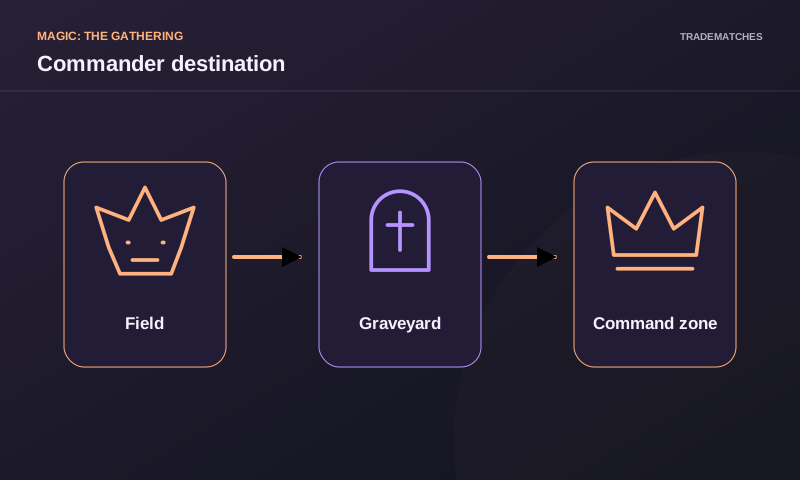
In Commander, if your commander goes to the graveyard or exile, it arrives there first, and its owner can move it to the command zone when state-based actions are checked. If instead it were going to the hand or the library, its owner can substitute that destination with the command zone before the movement occurs. This difference explains which abilities trigger and why you can't change your mind at any later point.
The command zone is the owner's option
Commander rules allow a commander to return to the command zone when it leaves the battlefield or moves between certain zones. The decision belongs to the card's owner, who may differ from the player who controlled it just before. There is no universal obligation to send it to the command zone every time. Sometimes it's strategic to leave it in the graveyard to reanimate it or in exile because another card allows interaction with it. That strategic decision must be made at the moment the rule offers it.
The command zone allows you to re-enter a commander according to the format's rules. Re-entering from there increases the commander tax, which depends on how many times it has been returned from that zone. The existing TradeMatches guide on the commander tax explains that calculation. Here, the question is prior: in which zone does the card actually end up after an event? Making a wrong decision about the destination changes whether you can re-enter it from the command zone, recover it from the graveyard, or use an effect that references exile.
If it goes to the graveyard, it arrives there first
When a commander dies or an effect sends it to the graveyard, the card effectively passes through the graveyard. Then, during the next check of state-based actions, its owner can move it to the command zone if it was placed there since the last such check. This formulation differs from a substitution that prevents touching the graveyard. Therefore, an event such as "when a creature dies" may have occurred even though the commander ends up in the command zone shortly afterward.
Example: your commander is a creature and an effect destroys it. The card arrives in the graveyard. The relevant events for abilities that trigger on death or entry into the graveyard occur, as long as their conditions are met. Before a player receives priority, state-based actions are checked and you can choose to move the commander to command. An already-triggered ability does not automatically vanish because the card changes zones again. Its final result depends on specific objectives and text.
Exile works with a similar opportunity
If the commander goes to exile, it also arrives there first, and its owner can move it to the command zone when state-based actions are checked, provided it was placed there since the last such check. This matters if a card specifies that an object was exiled. Do not automatically interpret "exile the commander" as "it never was in exile"; that oversimplification was the source of many confusion with triggered abilities.
Imagine a spell exiles your commander to prevent it from returning from the graveyard. After resolution, you decide during the regulatory opportunity whether to leave it in exile or move it to command. If you send it to command, you can later consider re-entering it from there, paying the corresponding costs. If you choose to leave it in exile, you cannot later demand to move it to command ten minutes later simply because it now suits you, except when a new event or effect provides another opportunity. The temporary decision matters.
Hand and library use a prior substitution
When a commander is sent to the hand or library of its owner from any location, the owner can place it in the command zone instead. The phrase "in its place" indicates a replacement effect: you choose before the movement completes. If you choose command, the card does not enter the hand or library for that event. That's why abilities requiring the card to have entered one of those zones are analyzed differently than those triggered by death or exile.
Example: an effect would return your commander to your hand. You can allow it to reach your hand and perhaps re-enter it from there under normal rules, or substitute that destination with the command zone. The best choice depends on mana available and the rest of the game; there is no universal decision. If you choose command, do not announce a hand-arrival ability afterward because that specific movement was substituted before it occurred.
The library requires thinking about information and access
If an effect intends to place the commander in the library, the option to substitute the destination with command avoids mixing it with cards that are hard to find. You can leave it in the library if you have a strategic reason and the sequence allows it. But once you choose the destination and the event completes, you cannot change it simply due to preference. If the effect also shuffles the library, read the exact order of its instructions; the decision about the commander does not automatically erase the rest of the effect.
The library is a zone with hidden information and a regulated order. Do not search for or reveal the commander in it after you've chosen to leave it there. If you're concerned about losing access to your main piece, evaluate the command zone when the substitution is offered. If your strategy relies on a card entering the library, consult the specific text before deciding. The practical distinction is simple: command is a prior option for hand and library, while for graveyard and exile it's typically an option after having entered the zone.
Why "dies" can still happen
In Magic, a creature dies when it moves from the battlefield to the graveyard. Since the commander arrives in the graveyard before the opportunity to move it to command, that event can have occurred. Abilities triggered by death are recognized during the regulatory sequence and are placed on the stack when appropriate. It is not required that the card remain in the graveyard for the event to have occurred, although a specific ability might require information or an objective that is no longer available.
Suppose a permanent says "whenever a creature you control dies...". Your creature commander you control moves from the battlefield to the graveyard. The trigger can occur. Afterward, you decide to move it to command. When resolving the ability, read exactly what it attempts to do: an ability that only lets you draw can function normally, while one that attempts to return "that card" from the graveyard may fail because the card has already changed zones. Do not convert the phrase "triggers on death" into a guarantee that any subsequent effect will find the commander there.
Who decides if a rival controlled your commander?
Control can change during the game, but card ownership does not change in the same way. If a rival controls your commander and it goes to the graveyard or exile, the opportunity to move it to command belongs to its owner. The controller of the spell that destroyed or exiled it does not make that decision for you. Before moving it, confirm where it was placed and who the owner is. This check is useful in multiplayer games with control-stealing effects.
Example: another player temporarily controls your commander. It is destroyed and arrives in your graveyard as a card of your ownership. At the appropriate time, you decide whether to send it to your command zone. Abilities triggered by death may depend on who controlled the creature before it left the battlefield—a matter distinct from who chooses the final destination. Separating owner, controller, and zone avoids a dispute in which each player believes they have the same kind of decision.
The decision window does not remain open
For graveyard and exile, the rule checks whether the commander was placed in that zone since the last time state-based actions were checked. It's an opportunity tied to that recent event. If you choose to leave it there and then other checks occur, you do not retain a permanent button to move it to command whenever you want. The card may leave that zone via another spell or ability; if it later returns to a zone covered by the rule, a new situation must be evaluated.
A good habit is to announce the decision as soon as the effect that moved the commander resolves and the relevant state-based check occurs. This way, everyone knows where the commander is before making new decisions. Avoid ambiguous phrases like "I'll leave it for now and then see" if you mean to accept it staying in the graveyard. In Commander, the commander's location is fundamental information for future costs and for the legality of other cards. The moment of choice is part of the play.
How it relates to the commander tax
The tax does not increase simply because the commander goes to the command zone. What matters is how many times you've returned it from that zone during the game. If you've returned it from command twice, a subsequent return from there incurs the corresponding cost; if an effect puts it in your hand and you return it from there, the cost of that return is determined by the applicable rules and text. The specific guide on the commander tax details the calculation of two mana per prior return from command.
This gives context to the choice of zone. Sometimes leaving a commander in the hand may be more economical than sending it to command and returning it from there. In other cases, keeping it accessible from command may offset the cost increase. If it goes to the graveyard, a revival card might return it without returning it from command, but there's a risk that your opponent will interact with the graveyard. Do not convert these possibilities into a fixed recommendation; evaluate mana, available cards, and real threats.
A table method for resolving each exit
When the commander changes zones, first state your intended destination: graveyard, exile, hand, or library. If it's hand or library, ask the owner whether to substitute that destination with command before moving the card. If it's graveyard or exile, perform the movement, identify the events that occurred, and during the check of state-based actions, offer the option to move it to command to the owner. Then record where it actually ends up. This sequence avoids mixing a prior substitution with a later action.
In a complex interaction, temporarily place the card in the zone it passed through so you can see what happened, without leaving it there unnecessarily when command is chosen. Do not resolve multiple triggered abilities and movements in your memory; use the stack and consult current rules. The goal of this routine is to preserve two facts: whether the card touched a zone that can trigger abilities, and where it ended up at the end. These facts are sufficient to resolve many future doubts without reconstructing the entire game.
Frequently Asked Questions
Does my commander die if I choose to put it in command?
If it moved from the battlefield to the graveyard, yes—the death event occurred before the opportunity to move it to command. The specific ability triggered will resolve according to its text.
Can I leave it in the graveyard to recover it later?
Yes, the command zone is the owner's option. If you choose to leave it there, you cannot move it to command later at will without a new event or effect allowing it.
Does the option work the same for the hand?
No. For hand and library, it's a prior substitution: you can place the commander in command instead of sending it to that zone.