Summoning sickness in Magic: what it stops
On this page
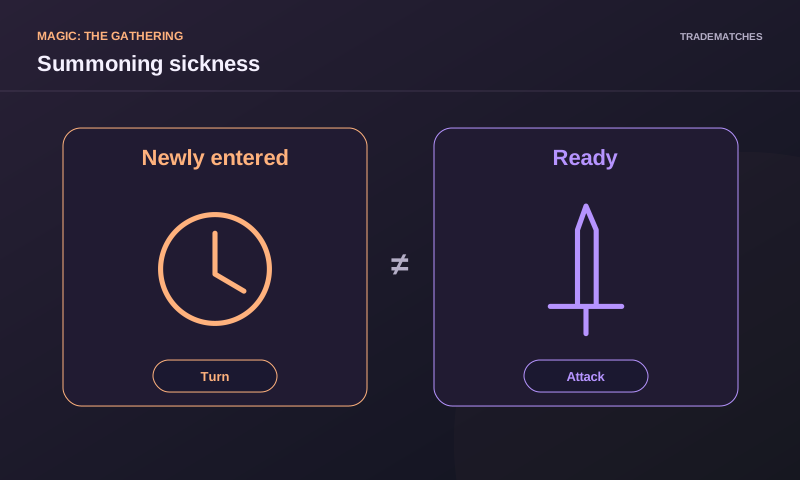
The so-called summoning sickness in Magic prevents a creature from attacking or activating an ability that costs a tap or untap symbol, unless you have continuously controlled it since the beginning of your most recent turn. The rule does not prevent blocking, nor does it block all other abilities of the creature. Priority is the usual exception: it allows attacking and using those abilities with the symbol even if the creature just entered the battlefield.
What the rule actually says
"Summoning sickness" is an informal name. The full rules do not place a state called "summoning sickness" on the card; instead, they ask how long the creature has been under the controller's continuous control. If you did not control it continuously since the beginning of your most recent turn, it cannot attack and you cannot activate any abilities whose cost includes a tap or untap symbol. These are the two main restrictions of the rule.
A creature you play during your main phase normally enters under your control at the end of that phase, so it does not meet the time requirement. When your next turn begins and you have maintained control of it since the start of that turn, it may attack if nothing else prevents it. You do not need to place a token on the creature or wait a fixed number of phases after playing it—the test is made against the beginning of your most recent turn. Text from other cards may grant priority or alter the possibilities, but the foundation remains continuous control.
Attacking is the restriction most commonly seen
If you play a creature and proceed to combat on the same turn, you cannot declare it as an attacker under the general rule. It does not matter how powerful the creature is, whether your opponent is at one life or has no blockers. Simply untapping it when it enters does not satisfy the requirement of continuous control. A creature you already controlled from the start of your turn can attack if it meets all other combat conditions.
Example: During your turn, you play a creature A with a cost of two. You leave it untapped and proceed to declare attackers. Creature A cannot attack, even though it is physically ready. You finish your turn, your opponent plays their turn, and creature A remains under your control. When your next turn begins, the temporal situation changes. If you still control A when combat begins and no other effect prohibits it, it may attack. This possibility arises from continuous control since the start of the turn, not from having "survived a round" as an imprecise phrase.
Abilities with tap or untap symbols
The other part of the rule affects abilities activated by creatures whose cost includes a tap or untap symbol. If the creature does not meet the requirement of continuous control, you cannot activate those abilities, even if the creature is physically untapped and you have the mana available. Look for the symbol in the activation cost, which usually appears before the two points of text. A verb that says "tap a creature" within the effect is not necessarily the same type of cost.
Suppose a creature that just entered has an ability written as "{T}: add a mana." You cannot activate it immediately due to the general summoning sickness rule, unless it has priority or another applicable exception. If instead, its ability says "pay mana: draw a card" and does not contain {T} or {Q} in its cost, this rule alone does not block it; you still need to pay the cost and meet any other conditions. Do not assume that all activated abilities expect a turn to pass.
Abilities without those symbols can still function
An ability activated by a creature that just entered can be used at a legal time if its cost does not contain the restricted symbols and nothing else prevents it. Likewise, a triggered ability can occur when the creature enters the battlefield or when an event happens, and a static ability can modify the battlefield while the creature is there. Summoning sickness does not erase the text of the card; it only limits two specific actions related to attacking and certain activation costs.
Imagine a creature with a triggered ability that reads "when this creature enters..." That ability can trigger upon entering, even though the creature cannot attack yet. If it has a continuous bonus for other creatures, that bonus can apply as long as its conditions are met. It is important to identify the type of ability before declaring that "the creature can do nothing." Sometimes a support creature is useful on the same turn it enters, even if it cannot attack or pay a cost with a tap symbol.
Blocking does not require waiting until the next turn
The summoning sickness restriction does not prevent blocking. If a creature entered under your control during your turn and remains untapped when your opponent attacks, it can block if it meets all other blocking rules. This creates a practical difference: it could not attack immediately, but it can serve as defense before your next turn begins. If the creature entered tapped or has an effect that prevents blocking, those other limitations still apply.
Example: You play a high-defense creature and end your turn without attacking it. Your opponent attacks with a creature that can be blocked by it. You can declare your creature as a blocker if it is in a legal position to do so. It does not need priority to block. If your opponent asks about summoning sickness, explain that the rule applies only to attacking and activating abilities with specific symbols in the cost, not to declaring blockers. The untapped state and blocking restrictions are evaluated separately.
Priority removes both prohibitions
A creature with priority can attack even if you did not control it continuously since the beginning of your most recent turn. You can also activate its abilities with a tap or untap symbol under those same circumstances. It does not need to wait until the next turn just because it entered a few seconds ago. Priority does not pay costs, does not turn an ability into an instant, nor does it allow ignoring a condition written on the card; it removes the specific temporal restriction of the summoning sickness rule.
Suppose a creature with priority enters during your main phase and is untapped. If combat occurs and it can attack, the summoning sickness rule does not stop it. If it has an ability "{T}: ..." it can also be activated at a legal time, even though it is new, as long as it is untapped and all other requirements are met. If it loses priority before you attempt to attack or activate the ability, the continuous control requirement returns. Check the current state when you declare the action, not just what it had when it entered.
Control matters more than the card's age
The rule does not ask when the card was printed or how long it has been on the battlefield under another player's control. If you gain control of a creature your opponent controls during your turn, you typically did not control it continuously since the beginning of your most recent turn. In that case, it cannot attack or pay costs with restricted symbols due to the general summoning sickness rule, even if the creature has been on the battlefield for several turns. Priority can allow those actions if it is present.
Example: Your opponent played a creature three turns ago. During your main phase, you gain control of it via an effect. From your perspective, it just began its period of control, so the time it spent under your opponent's control does not count. If you attempt to attack it immediately, the continuous control test applies and you normally get a "no" unless it has priority or another exception. This situation shows why "new creatures have summoning sickness" is an incomplete explanation: an old creature can be restricted after changing controllers.
A permanent that becomes a creature
A permanent that was not a creature before can become one via an effect. While it was not a creature, the summoning sickness rule did not limit its abilities due to being a creature. When it becomes a creature, you must apply the continuous control test to attack or activate an ability of that creature with a tap or untap symbol. If you already controlled the permanent continuously since the start of your turn, that test may be satisfied even if the transformation is recent. If the permanent just entered this turn, the test may not be satisfied.
The common example is a land that becomes a creature. If you controlled it before the start of your turn and it becomes a creature now, it is not considered "newly controlled" by the type change. If you just played it this turn and transformed it into a creature, the temporal requirement may prevent it from attacking or activating an ability with {T} while it is a creature, unless it has priority. Do not confuse the moment it became a creature with the moment you began controlling it; the rules look at the latter.
Tapping a creature via an effect does not equate to activating {T}
The restriction applies only to activating an ability of that creature whose cost contains the mentioned symbols. Another spell or ability may instruct you to tap a creature, and paying a different cost may require you to tap other objects. The legality of those actions depends on the specific wording. Do not conclude "it is impossible because of summoning sickness" just because an effect makes a creature tap. You must identify who is activating which ability and where the symbol appears.
For example, if an ability from another permanent instructs you to tap a creature you control as part of an action, Rule 302.6 does not automatically apply as if you had activated a {T} ability on a creature that just entered. There may be other restrictions, but they are not the same reason. In a doubtful interaction, show the exact cost and ask whether you are activating an ability of the creature or resolving/paying an instruction from another card. That grammatical reading usually clarifies the situation.
How to check at the table
When you want to attack or use an ability, ask yourself three questions. First: Is the object a creature at this moment? Second: Have I controlled it continuously since the beginning of my most recent turn? Third: If the answer to the second question is no, does it have priority or another exception that allows exactly this action? For an ability, add a fourth: Does its cost contain a tap or untap symbol? If not, summoning sickness does not block it by itself.
Common mistakes include preventing a new creature from blocking, allowing an opponent's creature to attack because "it has been on the battlefield for a while," blocking all of its abilities, or believing that untapping it removes summoning sickness. A simple mental note is "control since the start of my last turn." You do not need to mark the card with a summoning sickness counter, but you must remember control changes and priority effects. If multiple cards alter attack permissions, read their current texts before declaring attackers.
Frequently Asked Questions
Can a new creature block?
Yes, summoning sickness does not prevent blocking. It must meet all other blocking rules and be in a legal position to do so.
Can an ability without {T} or {Q} be used?
Summoning sickness does not block it by itself. Check the timing, the cost, and any other restrictions on that ability.
Does priority allow using an ability with {T} on the turn of entry?
Yes. Priority removes the temporal restriction for attacking and for activating abilities with tap or untap symbols, without eliminating other costs.