Magic dredge: replacing draws and counting cards
On this page
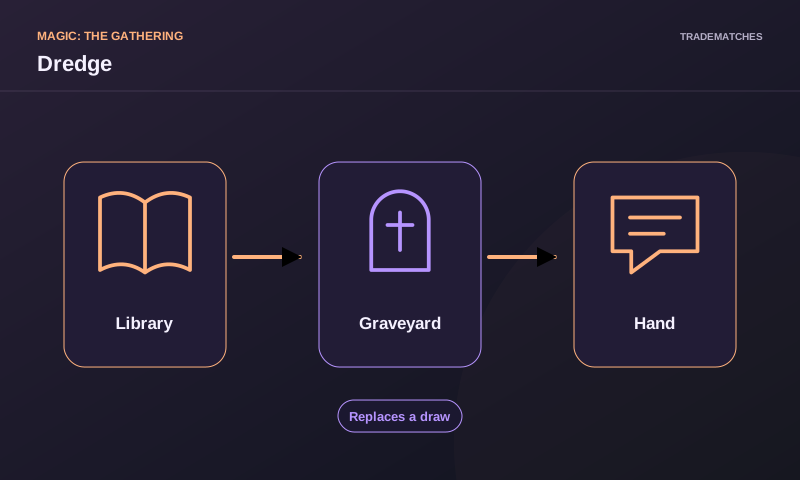
Dredge replaces one card draw with milling the stated number of cards and returning that dredge card from your graveyard to your hand. It is optional and requires enough cards in your library to mill the full number. It does not add a card draw after the replacement, and it is not an activated ability you can use whenever you want.
Find a draw that has not happened yet
Dredge is a replacement effect available while the relevant card is in your graveyard. Its number sets the milling requirement. If you choose to replace a draw with dredge 3, you mill three and return the chosen card to hand instead of drawing the library's top card. You do not inspect that top card first and then decide that you would prefer dredge.
Under Magic's rules, drawing several cards is performed as individual draws. A hypothetical instruction to draw three therefore creates separate replacement opportunities. You make the dredge decision as each draw would occur, using the game state then. A single dredge does not replace the entire three-card instruction.
Imagine a card with dredge 3 in your graveyard and a spell instructing you to draw two. You can replace the first draw with that card's dredge. It is now in your hand, so it cannot provide a graveyard replacement for the second draw. A different available dredge card, including one milled during the first replacement, may provide a later choice if all requirements are met.
Count the library before choosing
The milling requirement must be payable in full. A library with two cards does not support dredge 3. You cannot mill two, return the dredge card, and describe that as completing the instruction as far as possible. The eligibility of this replacement has a specific library-size check.
| Library before the draw | Available card | Can that dredge replace the draw? | Library after a successful replacement |
|---|---|---|---|
| 12 cards | Dredge 3 | Yes | 9 cards |
| 3 cards | Dredge 3 | Yes | 0 cards |
| 2 cards | Dredge 3 | No | Replacement unavailable |
| 0 cards | Dredge 1 | No | Replacement unavailable |
These examples exclude other replacement effects and assume the card is still in the graveyard. Having exactly enough cards can allow the replacement to empty the library without performing the replaced draw. It does not protect you from a future required draw from an empty library.
For practice, start with eight cards and two graveyard cards, each with dredge 3. Replacing the first draw leaves five cards. Replacing the second with the other graveyard card leaves two. A third dredge 3 would be unavailable unless another effect had changed the library. Writing the remaining count after each event avoids treating a multi-draw instruction as one payment.
Milling and drawing are different events
A successfully replaced draw does not happen. An ability that needs you to draw a card cannot count the milled cards as draws. An ability concerned with cards entering the graveyard needs its own qualifying conditions checked. Those events are not interchangeable just because cards moved out of the library.
Likewise, returning the dredge card from the graveyard to your hand is not drawing it. A spell or ability can move a card to hand without creating a draw event. The result may still increase your hand size, but trigger conditions depend on the procedure rather than the final number of cards you hold.
Suppose you have four cards in hand, replace one draw by dredging, and return the selected card. You finish with five cards in hand, just as an ordinary draw would produce. That equal hand-size change does not mean both routes satisfy the same “when you draw” condition. Track the action words rather than inferring the event from the count.
Dredge does not open a response window inside a resolution
If a spell is resolving and instructs you to draw, choosing a dredge replacement is part of processing that instruction. Players do not receive a new priority window between the milling and returning the selected dredge card merely because several physical cards move.
An opponent may have a chance to remove the relevant graveyard card before the draw-producing spell or ability resolves. If the card is no longer in the graveyard when the draw would happen, its dredge replacement is unavailable there. That is a question about timing before resolution, not permission to interrupt a chosen replacement mid-process.
This matters when practising with graveyard interaction. Say exactly when you want to act: before a draw spell resolves, during an earlier priority window, or after the resolved spell. “In response to dredge” usually fails to identify a legal window because dredge itself is not an activation placed on the stack.
Decide what the replacement is supposed to achieve
A draw gives you an unknown card from the library. Dredge gives you the known graveyard card while putting other library cards into the graveyard. Whether that helps depends on the deck's actual use of those zones. The mechanic is not automatically superior because it mills more cards or feels like additional resources.
Consider an original practice exercise. You need one specific answer from your library next turn. Your available dredge card does not answer the problem. Dredging returns a known card but can mill the answer you hoped to draw. If the deck can later use that answer from the graveyard, that may be acceptable. If it cannot, the same movement has a different practical cost.
In another scenario, your graveyard card is the exact tool you need and your library still comfortably meets the requirement. Replacing the unknown draw may provide certainty about that one card. The benefit comes from the known return, not a guarantee that the milled cards will be useful. Keep those two reasons separate when comparing decisions.
Record multi-draw decisions with a short ledger
Use a four-column practice sheet: draw number, chosen replacement, remaining library, card returned. For a three-draw instruction, fill one row at a time. If the first milling reveals a new dredge card, add it to the available graveyard choices for subsequent rows only after it is actually there.
This ledger also helps review mistakes. “I dredged three times” is insufficient if the same card remained in hand after the first replacement or the library became too small. The sheet forces you to account for locations and counts without inventing a shortcut. It is an instructional tool, not a suggestion to maintain unauthorised notes during a tournament; event note policies apply separately.
Frequently asked questions
Can I dredge with fewer library cards than its number?
No. That replacement requires at least the stated number of cards in the library. You cannot choose it and mill a smaller amount instead.
Can a card milled by one dredge replace the next draw?
Potentially yes, if it is now in the graveyard, has dredge and its requirements are met when the next individual draw would occur. Evaluate each draw separately.
Does returning the dredge card count as drawing it?
No. The draw was replaced. Milling and returning the chosen graveyard card are the replacement's actions, not extra card draws.