Magic ninjutsu versus sneak: entering versus casting
On this page
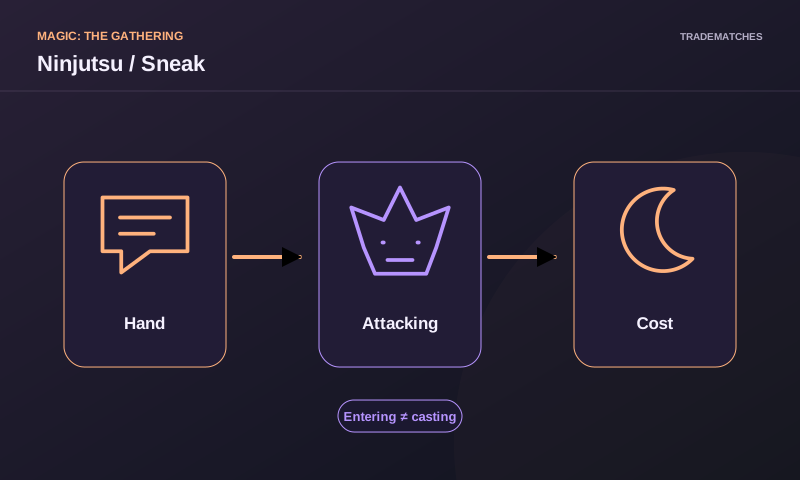
Ninjutsu is an activated ability that puts a card from your hand onto the battlefield tapped and attacking. Sneak is an alternative way to cast a spell during your declare blockers step, returning an unblocked creature as part of its cost. Both can replace an attacker, but only sneak casts the card, and their legal timing is different.
The comparison below uses Magic's Comprehensive Rules effective September 25, 2026. Older explanations can use different rule numbers or omit the combat clarifications introduced alongside Teenage Mutant Ninja Turtles.
Wait until an attacker is actually unblocked
An attacker is not an unblocked creature simply because the defending player has not chosen blockers yet. That status is established during the declare blockers procedure. The defender must have the opportunity to declare legal blocks before you use a cost that requires an unblocked attacker.
Suppose you attack with a small creature and immediately announce ninjutsu before the defender decides what to block. The required unblocked status has not yet been established. Pause the action and move through the proper combat step. “It probably will not be blocked” is a prediction, not a rules condition.
Once blockers have been declared, identify which attackers are unblocked and who or what they are attacking. That information is relevant both to paying the return cost and to determining the destination of the replacement creature's attack.
Ninjutsu uses an ability on the stack
To activate ordinary ninjutsu, reveal the appropriate card from your hand, pay its stated cost and return an unblocked attacking creature you control to its owner's hand. The ability then waits on the stack. On resolution, it puts the ninjutsu card onto the battlefield tapped and attacking.
Returning the attacker is part of the cost. It happens before opponents can respond to the activated ability. An opponent cannot retroactively destroy that returned attacker on the battlefield to stop a cost already paid. They may still have a legal response to the ability itself or to the resulting creature later.
The card remains revealed until the ability leaves the stack. Keep it visible rather than mixing it back into your hand while everyone considers responses. This allows the defending player to read the actual cost and instructions being used.
Sneak casts a spell using an alternative cost
Sneak permits casting at instant timing during your declare blockers step. You pay the sneak cost and return an unblocked creature you control rather than paying the spell's mana cost. The resulting object on the stack is a spell, not a ninjutsu activated ability.
Follow the normal casting procedure, including choosing targets when required, determining the total cost and paying applicable additional costs. An alternative cost does not erase a separate cost increase, and you cannot combine two different alternative costs for the same casting merely because both are available.
For a creature spell, the sneak permission changes the timing that would normally restrict you to your own main phase with an empty stack. For an instant or sorcery with sneak, follow that spell's instructions; it does not become an attacking creature just because its alternative cost returned one.
The timing windows are not interchangeable
Sneak's permission specifically applies during your declare blockers step. It does not extend into combat damage or end of combat merely because an attacker remains unblocked. Ordinary ninjutsu can be activated in later parts of combat while its required unblocked attacking creature still exists and you have priority.
This can matter after combat damage. If an unblocked attacker has already dealt its damage, ninjutsu may still return it in an appropriate priority window. A creature that enters afterward normally does not deal another round of ordinary combat damage that has already happened.
First strike and double strike can create more complicated damage-step sequences. Establish which step you are in and whether a later damage step remains. Do not generalize “ninjutsu after damage” into “every incoming Ninja gets another hit.” Sneak's narrower casting window avoids assuming that these later opportunities also apply to it.
| Question | Ninjutsu | Sneak |
|---|---|---|
| What goes on the stack? | An activated ability | A spell |
| Is the incoming card cast? | No | Yes |
| Where is ordinary use available? | The card's owner's hand | Wherever casting permissions allow |
| Is use limited to declare blockers? | Not in the same way | Yes, for the sneak permission |
| What is returned as a cost? | An unblocked attacking creature you control | An unblocked creature you control |
| Does a creature arrive attacking? | Yes | Yes, if the permanent is a creature |
Different responses can stop the two procedures
An effect that counters a creature spell can interact with a creature cast using sneak if its conditions are met. Ordinary ninjutsu is not a creature spell, so “counter target creature spell” does not counter that activated ability. An effect that can counter an activated ability may be relevant instead.
This is not a claim that ninjutsu makes the resulting creature invulnerable. After it enters, opponents may use legal removal in the next appropriate priority window. The distinction concerns what object was on the stack during the initial procedure.
Similarly, abilities that trigger when you cast a spell see sneak casting, subject to their exact conditions. They do not trigger merely because ninjutsu put a creature onto the battlefield. Enter-the-battlefield abilities may apply to either arrival, while “whenever this attacks” requires examining whether the creature was actually declared as an attacker.
Entering attacking does not mean being declared as an attacker
The incoming creature is already attacking when it arrives. You do not repeat the declare attackers step, and the defender does not receive a new ordinary declaration of blockers simply because the attacker changed. Read any effects that can still alter combat separately.
This also explains why ordinary summoning sickness is not a barrier to the immediate attacking status created by the effect. The creature is not being declared as an attacker through the usual turn-based action. That does not grant it every activated ability with a tap symbol afterward; those permissions have their own requirements.
If a creature has an ability triggered by being declared as an attacker, entering attacking does not automatically trigger it. By contrast, an ability that triggers on dealing combat damage may still trigger if the incoming creature legally deals that damage later in the combat.
Preserve the attack's destination
Under the current rules, the creature arriving through ninjutsu attacks the same player, planeswalker or battle as the creature returned to pay the cost. Sneak's attacking permanent follows the same destination relationship. Do not redirect an attack from a planeswalker to its controller simply because you changed creatures.
In multiplayer, this is particularly useful to announce. Point to the returned attacker and identify its destination before moving it. A vague “replace this with my Ninja” can conceal whether the table remembers which opponent was being attacked.
If that destination has left the game or stopped being a legal attacked object before resolution, consult the combat rules for the resulting state. The mechanic does not provide a general permission to select a new opponent whenever the original destination becomes inconvenient.
Commander ninjutsu is a named exception
Ordinary ninjutsu functions from the hand. Commander ninjutsu expressly adds the command zone as a place from which its ability works. A commander with ordinary ninjutsu does not gain that extra permission just because it is your commander.
Commander tax applies to casting a commander from the command zone. Using commander ninjutsu is activating an ability, so the ordinary casting-tax calculation is not attached to that activation. If you later cast the commander instead, use the actual number of previous command-zone castings rather than counting every arrival through an ability.
This distinction is worth recording when teaching a commander deck. Label the action as “activate commander ninjutsu” or “cast the commander.” A generic “play my commander” can leave the table with incompatible expectations about both tax and responses.
Plan the exchange of creatures deliberately
Returning an attacker may protect it from an anticipated effect or let you reuse an entering ability later, but it also removes that creature's current battlefield presence. Consider whether the replacement's benefit justifies the cost and whether you can afford to redeploy the returned creature.
For example, replacing a small utility creature before damage may improve a hit, while returning an expensive attacker after damage may preserve it for another turn. Neither option is automatically best. The correct choice depends on the legal window, available mana, possible responses and the incoming card's specific text.
When buying cards for the plan, search for the actual printed keyword. Sneak cards and ninjutsu cards can support different cast triggers, response interactions and timing sequences. Similar artwork or an association with Ninjas does not make one a functional substitute for the other.
Frequently asked questions
Can I use ninjutsu before blockers are declared?
Not by assuming an attacker will be unblocked. You need an actual unblocked attacking creature to return, established through the combat procedure or another applicable effect.
Does a counterspell stop ninjutsu?
Check what the counterspell can counter. Ordinary ninjutsu puts an activated ability on the stack, not a creature spell. A response must be legal for that object; removal after the creature enters is a separate option.
Can I use sneak after ordinary combat damage?
The sneak casting permission is limited to your declare blockers step. It does not share every later combat window that can remain available to ninjutsu.