Planeswalker loyalty abilities in Magic
On this page
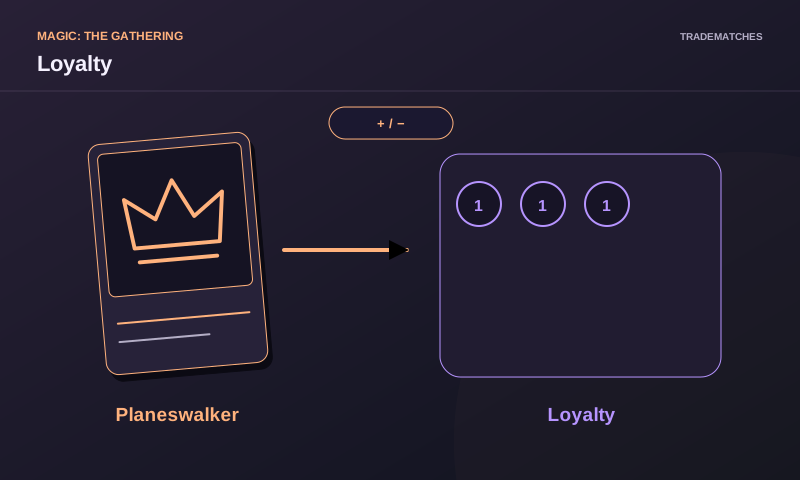
A Planeswalker enters the battlefield with as many loyalty counters as indicated by the number printed in the bottom-right corner. To activate one of its loyalty abilities, you must be in a main phase of your own turn, have priority, and have an empty stack. Only one loyalty ability of that permanent can be activated per turn, unless an effect explicitly changes this rule. The +, −, or 0 symbol next to the ability is part of its cost: it adds, removes, or does nothing to loyalty counters when activated, before your opponent can respond. Understanding the order prevents three common mistakes: using two abilities in the same turn, paying a −4 with only three counters, and thinking your opponent can prevent the payment by responding afterward.
Printed Loyalty and Counters in Play
The number in the corner of a Planeswalker indicates its loyalty outside of the battlefield and how many counters it receives upon entering, unless other effects modify entry. Once in play, its loyalty equals the number of loyalty counters it currently holds, not the printed number. If it enters with four and you activate a +1 ability, its loyalty becomes five; if it takes two damage afterward, two counters are removed and it drops to three. Check the physical counters or the table's record to know its current loyalty. The printed number indicates the starting point, not a maximum cap that prevents it from increasing beyond that value.
Loyalty counters are not life points of the player nor +1/+1 counters of a creature. They are placed on the Planeswalker and removed by damage taken or by loyalty ability costs. Any effect that adds counters of a certain type must specifically name them or indicate it through applicable rules. On a table with multiple Planeswalkers, use distinguishable dice or markers for each one and announce the number after every change. If an opponent attacks the Planeswalker, do not directly reduce the controller's life points for that damage unless otherwise instructed.
When Can You Activate an Ability?
Rule 606.3 of the current rules requires four simultaneous conditions: you control the permanent, it is a main phase of your turn, you have priority, and the stack is empty. This is the same general moment when you could cast a spell, but the ability remains an activated ability with its own costs. You can use it during either the first or second main phase if the conditions are met. You cannot normally activate it on your opponent's turn, during combat, in response to a spell on the stack, or while another ability is waiting to resolve. Some exceptional effects change these limits; they must explicitly state such changes.
A Planeswalker can activate a loyalty ability on the turn it enters the battlefield, if the legal moment has arrived. The "summoning shock" limits certain creature actions, but does not impose a general wait on Planeswalker loyalty abilities. If you cast it during your main phase and the spell resolves with an empty stack, you usually have the opportunity to activate a loyalty ability before moving to another action, as long as you retain priority at the appropriate moment. If it enters during combat due to an effect, you might need to wait until a main phase of your own with an empty stack.
One Per Permanent, Not One Per Player
The limit refers to that permanent: if you have already activated one of its loyalty abilities this turn, you cannot activate another loyalty ability of that same permanent during the same turn under normal rules. It does not matter whether one is +1 and the other −2, nor whether the first was countered after activation. The activation history is checked for the permanent. If you control two different Planeswalkers, each can activate one legal ability during your turn. The limit is not "only one Planeswalker ability on the entire board."
Example: you control a Planeswalker A and a Planeswalker B. During your first main phase, you activate the +1 of A and it resolves. You can later activate the −1 of B if you have priority, the stack is empty, and B has sufficient counters. You cannot go back to A to use its 0 simply because the phase changed or because your opponent did something in between. If A leaves the battlefield and later returns as a new object, the object's identity rules may change the evaluation; analyze that specific interaction and any effect that allows additional activations rather than assuming all cards with the same name share activation history.
The +, −, and 0 Symbols Are Costs
An ability "1: effect" requires placing a loyalty counter on the permanent when activated. A "−2: effect" requires removing two. A "0: effect" does not change counters for that symbol, but does consume the normal loyalty activation of that permanent for the turn. The cost is paid during activation, before the ability becomes available for opponents to respond. Therefore, if you activate a +1 on a Planeswalker with three counters, it will have four when your opponent can normally respond. You do not wait for the ability to resolve to add that counter.
If you activate a −3 with exactly three counters, you pay the three and the Planeswalker drops to zero. A state-based action will place it in its controller's graveyard when appropriate, before the ability resolves. This does not automatically cancel the already-activated ability: it remains on the stack and can resolve if its requirements, such as legal targets, continue to be met. This sequence explains why a "ultimate" that leaves the Planeswalker with zero counters can still produce its effect even if the card leaves the battlefield. Do not confuse the permanence of the source with the permanence of the ability on the stack.
How Many Counters Do You Need for a Negative Cost?
To activate a −N ability, the Planeswalker must have at least N counters available at the time of activation, considering any cost modifications. You cannot announce a −4 if it only has three counters and promise a later effect will add the fourth. The payment is part of activation and must be possible at that moment. A +N cost, on the other hand, adds counters; it does not require the Planeswalker to already have N to "support" it. A 0 ability also does not require counters to pay its symbol, although the existence of a permanent with zero loyalty may be affected by state-based actions.
Example: a Planeswalker has five counters and abilities +1, −3, and −6. You can activate +1 and increase to six; you cannot activate −6 afterward in the same turn due to the one-ability-per-permanent limit, even though you now have six. On your next turn, if it remains in play with six and all other conditions are met, you could choose to activate −6 and remove them as cost. This example separates "having sufficient counters" from "not having activated another ability of the same permanent this turn." Both checks are necessary.
What Can Your Opponent Do in Response?
A loyalty ability activated uses the stack, except for a specific exception. After announcing it and paying its cost, your opponent can respond with instants or allowed abilities. If the Planeswalker is killed or exiled at that point, the ability remains on the stack; removing the source does not undo the activation. It may fail due to losing all legal targets or some other specific reason, but not due to a general rule of "if the Planeswalker leaves, its ability disappears." It is useful to announce the ability's target, if any, and show the counters paid before giving up priority.
Your opponent also cannot interrupt the payment mid-process to reduce loyalty and make a previously legally activated ability illegal. They can act before you have priority to activate it, or respond when the ability is on the stack after payment. The difference is decisive if a Planeswalker enters with exactly the amount needed for a negative ability: once you have priority and legally choose to activate it, the cost is paid as part of the process. For damage or prevention interactions during that window, consult the priority rules and the specific card.
Damage to the Planeswalker and Zero Loyalty
A Planeswalker can be attacked. When it takes damage, that number of loyalty counters is removed. If its loyalty reaches zero, it is placed in its controller's graveyard as a state-based action. You do not need an effect to say "destroy" for it to leave the battlefield. Also, damage-related counter loss does not equate to paying a loyalty ability cost: these are different causes that can occur at different times. If an attack deals more damage than the remaining counters, do not automatically transfer the excess to the controller; resolve combat and specific rules if applicable.
Suppose a Planeswalker has four counters. An attack deals two damage: it now has two. On your next main turn, you could activate a −2 ability if the moment is legal, pay both counters, and leave it at zero. If instead, it takes two more damage before that moment arrives, it reaches zero due to damage and is sent to the graveyard. The difference affects which ability, if any, remains on the stack. Keeping counters updated after each damage is essential to avoid announcing an impossible activation.
Loyalty and Legend Rules Are Separate Questions
Planeswalkers are legendary, and the legend rule may require you to choose between two legendary permanents under your control with the same name. That choice is not automatically decided by who has more loyalty; you choose which one to keep. Two versions of the same character with different full names can coexist. Each permanent maintains its own loyalty activation history and counters. If a new copy enters with fresh counters and you must choose between it and the original, you can evaluate which suits you, but you cannot merge counters or transfer activation from one to the other.
In physical games with multiple versions of a character, read name and loyalty separately. The name determines whether there is a legend rule conflict; current counters determine which negative abilities each copy can pay. Neither the Planeswalker subtype nor the illustration replaces these two checks. A player might mistakenly remove a copy because it shares the same character in art, even if the name differs, or keep it and assume its counters increase due to another entry. The rules do not make any such transfers.
Quick Check Before Activating
Read the symbol and target of the ability; confirm you control the Planeswalker, you're in your main phase, you have priority, and the stack is empty; verify that no loyalty ability of that permanent has already been activated this turn; and ensure you can pay any negative counters. Announce the ability, choose legal targets, and pay the cost. Allow opponents to respond when appropriate. If the Planeswalker reaches zero, place the card in the graveyard at the moment marked by the state-based action and retain the ability on the stack to resolve or counter it based on its targets.
This list also helps when building or trading for a Planeswalker. A powerful −6 ability is not necessarily usable immediately if the card enters with three counters and only increases by one at a time. A +1 ability may protect the Planeswalker by increasing loyalty as part of the cost, but its effect could still be countered. Compare the initial number, first-turn options, exposure to attacks, and the card's actual role in your deck. The most spectacular ability in the text does not necessarily represent what the card will do in a typical game.
Frequently Asked Questions
Can I activate an ability on the turn the Planeswalker enters?
Yes, if during your main phase you have priority, the stack is empty, and the cost and conditions are met. There is no general one-turn wait for loyalty.
Can I use the +1 and then the −1 of the same Planeswalker?
No, by normal rules. Only one loyalty ability of that permanent can be activated per turn, even if the +1 left sufficient counters.
Does the ability disappear if the Planeswalker reaches zero when paying it?
No automatically. The already-activated ability remains on the stack; the Planeswalker moves to its controller's graveyard due to zero loyalty, and the ability resolves afterward if its requirements, such as legal targets, continue to be met.