Magic sacrifice versus destroy: what prevents each
On this page
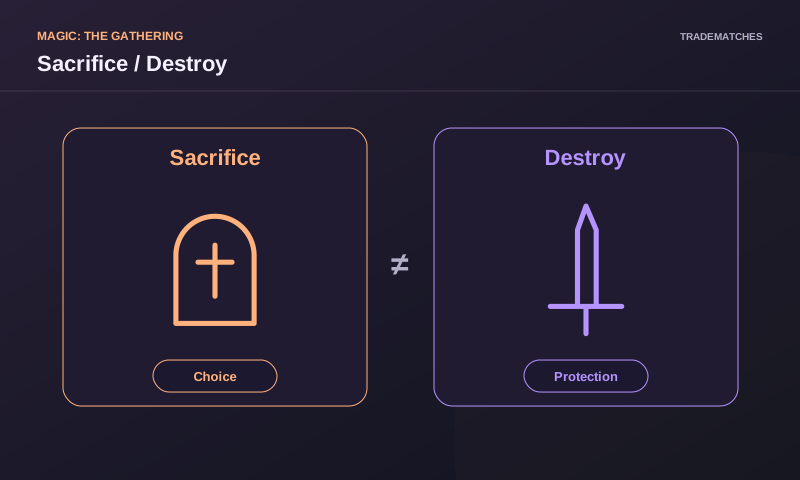
Indestructible does not stop a sacrifice. Destroying a permanent and sacrificing one are different actions in Magic. A sacrifice moves a permanent you control to its owner's graveyard; it is not destruction. Read whether the instruction is a cost, an effect, or a player being told to choose before deciding what can respond to it.
Separate the action from the destination
Several actions can end with a creature card in a graveyard. A destroy effect, lethal damage on a creature without indestructible, a sacrifice and zero toughness can have that destination, but they do not use the same procedure. Protection that stops one procedure does not necessarily stop another.
The comprehensive rules define destroy and sacrifice separately. They also define a creature dying as moving from the battlefield to a graveyard. This means a sacrificed creature can die even though it was not destroyed. Conversely, exiling a creature normally does not make it die, because the destination is different.
An indestructible creature can survive a destroy instruction and lethal damage, but that ability does not prevent its controller from sacrificing it. It also does not keep a creature with zero or less toughness on the battlefield. Check what caused the departure rather than concluding that indestructible means “cannot leave.”
| Procedure | Does indestructible itself stop it? | Main check |
|---|---|---|
| Destroy the permanent | Yes, if it is currently indestructible | Is this actually destruction? |
| Sacrifice the permanent | No | Does the choosing player control it? |
| Exile the permanent | No | Is the selection legal? |
| Return it to hand | No | What permanent and owner does the instruction specify? |
| Creature has zero toughness | No | Current toughness, after applicable effects |
You can sacrifice only what you control
Suppose you control an opponent's creature because a temporary effect gave you control of it. You may be able to sacrifice it to an ability whose cost permits that creature. You control it now, although its owner has not changed. It goes to its owner's graveyard, not yours.
Reverse the situation. A creature you own is currently controlled by another player. You cannot use it to pay your own sacrifice cost merely because it came from your deck. Ownership answers where the card belongs; control answers whether it is available to your sacrifice instruction. Check any additional requirements such as creature type, tapped status or being another permanent.
A hypothetical cost saying “sacrifice another creature” cannot be paid with the source creature itself. A cost saying “sacrifice an artifact” cannot be paid with a creature lacking the artifact type. Neither case is fixed by the creature being indestructible or valuable. Eligibility comes before the physical act of putting anything in the graveyard.
A cost is paid before anyone responds
Consider a hypothetical activated ability with “sacrifice a creature” before its colon and an effect after the colon. The sacrifice is part of paying the activation cost. Once the ability is legally activated, the sacrificed creature has already left. An opponent cannot respond by destroying that same creature to stop you paying a cost that is complete.
The opponent may respond to the ability if the rules permit, and may be able to counter it or change whether its effect works. Countering the ability does not normally return the paid sacrifice. This is why saying “I respond to the sacrifice” is ambiguous: are you discussing a cost already paid, a spell still waiting to resolve, or a separate triggered ability?
Imagine you activate an ability, sacrificing a token creature as its cost. Your opponent counters the ability with an appropriate response. You lose the token and the ability's effect does not happen. The cost and result are separate parts of the transaction. Only a specific applicable rule or effect would change that outcome.
An effect can give the player a later choice
A spell that tells a player to sacrifice a creature makes that choice during the relevant resolution. Until then, the board might change. If the instruction is “target player sacrifices a creature,” the target is the player. The creature chosen to sacrifice is not automatically targeted by that spell.
This distinction explains why a creature's hexproof does not necessarily protect it against an instruction addressed to its controller. The exact target and any restrictions still matter. A player with protection from being targeted may produce a different interaction from a creature with hexproof. Do not treat all sacrifices as universally untargeted: read the spell or ability's actual targeting language.
For a teaching example, a player controls one indestructible creature and one ordinary token when told to sacrifice a creature. If either meets the instruction, the player can choose the token. If the token leaves before resolution and only the indestructible creature remains, indestructible alone does not excuse sacrificing the remaining eligible creature. A restriction specifying a particular subset might change those choices.
Death triggers and replacement effects
A creature sacrificed from the battlefield to a graveyard can satisfy a “dies” trigger. The trigger is not the sacrifice cost itself; it is generated by the qualifying event. Handle its placement on the stack and ordering through the normal triggered-ability procedure after the activation or spell has been processed as applicable.
Now imagine an applicable replacement effect that sends a creature to exile instead of a graveyard. The creature may still have been sacrificed, but it did not die if the actual movement was battlefield to exile. A “whenever you sacrifice” condition and a “whenever a creature dies” condition ask different questions.
Tokens can also die if they make the relevant movement, even though they subsequently cease to exist. Their later disappearance does not erase the preceding event. In a practice game, write two labels beside the event: “action performed” and “actual destination.” That record makes it much easier to distinguish triggers than grouping every departed creature under “destroyed.”
Compare removal cards by the choice they create
A targeted destroy spell may let you choose exactly which opposing creature to remove, but indestructible can stop destruction. A sacrifice instruction may bypass that particular protection while giving the opponent a choice of expendable creatures. Neither description makes one card always superior. The opponent's board and the exact restrictions determine how reliable the effect is.
For example, a sacrifice effect directed at a player with four small tokens might remove one token instead of the important creature. An effect with a narrower eligible category can change that choice. When planning a trade for removal spells, record the practical role you need: precise target selection, a way around indestructible, or a sacrifice outlet for your own board. Those are different deck requirements.
Frequently asked questions
Can I regenerate a creature instead of sacrificing it?
No. A regeneration replacement applies to destruction, not a sacrifice. A regeneration shield does not change the eligibility or payment of a sacrifice instruction.
Can I sacrifice an opponent's creature?
Only if you currently control it and it meets the instruction's requirements. Ownership alone does not prevent a controlled creature from being sacrificed; its card goes to the owner's appropriate zone.
Does countering the ability refund its sacrificed creature?
Normally no. If sacrifice was a cost, it was already paid when the ability was activated. Countering the effect does not undo that payment.