Magic suspend: counters and casting from exile
On this page
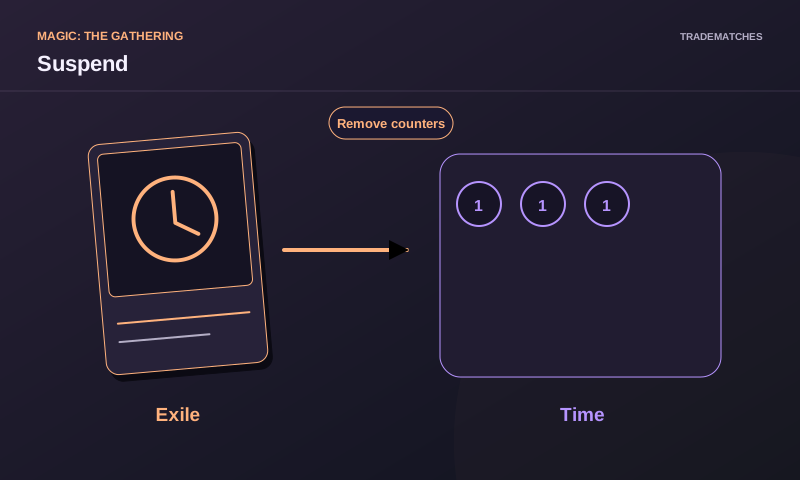
Suspend lets you pay a card's suspend cost to exile it from your hand with time counters. At the beginning of your upkeep, its suspend ability removes a counter. When the last counter is removed, another triggered ability lets you play it without paying its mana cost if you can. Under the current rules, you may decline.
The sequence contains several distinct events. Exiling through suspend is not casting the spell, removing a counter is not resolving that spell, and the final triggered ability can involve choices and additional costs. Track each stage rather than moving the card directly from a waiting pile onto the battlefield.
Suspend is an alternative waiting procedure
Read the suspend number and cost printed on the card. The number determines its initial time counters through that suspend procedure; the cost is what you pay to begin waiting. It is not necessarily the card's normal mana cost, and paying it does not put the card onto the stack as a spell.
The permission to suspend from your hand depends on whether you could begin casting that card in the relevant circumstances. The rules have specific checks for that permission. You cannot generally suspend any card from any zone merely because you can afford the displayed cost.
Once suspended, place the card face up in exile with clearly visible time counters. Keep it apart from other exiled cards that have different permissions, such as Adventures or cards temporarily exiled by a permanent. Sharing the exile zone does not mean they all use the same route back into the game.
The upkeep ability removes a counter
At the beginning of your upkeep, the relevant suspend ability triggers for a suspended card you own. That ability uses the stack. Players can respond before it resolves, and removing the counter happens through its resolution rather than as an automatic physical adjustment before anyone can act.
Imagine a card with three time counters. On its first relevant upkeep, the triggered ability resolves and leaves two. On the next it leaves one. On the following one, removing the last counter produces the separate final-counter trigger. This ordinary timeline assumes no other effect changes the counters.
Other spells and abilities can add or remove time counters when their wording permits it. A card can therefore reach its last counter sooner or later than the ordinary upkeep schedule. Record the actual counters remaining instead of assuming that a suspend number is an unavoidable fixed number of turns.
Removing the last counter creates another trigger
The final-counter ability triggers when the last time counter is removed from a suspended card. It is distinct from the upkeep ability that might have removed that counter. There is a new stack object to resolve before the card is cast, so players can act during the appropriate priority window.
If an effect removes the last counter during another player's turn, that can still trigger the casting instruction. The ordinary type-based timing of a sorcery is not the same as permission to cast through the resolution of this ability. Read any other restriction that could prevent the casting, however.
This separation helps explain why “the counter disappeared, so the spell has already resolved” is incorrect. The casting instruction must resolve, the card must be legally cast, and the resulting spell still needs to resolve through the stack. Opponents have opportunities appropriate to each stage.
| Stage | What is happening | What is not yet happening |
|---|---|---|
| Pay suspend cost | Card is exiled with time counters | The card is not being cast as a spell |
| Upkeep ability resolves | A time counter is removed | The waiting spell is not resolving |
| Last-counter ability resolves | Card is cast if possible | Its effect has not resolved yet |
| Spell resolves | Follow the spell's instructions | This is no longer the suspend payment |
Playing the card is optional under the current rules
The final-counter instruction gives you a choice under the current rules. You may play the card if able, or decline. Older explanations describing a compulsory casting are out of date. If you choose to cast, you still make legal choices, including modes and targets, and comply with applicable restrictions.
If you decline or playing is impossible, the card remains in exile. With no time counters left, it is no longer suspended in the rules sense, so the normal suspend upkeep ability will not keep trying to cast it every turn. A different effect would need to supply a suitable new permission or restore the relevant suspended state.
This is particularly important for a targeted spell with no legal targets at the crucial moment. You do not choose an illegal target just to complete the schedule, and you do not silently return the card to your hand. Check why casting cannot occur and leave the card in the zone required by the rules.
Without paying mana cost still has limits
Casting without paying the mana cost provides an alternative cost for that spell. It does not erase mandatory additional costs, casting restrictions or requirements for legal targets. You cannot combine that alternative cost with another alternative cost merely because its effect would be convenient.
Optional additional costs can still matter when the rules permit them. If you choose one, account for its payment before the spell is cast. Distinguish these choices from the original suspend payment, which occurred earlier and does not create a reserve of mana to use on the later casting.
For a hypothetical spell requiring a mandatory discard in addition to its mana cost, a free casting instruction does not automatically supply a card to discard. If you cannot pay the required additional cost, you cannot cast the spell that way. Announce the actual obstacle rather than saying the spell “costs nothing” in every respect.
X and cards with no mana cost
When you cast a spell without paying its mana cost and that cost contains X, the normal choice for X is zero unless another rule or effect specifies otherwise. Suspend is not a permission to choose an arbitrarily large X while paying no mana. Check whether X appears in the mana cost or somewhere else.
Some well-known suspend cards have no printed mana cost at all. That differs from having a printed cost of zero. You cannot normally pay a nonexistent mana cost, but an appropriate alternative casting permission can allow the spell to be cast. The precise permission, not the blank corner alone, makes the play possible.
For buying or deck building, do not assume that every blank-cost card can simply be played for free from your hand. Write down how your deck intends to access it: suspend, another alternative permission or a different legal mechanism. That check can expose an attractive combination that never had a valid casting route.
Suspended creatures and haste
A creature cast through the final suspend ability gains haste through the relevant suspend rules until the specified control condition ends. This can let the resulting creature act sooner than one ordinarily cast that turn. It does not make the creature immune to removal or give it unlimited attacks.
The haste belongs to the creature resulting from the suspend casting. If that creature is blinked and returns as a new object, do not automatically carry the granted haste over to its replacement. An independent printed haste ability would be a different reason for the returned creature to have haste.
Also distinguish haste from readiness. A creature entering tapped cannot attack merely because it has haste. A restriction saying it cannot attack still matters. Suspend supplies a particular exception to the control-duration restriction, not a general override of every condition attached to attacking.
Announce the waiting card clearly
During a game, announce the card, the suspend payment and the initial counter count. At each upkeep, put the triggered ability on the stack clearly before changing counters. If several suspended cards trigger together, identify which ability belongs to which card and choose the relevant ordering.
For practice, use a written timeline with a separate line for each stack event. Test an accelerated last counter, a countered upkeep ability and a situation with no legal target. These cases teach more than repeatedly running the ordinary three-upkeep sequence because they reveal where the casting permission actually comes from.
Frequently asked questions
Can I counter the act of suspending with an ordinary spell counter?
Suspending from hand is not casting that card as a spell. An ordinary effect that counters a spell does not apply to that initial action. Later triggered abilities and the eventual spell have their own response opportunities.
May I leave the card waiting after its last counter disappears?
You may decline to play it when the final-counter ability resolves. It remains in exile without time counters, just as it does when playing is impossible. Suspend does not automatically retry on every later upkeep, so declining does not reserve a freely reusable permission for another turn.
Can the last counter be removed on an opponent's turn?
Yes, through a suitable effect. The last-counter ability can then provide permission to cast during its resolution. Check other casting restrictions and costs rather than applying only the usual timing for that card type.