Confusion in Pokémon TCG and the attack coin flip
On this page
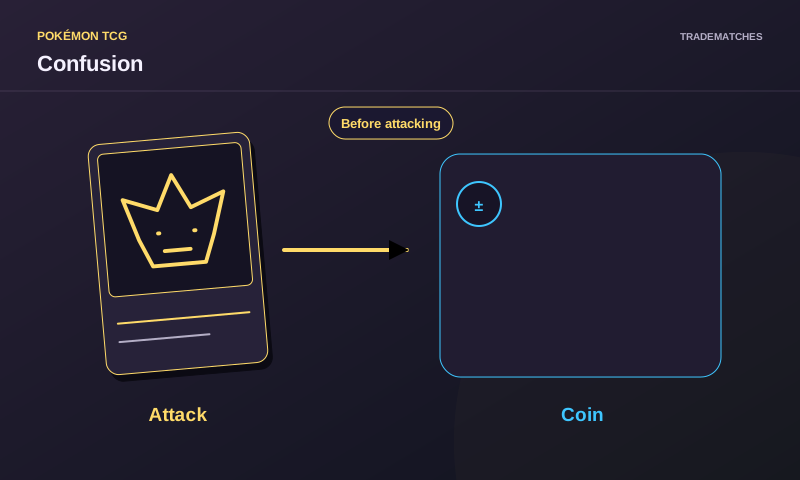
A Confused Pokémon may attempt to attack, but you must flip a coin first. Heads lets the attack proceed normally. Tails stops the attack and puts three damage counters on your own Pokémon. Passing that check does not remove Confusion, and the condition does not automatically expire at the end of your turn.
Recognising a Confused Pokémon
Confusion is a Special Condition affecting the Active Pokémon. Show it by turning the Pokémon upside down, with the top of the card pointing towards you. Keep its attached Energy and existing damage counters easy to see. The orientation records a condition; it does not change the Pokémon's HP, printed attacks or Energy requirements.
The official Pokémon rulebook explains five Special Conditions and the separate check for Confusion. Their consequences differ. A Confused Pokémon can attempt an attack, whereas an Asleep or Paralyzed Pokémon cannot attack while that condition applies. Recovery rules for one condition should not be borrowed for another.
An attack or another card effect can cause Confusion if its text says so. For example, Mind Bend on Munkidori from Twilight Masquerade makes the opponent's Active Pokémon Confused. On the next turn, assess the condition actually applied alongside any other effects still affecting that Pokémon. The name of the attack alone is not enough to reconstruct the situation.
When to make the attack coin flip
Carry out your turn's other legal actions before attempting the attack. You may attach Energy, play permitted Trainer cards, use available Abilities or arrange a switch if your cards allow it. Do not flip for Confusion at the start of the turn and then decide whether the result makes attacking attractive. The check belongs to the attack attempt.
First make sure the chosen attack is legal. You need its Energy requirements and must satisfy any applicable restrictions. Confusion does not let you test a coin flip for an attack you could not use. Announce the attack, then deal with the Confusion check before resolving the attack's damage and instructions.
On heads, continue with the announced attack. Follow its text, make any additional flips it requires and calculate its damage in the usual way. On tails, stop that attack and put three damage counters on the attacking Pokémon. You cannot choose a different attack or retry the first one because the check was unsuccessful.
Your turn ends after the attack attempt, followed by the relevant Pokémon Checkup. This makes sequencing important. If you intended to play a switching card, use the opportunity before declaring the attack. Finding that card in your hand after tails does not create permission to return to the earlier part of your turn and try again.
Three damage counters are not a 30-damage attack
Each damage counter represents ten damage, so three counters add thirty damage to the amount already recorded on the Pokémon. However, Confusion instructs you to place counters. It is not an opposing Pokémon dealing attack damage. The attacking Pokémon's Weakness or Resistance does not modify the number of counters you place.
Consider a Pokémon with 100 HP and seven damage counters already on it. Thirty more damage would reach its HP. If that Pokémon attempts an attack while Confused and flips tails, the three new counters bring its total to ten. It is Knocked Out, and the attack you announced never damages the opposing Pokémon.
Printed Resistance would not reduce those three counters. The opposing Pokémon's type is also irrelevant to this consequence of Confusion. Clear language helps avoid applying the wrong rules: say that you are placing three counters because of Confusion, rather than describing it as an enemy attack dealing thirty damage to your own Pokémon.
| Situation | What happens |
|---|---|
| Heads for Confusion | Resolve the announced attack normally |
| Tails for Confusion | The attack does not happen; put three counters on the attacker |
| The attack also requires flips | Make those after passing Confusion, as instructed |
| The new counters reach the Pokémon's HP | Resolve the resulting Knock Out |
| The attack succeeds | Confusion remains unless an effect removes it |
Separate the condition's flip from an attack's flips
Suppose your chosen attack itself asks you to flip a coin, with different outcomes for heads and tails. A Confused attacker must first pass the condition's check. Only heads on that first flip lets you begin resolving the attack and reach its own coin flip. The two checks have separate instructions and separate consequences.
Tails on the attack's own flip does not apply the Confusion penalty again. Instead, follow that attack's wording: it might deal less damage, miss an additional effect or produce another result. Similarly, a card that changes coin flips for attacks should not be assumed to change every coin flip in the game. Read which flips it actually affects.
When teaching the game, announce the reason for each flip before making it. Saying “Confusion check” and then “attack effect” makes the sequence visible to both players. You can also point to the announced attack so nobody mistakes the successful condition check for the result the attack itself was asking you to generate.
Removing Confusion without removing damage
When a Pokémon evolves or moves to the Bench, it recovers from its Special Conditions. That creates two common solutions: legally evolve your Active Pokémon, or move it to the Bench through retreating or a switching effect. A card might also explicitly remove the condition. In that case, apply its wording and requirements.
Healing damage and removing a Special Condition are different operations. An effect that only heals damage does not remove Confusion for that reason. Conversely, evolving or moving to the Bench does not erase the damage counters already on the Pokémon. Keep those counters unless another instruction actually heals or moves them.
If you switch the Confused Pokémon to the Bench and later bring it Active again, its former Confusion does not return automatically. Moving to the Bench removed it. Check that each part of your planned sequence is legal: you need an available replacement, usable switching cards and no additional restriction preventing the movement you intend.
This matters when evaluating a switching card as a remedy. You are not merely changing which Pokémon can attack; you are also removing conditions from the Pokémon that leaves the Active Spot. Its attached cards and remaining damage still need to be tracked correctly. Do not tidy the board by removing every marker without checking what each marker represents.
Retreating while Confused
Confusion alone does not prohibit retreating. You may pay the normal Retreat Cost if the usual requirements are met and no other effect prevents it. Under the rules discussed here, you do not flip a Confusion coin to attempt that retreat. The condition's coin flip is attached to attempting an attack.
Paying the cost may still make retreating unattractive. Discarding Energy could leave the same Pokémon unable to attack on a later turn. If a usable switching effect would preserve those attachments, compare that option with retreating. This is a resource decision: both routes can be legal, but they do not necessarily leave you with the same position.
Normal retreating also has its once-per-turn limit. You cannot pay for two ordinary retreats simply to send a Pokémon to the Bench and bring it straight back. Switching effects follow their own instructions and should not be mistaken for an extra paid retreat. Keep track of the operation used, rather than counting every change of Active Pokémon as identical.
Confusion alongside other Special Conditions
Asleep, Confused and Paralyzed are represented by card orientation. If one of these conditions is applied after another, the newer condition replaces the earlier one. A Pokémon does not retain three contradictory orientations with three independent requirements. Identify the condition applied most recently and show that one properly.
Poisoned and Burned use markers, so they can coexist with Confusion. A Pokémon that is both Confused and Poisoned can attempt its attack using the Confusion check, then undergo the Poisoned processing during Pokémon Checkup. Resolve damage counters at the appropriate time for their cause instead of folding everything into a single coin flip.
Remember that later damage when assessing the risk of an attack. The Pokémon might survive three Confusion counters but be Knocked Out during Checkup because another condition adds more. Look at the complete sequence and the Prize cards at stake, particularly when losing that Pokémon would concede several Prizes or end the game.
Deciding whether the attempt is worth it
A fair coin gives heads and tails equally likely outcomes, but not every Confused attack is an equivalent decision. Compare the benefit of heads, the cost of tails and the alternatives actually available in your hand and on the board. An attack that could take your final Prize cards has different stakes from an attack that only adds minor damage.
If losing the attacker would hand the opponent the game, examine switching, evolution and recovery options first. If you have no productive alternative and heads could win immediately, attempting the attack might be sensible. The condition's rule permits the attempt; it does not prescribe a universal strategy of always attacking or always retreating.
Frequently asked questions
Does heads cure Confusion?
Heads allows that attack to proceed. The Pokémon remains Confused, so a later attack attempt requires another check if no permitted effect or movement has removed the condition.
Do I flip to recover during Pokémon Checkup?
Confusion has no Checkup recovery flip. Use a permitted remedy such as evolving, moving to the Bench or resolving an effect that explicitly removes the condition.
Can a Confused Pokémon use its Ability?
Confusion does not itself forbid every Ability. Check the Ability's wording, the Pokémon's location and any additional restrictions. Its mandatory coin flip concerns the attempt to attack.