Asleep vs Paralyzed in Pokémon TCG
On this page
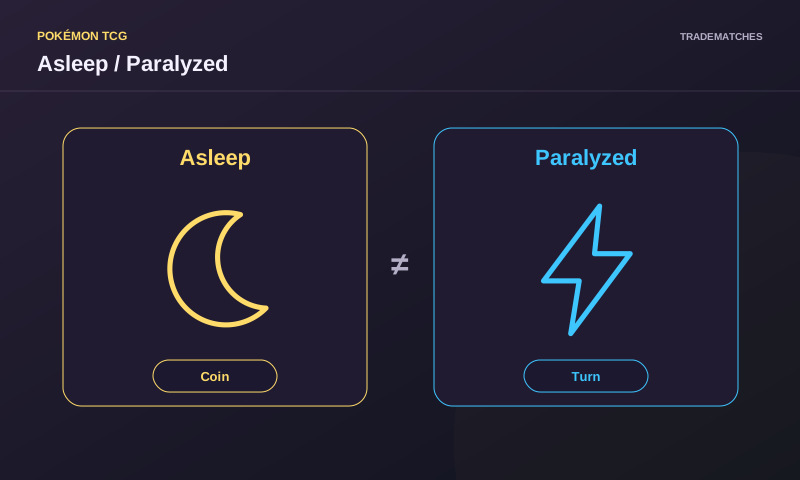
In Pokémon TCG, a Pokémon in the Active Spot Asleep and one Paralyzed share two limitations: they cannot attack or retreat using the normal retreat action. The difference lies in recovery. Asleep is checked with a coin during each Pokémon Checkup; Paralyzed is removed during the Pokémon Checkup following the next turn of its owner. Understanding this timeline prevents skipping an attack or allowing one too early.
Two states with the same immediate restriction
If your Active Pokémon is Asleep or Paralyzed when you want to declare an attack, it cannot do so. You also cannot use the normal retreat action to pay its cost and send it to the Bench. Even if it has sufficient Energy and the attack has no other condition, the state continues to impose its restriction. The opponent's low HP does not remove this prohibition from the affected Pokémon.
However, your turn is not canceled. You can still draw the initial card, play Basic Pokémon to the Bench, attach Energy, and use legal cards or Trainer abilities according to their text. The state applies only to the Active Pokémon, not to your entire hand or all of your Pokémon. This distinction is important when preparing a retreat: you may not be able to attack with the Active Pokémon, but you might still be able to prepare another Pokémon for the next turn or use a card that changes the Active Pokémon if its instructions allow it.
How Asleep is represented
The rules state that the card of an Asleep Pokémon should be rotated counterclockwise. On a table with multiple cards and counters, the orientation makes the state visible without relying on memory. Place the card so both players can distinguish it from a card rotated for another condition. An Asleep Pokémon cannot attack or normally retreat while in this state; there is no additional Energy cost that allows ignoring it.
During Pokémon Checkup, a coin is flipped for the Asleep Pokémon. If it lands heads, it recovers and the card returns to its normal position. If it lands tails, it remains Asleep and will be checked again during the next Pokémon Checkup if it stays in the Active Spot. The coin is not flipped when the owner simply declares they want to attack or only at the start of their turn. The official moment is between turns, and this detail changes the outcome when the state applies after a rival's attack.
How Paralyzed is represented
A Paralyzed Pokémon is rotated clockwise. It is also blocked from attacking and normally retreating. Unlike Asleep, it does not recover from a lucky coin flip. The state ends during Pokémon Checkup after the next turn of the player who controls the Pokémon. Therefore, it's important to remember who owns the Pokémon and when the Paralysis was applied, rather than vaguely counting "a full turn."
Suppose A attacks and Paralyzes B's Active Pokémon. During B's next turn, that Active Pokémon remains Paralyzed and cannot attack or normally retreat. At the end of that turn, the corresponding Pokémon Checkup removes the Paralysis. When B gets their next turn, if no other effect occurs, their Pokémon will no longer be blocked by that Paralysis. The fact that the Pokémon recovers after B's turn does not allow retroactively recovering an attack that was not declared during that turn.
The difference in the game timeline
Now imagine the same attack by A, but this time it puts B's Active Pokémon to sleep. After the attack and A's turn ends, Pokémon Checkup occurs. If the coin lands heads, B begins their turn with the Pokémon recovered; if it lands tails, they begin with it still Asleep. If B fails to recover it and ends their turn, there will be another Pokémon Checkup with a new opportunity to recover. It's not about "waiting for a fixed turn"—the outcome of the checks determines how long the state lasts.
This comparison affects specific decisions. Facing Asleep, it may be reasonable to wait for the coin flip if you don't need to act immediately, though the result is not guaranteed. Facing Paralyzed, the normal recovery has a fixed moment, and if you need to attack on that next turn, you must consider an alternative allowed solution. Do not confuse a chance of waking up with a promise of an attack: even after recovering the Pokémon, you still need to meet Energy requirements, attack text, and any remaining effects.
What is Pokémon Checkup and why it matters
Pokémon Checkup is the step between turns during which Special Conditions and certain effects that occur at that moment are processed. The rules establish an order for checking Poisoned, Burned, Asleep, and Paralyzed. Afterward, other Trainer or Ability effects that occur during Pokémon Checkup are applied, and it is checked whether any Pokémon is Knocked Out. It is not an additional turn during which Energy can be attached or Trainers can be played.
For these two states, a clear table helps more than a half-remembered rule. At the end of each turn, indicate the affected Active Pokémon and state whether a coin is flipped for Asleep or whether Paralysis should be removed because the owner's turn has ended. If there is also damage from Poisoned or Burned, do not resolve actions in a convenient order; follow the regulation sequence. This habit prevents healing or Knocked Out actions from occurring before their proper step.
Normal retreat versus changing the Active Pokémon via an effect
"Cannot retreat" describes the normal retreat action of the Active Pokémon. Some cards instruct changing the Active Pokémon or moving Pokémon in another way. The fact that a Pokémon is Asleep or Paralyzed does not automatically make all such instructions illegal. To resolve a specific card, read which player chooses the Pokémon, which zone of origin is allowed, and whether any condition is required. If the condition is met, follow the card's text and applicable rules for that change.
Once the affected Pokémon is sent to the Bench, it recovers from its Special Conditions. Therefore, it's possible that changing it via a legal card fulfills two objectives: removing the blocked Active Pokémon from the Active Spot and leaving it without Asleep or Paralyzed status on the Bench. Do not assume, therefore, that you can pay the normal retreat cost; that action remains prohibited while the condition is present. The difference between "retreating" and "being changed by an effect" depends on the exact verb of the action.
Evolution also removes the condition
When a Pokémon evolves, it recovers from all its Special Conditions. This includes Asleep and Paralyzed. If your affected Active Pokémon can legally evolve during your turn and you have the correct card, that evolution can make it ready to act, provided its new card and the rest of the rules allow the attack. The change does not occur by announcing a future evolution: the evolution must first be performed legally. The guide on when a Pokémon can evolve explains the limit of the first turn and of Pokémon newly placed into play.
Evolution is not a general cure. The damage counters the Pokémon already had do not disappear simply because it evolves; its attached Energies also do not vanish automatically. Therefore, if it was close to being Knocked Out, check the HP of the evolved Pokémon and the accumulated damage after removing the condition. A play may resolve Asleep but still be bad if the Pokémon retains enough damage that another attack will defeat it immediately. Condition, damage, and resources are separate data points.
Relationship with Confused, Burned, and Poisoned
Special Conditions do not all function the same way. Asleep, Paralyzed, and Confused are represented by rotating the card in different directions. The rules state that if another of these three conditions is applied, only the last one remains. The card is not rotated in two directions at once, nor are two incompatible checks performed simultaneously. If a Pokémon is Asleep and then becomes Paralyzed by a later effect, it uses the new orientation and resolves the condition that remains.
Poisoned and Burned are shown with markers. They can coexist with Asleep or Paralyzed, so a Pokémon can be blocked from attacking and still take damage during Pokémon Checkup. A marker for a condition does not replace the accumulated damage counters. This combination explains why simply straightening the Pokémon after recovering from Asleep is not enough: check whether other markers remain and whether accumulated damage has reached its HP. Removing a condition does not automatically erase the others.
What you can prepare while the Active Pokémon is blocked
If there is no immediate exit, use the turn to improve your position. You can attach Energy to a Pokémon that will attack later, lower a Basic Pokémon to cover a weakness in your deck, or play allowed Trainers that seek resources. You can also decide not to use a change card if the Asleep Pokémon's coin flip might recover it during the next Pokémon Checkup. This decision depends on your hand and the pressure from your opponent; no rule requires using a resource just because the Active Pokémon cannot attack now.
With Paralyzed, plan for the turn that the Active Pokémon will likely lose. If there is a legal evolution or a change effect in your hand, check whether using it opens a useful attack or simply consumes resources without improving the result. If there is no exit, prepare the Bench and calculate what the next Active Pokémon needs. A Pokémon on the Bench is not also Paralyzed because the Active Pokémon was. This simple observation prevents a player from treating their entire board as immobilized and missing valuable actions.
Common mistakes and a quick check
The most common mistakes are flipping a coin for Paralyzed, waiting until the end of your own turn to flip the first coin for Asleep, paying a normal retreat despite the condition, or removing damage when evolving. It's also easy to forget that a new rotation condition replaces the previous one, or to remove Poisoned and Burned markers because the Pokémon has recovered. Each mistake mixes rules that are processed separately. Announce the condition, keep markers visible, and follow the turn-between steps in order.
When in doubt, answer these questions in order: Is the affected Pokémon Active? Is the card rotated counterclockwise or clockwise? Are we in a Pokémon Checkup or during an action in the turn? Has an evolution or legal change to the Bench occurred? Are there any remaining markers or damage? If the situation depends on a card text that alters these rules, read that text fully and consult the current version. It's safer to reconstruct the sequence than to decide solely based on the card's appearance.
Frequently Asked Questions
Can I attack if the Pokémon wakes up just before my turn?
Yes, if it recovers the condition during Pokémon Checkup and then meets the attack's conditions. Waking up removes the Asleep restriction, but it does not pay Energy or eliminate other effects.
Does Paralyzed get removed with a coin flip?
No. Normal recovery occurs during Pokémon Checkup after the next turn of the player who controls the Pokémon. A card that legally changes or evolves the Pokémon can remove the Special Condition earlier.
Does evolving cure damage in addition to the condition?
No by general rule. Evolving removes Special Conditions, but it preserves damage counters. After evolving, compare that damage to the HP of the evolved card.