What happens when your Pokémon TCG deck runs out?
On this page
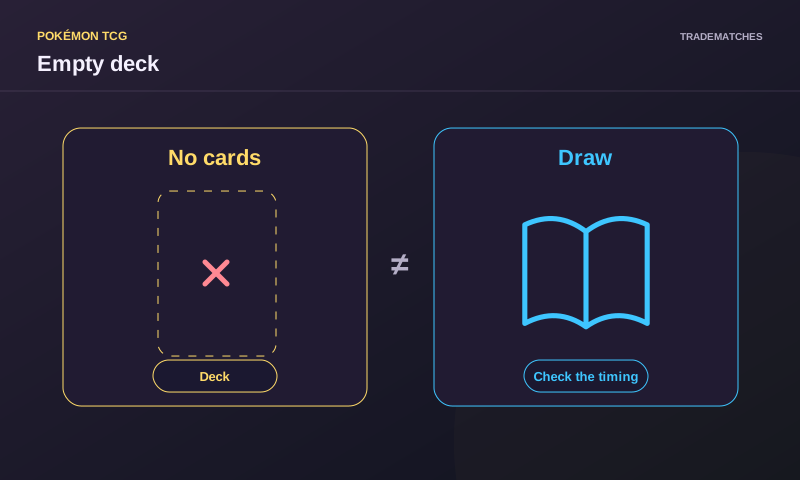
In Pokémon TCG, having an empty deck does not result in an immediate loss. You lose only if, at the start of your turn, you are required to draw a card and cannot because there are no cards left in your deck. However, if an effect during the game asks you to draw more cards than are available, you draw the available cards and continue. This distinction between mandatory initial drawing and drawing due to an effect resolves nearly all confusion about "deck-out" scenarios.
The decisive check occurs at the start of your turn
Each turn begins with a draw. If at that moment your deck contains no cards, you cannot complete the draw and you lose. It is not necessary for your opponent to attack or for your hand or field cards to be exhausted. The condition depends on a specific zone—your deck—and a specific moment—the mandatory draw at the start of your own turn. Counting how many cards remain before the end of a round helps determine whether you will have a turn ahead.
Suppose you end with zero cards in your deck and your opponent plays their turn without changing that situation. Even if you have many cards in your hand and several Pokémon in play, when it's your turn to begin again, you will not be able to draw the initial card. That is when you lose due to an empty deck. If during your opponent's turn a legal card returns cards to your deck, the outcome might change. Therefore, the actual state is always checked at the moment of drawing, not a prediction made at the end of the previous turn.
Emptying your deck during your turn does not end the game
It is possible for a Ability, a Supporter, or an attack to require you to draw the last card of your deck during your own turn. After resolving that action, your deck will have zero cards, but you have not lost solely because of that. You can continue with legal actions and may even win before it's your turn to draw again. This margin is important when you have an attack prepared that can take the last Prize card.
The rule also does not allow you to pretend there is a card in your deck to avoid risk. Both players can count how many cards remain in your deck, even if they do not know the order or identities of those cards. If you have one card and an effect requires you to draw it, your deck becomes empty. From that point, consider the timeline: Can you end the game now? Is there any effect in your hand or on the field that returns cards to your deck? Could your opponent end the game before you get a chance to draw? The answer depends on actual plays, not the size of your hand.
An effect that draws cards may request more cards than are available
The rules clarify that if a card orders you to draw or look at more cards than your deck contains, you draw or look at the available cards and the game continues normally. For example, with three cards remaining, an effect that orders you to draw five causes you to take those three. You do not lose because two cards are missing to fulfill the effect's requested number. The loss due to being unable to draw occurs only at the mandatory initial draw at the start of your turn.
This distinction prevents a premature conclusion when a Supporter or a Ability draws multiple cards. If the deck reaches zero during resolution, the resolution ends according to the text and the rules. You do not declare an automatic loss mid-effect. Afterward, the game continues. You may use the newly drawn cards to find a winning path or to refill your deck via another card. If you reach your next turn with no cards, then you will face the impossible initial draw.
Looking at cards and drawing cards are not the same
Some cards require you to look at the top cards of your deck and choose among them; others require you to draw them. In both cases, if there are fewer cards than specified, the available cards are processed according to the rules and the specific text. However, looking at cards does not equate to placing a card into your hand. Do not change a "look" instruction into a "draw" simply because the deck has one card, nor place that card into the discard pile if the text instructs you to return it. The fate of each card depends on the verb and the printed sequence.
Hypothetical example: You have two cards in your deck and a card says "look at the first five cards and put one of them into your hand," with additional instructions for the rest. You only look at the two available cards and apply the instructions you can fulfill to those two. That is not the mandatory initial draw. If part of the effect becomes impossible, do not invent cards to complete it; follow the text and, in case of doubt, consult the current rules. Precision matters because improperly moving a card can empty the deck before it is intended.
Prizes, hand, and discard are separate zones
The six Prize cards are removed from your deck during setup. Although they remain yours, they do not count as available cards for the normal draw. You also cannot use a card from your hand to "replace" the initial mandatory draw when your deck is empty. The discard pile does not automatically return to your deck. Each zone has its own rules, and only an authorized effect can move cards between them.
This explains a situation that seems strange at first: you can have five Prize cards pending, ten cards in your hand, and twenty in your discard pile, yet still lose due to being unable to draw at the start of your turn if your deck is empty. The game does not measure how many cards you own in total, but whether the mandatory action can take one from your deck. When assessing your risk, count the actual number of cards remaining in your deck after searches, draws, and effects; do not include Prizes or discard as if they were mixed together.
Cards that refill your deck
There are cards whose text allows returning cards from your hand or discard to your deck, shuffling it, or changing a draw action. There is no universal rule stating that you can always do this: you need the correct card, meet its conditions, and use it at a legal moment. If you return at least one card before the next mandatory initial draw and that card remains in your deck, you will be able to make that draw. If the card you return is later removed by another effect, the risk returns.
Read carefully the number and source of the cards the effect allows to be moved. "Up to," "exactly," and "choose" can produce different results. You also cannot assume that a search in the deck fills it; many searches actually remove cards from it. In a tight game, calculate the full sequence before playing a long draw effect. Refilling your deck is not valuable if you immediately empty the cards you just added, leaving you unable to draw at the start of your next turn.
Three examples with different quantities
Zero cards at the start: you begin your turn and must draw a card. Since your deck is empty, you lose due to this condition. Having a Ability that you could use "during your turn" does not allow you to skip the first draw to activate it earlier. The check occurs before those ordinary actions. If an active effect changes the draw or had already returned cards to your deck before the turn began, analyze the actual situation, but do not assume an exception that is not stated in any card.
One card during the turn: you have already completed the initial draw, and later an effect causes you to draw the last card. Your deck becomes empty, but you can continue playing. If you manage to take the last Prize before it's your turn to begin again, you can win. Three cards before a five-card draw effect: you draw the three available cards; you do not lose because two cards are missing to fulfill the effect. If you do not refill your deck and the start of your turn returns, you will not be able to draw the initial card and will then lose.
The condition can compete with other victories
In Pokémon TCG, you also win by taking the last Prize or by leaving your opponent with no Pokémon in play. For this reason, an empty deck should not be analyzed in isolation from the rest of the board. If your current attack can knock out your opponent's only remaining Pokémon, the game may end in your favor before your next mandatory draw occurs. If your opponent can take their last Prize during their turn, they may never get a chance to draw again.
When thinking about your game plan, list which condition might be fulfilled first. Do not say "I have zero cards left, I have lost" when you still have actions to play; nor say "I have one more turn" if you are already about to begin your turn with an empty deck. When two conditions occur in a complex sequence, follow the rules and the text of the cards. In an event, consult the judge if a simultaneous effect creates uncertainty, rather than applying a house rule about order.
How to control risk without playing blind
Count your deck before using a large draw effect. You do not need to reveal identities—the number of remaining cards is information both players can know. Calculate how many cards the effect will take, how many might return to your deck, and how many turns you expect to need. If you have few cards left, decide whether the draw genuinely improves your chance to win now or whether it forces you to find a way to refill your deck. The goal is not to avoid reaching zero at all times, but to know how much time you have left.
After playing, review how your deck was emptied. Perhaps you drew many cards to find a resource already in your hand, searched repeatedly without need, or had no alternative path to victory. It may also be a correct decision to accept the risk in order to try to win on that same turn. A single game does not prove your deck is poorly constructed, but a pattern of losses due to an impossible initial draw warrants reviewing the density of draws and the cards that recover resources.
Common mistakes and final check
Common mistakes include declaring a loss as soon as you draw the last card due to an effect, counting Prizes as deck cards, attempting to activate a regular Ability before the impossible initial draw, or believing that an effect requiring five cards forces a loss if only three remain. All are resolved by distinguishing the moment of the draw and its origin. An action that physically resembles another—drawing a card from the top—can have a different rule consequence.
To verify the situation, ask: Am I at the start of my turn or in the middle of an effect? Is the instruction the mandatory initial draw, looking at cards, or drawing due to a card? How many cards actually remain in the deck, excluding Prizes and discard? Does an active text change what will happen next? If the answer is "I am at the start of my turn, I must draw and my deck has zero cards," then the loss condition is clear. In all other cases, continue the sequence without anticipating a result.
Frequently Asked Questions
Do I lose exactly when I draw the last card from my deck?
No, for that single action. The ordinary loss occurs only if you cannot draw the mandatory card at the start of your turn.
What happens if an effect orders me to draw five and only three remain?
I draw the three available cards and continue the game. I do not lose because that effect cannot deliver the other two cards.
Do Prize cards prevent a deck-out loss?
No automatically. They are a separate zone. Only an authorized effect that legally moves cards to the deck can change how many remain for the next mandatory initial draw.