How to set up and take Prize cards in Pokémon
On this page
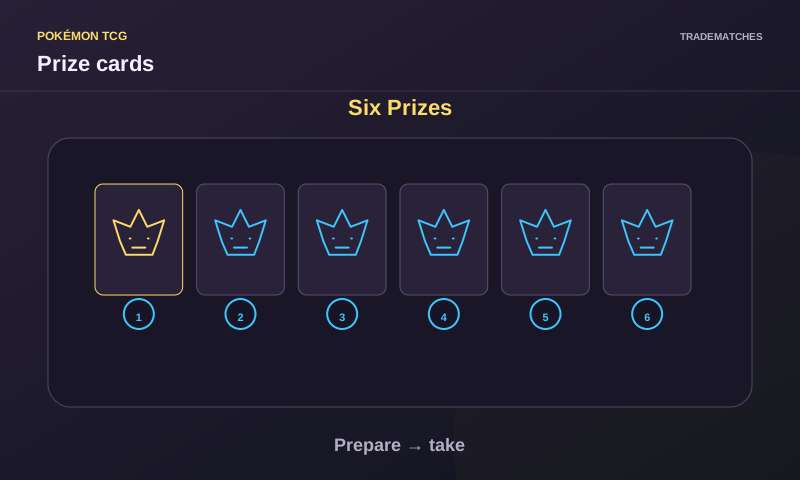
In Pokémon TCG, each player sets aside six cards from their own deck, face down, as Prize cards when preparing for a match. When a player defeats a rival Pokémon, they typically take one of their own Prize cards and place it in their hand. The player who takes the last Prize wins. This guide explains where Prize cards are placed, when they are collected, and how to avoid mistakes; the special Prize count granted by a Pokémon is covered in another entry.
Prize Cards Are Separated During Preparation
A standard match begins with a 60-card deck per player. The deck is shuffled, a seven-card hand is drawn, and one Basic Pokémon is placed in the Active Spot, with up to five additional Basic Pokémon on the Bench. Afterward, each player places the six top cards of their own deck aside, face down, as Prize cards. Six cards are not selected from the hand or searched for in the deck—these cards are drawn from the top after shuffling, following the preparation procedure.
The physical layout may vary depending on the table, but both players must clearly identify which area belongs to each player's Prize zone. Six separate and countable cards reduce errors later, especially when some have already been taken. Do not mix them with the Discard Pile or the deck. If an initial hand requires a mulligan due to lacking a Basic Pokémon, complete that procedure before considering the table prepared. The specific mulligan guide explains when the deck is reshuffled and a new hand is drawn.
Each Player Takes Their Own Prize Cards
A common confusion in the first match is taking a card from the opponent after defeating their Pokémon. The rule works in reverse of that intuition: when you defeat a rival Pokémon, you take one of your own Prize cards and add it to your hand. Your opponent retains their Prize cards. Thus, your six Prize cards function as a progress counter toward your victory and also as unopened resources from your deck that you haven’t yet seen.
Imagine Ana has four Prize cards and Bruno has two. Ana defeats a Pokémon of Bruno that grants a Prize. Ana takes one of her four face-down cards, places it in her hand, and is left with three Prize cards. Bruno keeps his two cards. The card gained by Ana does not immediately go into play, does not automatically attach as Energy, and does not go to the Discard Pile—it now becomes a card in her hand and must be used at a legal time if she wishes to use it.
Why Are Prize Cards Left Face Down?
Prize cards remain hidden while set aside, except when a specific effect allows viewing or manipulating them. You cannot lift them to check if a card is missing from your deck or to simply look at one out of curiosity. When you take a regular Prize card, you select one from that zone without knowing its identity, add it to your hand, and then see what you have obtained. The physical order of the cards is not a reliable indicator of their contents; the cards were not separated by importance.
If you're practicing with a new deck, it's tempting to look at the Prize cards to see which cards are "stuck" in there. Doing so changes the information available during the match and can alter decisions. A better practice is to play without seeing them and then review afterward what pieces were present. This post-match review helps you assess whether your deck relies too heavily on a single copy of a card. During the match, work with the normal uncertainty of the game and with effects that specifically allow interaction with Prize cards.
A Defeat Triggers the Prize Take
Under normal circumstances, a Prize is awarded when a rival Pokémon is knocked out. This can happen after an attack's damage, due to counters placed by an effect, or during a turn as part of a Pokémon Checkup. Simply announcing that an attack "should defeat" it is not enough; first, the damage must be resolved, applicable effects must be applied, and the Pokémon must actually be knocked out according to its HP and the rules. Only then is the corresponding Prize consequence applied.
Certainty is important when the defender already had damage. Suppose a Pokémon with 100 HP has 70 damage points and receives 30 more, with no effects changing the outcome. It reaches 100 HP and is knocked out, allowing the attacker to take a regular Prize, unless the card has a special rule. If the attack had only dealt 20 damage, it would leave 90 damage points and no Prize would be taken. A correct calculation prevents taking a card too early and having to rebuild a game sequence.
Regular Prize and Printed Exceptions
The basic rule states that one Prize card is awarded for each rival Pokémon knocked out. However, some Pokémon types specify that the opponent takes more than one when defeated. The number must be read from the card's rule or applicable regulation. The TradeMatches entry on Pokémon ex and Mega Evolution ex explains these specific differences. The key question here is the procedure: whether one or multiple cards, the player takes them from their own Prize zone and adds them to their hand.
Do not assume the number based on the card's size, HP, or damage dealt during the match. Two Pokémon with similar names or art may have different Prize rules. Also, do not convert every card attached to the defeated Pokémon into an additional Prize. Energy and Pokémon Tools attached to the defeated Pokémon follow the destination specified by the Knocked Out rules, but they are not themselves Prize cards. Always read the rule on the top card of the Pokémon that has been removed from play.
Taking the Last Prize Wins the Match
If you are the first player to take your last Prize card, you win the match. You do not need to play that final card from your hand or wait for the start of your next turn. That's why it's important to count how many Prize cards remain before attacking. If you only have one left and can knock out a Pokémon that grants at least one Prize, the attack can end the match. If you still have several left, a target with a special rule granting more Prizes might change your decision.
Prize cards are not the only condition for victory. You can also win if your opponent runs out of Pokémon in play or if they cannot draw a card at the start of their turn because their deck is empty. These conditions are resolved according to their own sequence; it is not necessary to take all six Prize cards in every match. The existence of other victory conditions does not allow taking Prizes without a Knocked Out. Keep the Prize progress, available Pokémon, and deck size separate.
When a Useful Card Is Among the Prizes
If you're looking for a card in your deck and it doesn't appear, one possibility is that it's in your hand, in the Discard Pile, or among the face-down Prize cards. Do not look at the Prize cards to confirm this unless a card's text explicitly allows it. Uncertainty is part of deck construction: depending on a single copy of a key card can leave you without it for much of the match. Cards that allow access to Prizes or exchange their contents must be read precisely, because their effect may differ from the standard procedure.
An example of planning: your deck uses two copies of a card that enables an attack. After searching your deck, you find no copies. Before concluding that both are among the Prizes, check your hand and Discard Pile and remember that searches may have restrictions. Even if you suspect one copy is set aside, continue playing with the actual information you have. If you achieve a Knocked Out, you will take a Prize blindly; it might be the card you're looking for or it might not. Do not announce a location as certain without having verified it.
Practical Sequence for Taking a Prize
Suppose an attack ends and knocks out the opponent's Active Pokémon. First, ensure that the damage and card conditions have been correctly resolved. Then, identify the Prize rule of the defeated Pokémon and how many cards should be taken. The owner removes the knocked-out Pokémon and any attached cards according to the applicable procedure; if a replacement is needed, follow the regulation sequence. The player who caused the Knocked Out takes the appropriate number of Prize cards from their own zone.
In a casual game, announcing aloud, "This Pokémon grants a Prize; I take one of my four," helps both players verify the counter. If the attack affected more than one Pokémon, resolve the consequences according to the regulation rather than assuming all defeats work as one. Do not mix Prize cards into your hand before confirming the correct number: once mixed, undoing an error may require information that no player should have known. The simplicity of the physical action does not eliminate the need to follow the correct order.
What to Do If Prizes Are Missing or a Hidden Card Is Revealed
Before starting the match, count six cards in each player's Prize zone. This brief check prevents an unintentional advantage and avoids discovering the issue mid-turn. If an error is detected in an informal game, pause before moving more cards and reconstruct only what both players can verify. Do not shuffle visible cards within the Prize zone without knowing whether that respects the prior state, nor allow a player to choose a card after seeing its identity.
At a tournament, inform the responsible person or the judge if there are missing Prizes, an extra Prize has been taken, or a hidden card has been revealed. The correction may depend on the timing and cards already seen; improvising a solution often worsens the problem. A photo of the table taken before the incident, if permitted by the rules and circumstances, can help recall quantities, but does not replace the official decision. The simplest measure remains properly separating and counting the Prizes at the start.
How to Practice Without Confusing Zones
In your first match, identify four areas with your partner: deck, hand, Discard Pile, and Prizes. Place the six Prize cards in a clearly separated group and mark which are yours. Each time a Pokémon is knocked out, ask, "How many Prizes does this card grant?" and "From which zone do I take them?" Then, move the cards to your hand and recount the remaining face-down cards. This routine takes only seconds and allows learning without constantly interrupting the game.
After reviewing the completed match, observe which cards remained in the Prizes and whether that affected your strategy. This post-match information may indicate that you need more ways to find a piece, an extra copy, or an alternative line of play. It's not necessary to turn every unfortunate Prize into an excuse to change your deck: the six cards are set aside randomly, and a match does not represent all possible outcomes. Reviewing helps distinguish a structural problem from a normal variation.
Frequently Asked Questions
Do I take a card from my opponent when I defeat their Pokémon?
No. You take the appropriate number of Prize cards from your own zone and place them in your hand.
Can I look at my six Prize cards at the start of the match?
No, by general rule. They remain face down and hidden, unless a card's text explicitly allows viewing or manipulating them.
Do Prize cards go into play immediately when taken?
No. They go into your hand. You can then play a Prize card obtained if a legal moment arrives and its conditions are met.