From Pokémon TCG Pocket to physical cards: what changes and how to start
On this page
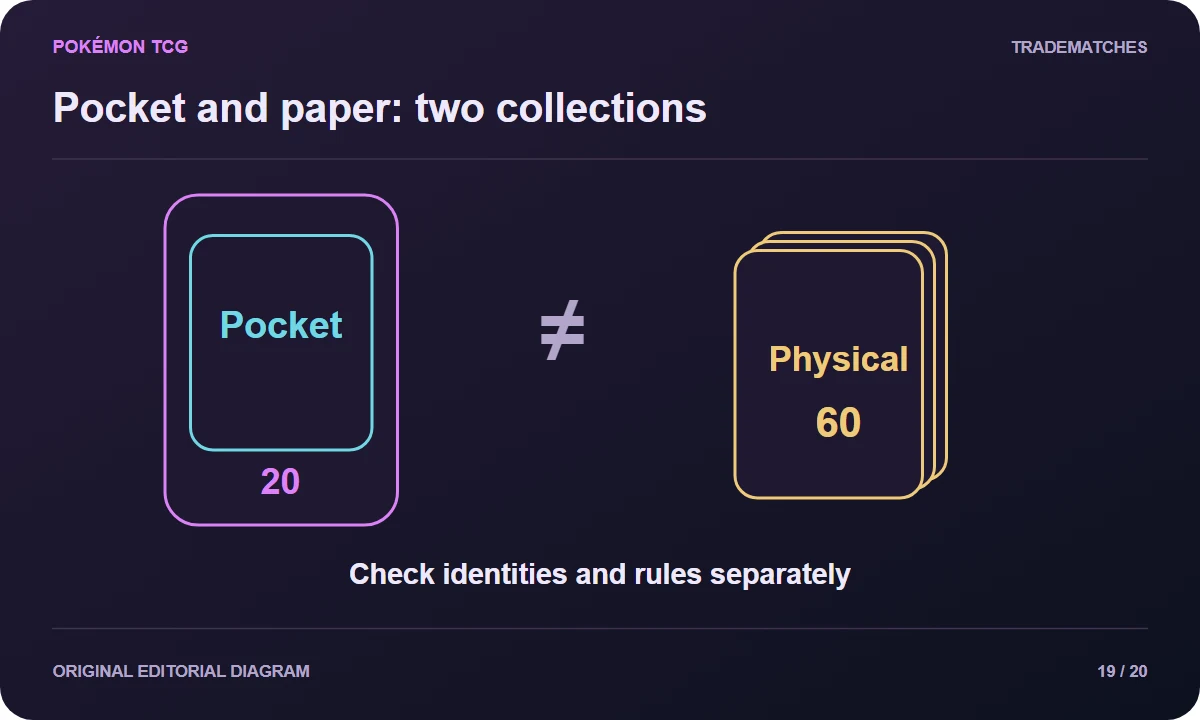
Pokémon TCG Pocket uses 20-card decks, an Energy Zone separate from the deck and matches played to 3 points. The physical game uses 60-card decks, Energy cards in the deck and 6 Prize cards. Your Pocket collection is digital. If you like an illustration, you can look for the physical card that uses it, if there is one.
This guide is for people who already play Pocket on their phone and are curious about owning real cards or sitting down to play at a table. What you know helps, but some rule changes will cost you your first games if nobody warns you.
What you already know from Pocket and still applies
A turn is built the same way: an Active Pokémon that attacks, Pokémon waiting on the Bench, Energy you attach to pay for attacks, evolution from Basic to Stage 1 and Stage 2, Retreat to switch your Active, and Trainer cards (Items, Supporters and Tools) that help you find cards or heal. Types and Weakness exist in both games too, although they are calculated differently.
In both games, a Pokémon generally has to wait until the turn after it enters play to evolve. In Pocket, the starting player can use an attack that requires no Energy on their first turn. In the physical game, the starting player skips the attack step.
What changes: Pocket versus the physical game
The table sums up the differences you notice most in your first game. For the detail of each physical rule, see our Pokémon TCG rules guide.
| Rule | Pokémon TCG Pocket | Physical card game |
|---|---|---|
| Deck size | 20 cards | Exactly 60 cards |
| Copies of a card | Up to 2 with the same name | Up to 4 with the same name (Basic Energy has no limit) |
| Energy | Energy usually comes from the Energy Zone. There are no Energy cards in the deck | You put Energy cards in your deck and can attach one per turn from your hand |
| How you win | One way to win is to reach 3 points by Knocking Out opposing Pokémon. The points you score depend on the Pokémon | You win by taking all 6 of your Prize cards, if your opponent has no Pokémon in play, or if they cannot draw at the start of their turn |
| Bench | 3 Pokémon by default | 5 Pokémon by default |
| Weakness | Adds 20 damage | Applies the modifier printed on the card (usually ×2) |
| Resistance | Does not exist | Reduces damage (usually by 30) |
| Opening hand | 5 cards | 7 cards |
| Running out of cards in your deck | Does not lose you the game | You lose if you cannot draw at the start of your turn |
| First turn of the player who starts | Can use an attack that requires no Energy | Cannot attack or play a Supporter |
Energy and the empty deck take some getting used to. In Pocket, Energy comes from its own zone. In the physical game, if you have no Energy in your hand, you usually cannot attach any that turn. That is why physical decks carry Energy cards and often Trainers to find them. In longer games, keep an eye on what is left in your deck. You lose if you cannot draw at the start of your turn.
Check your Active Pokémon’s Weakness before leaving it exposed. In Pocket, a 120-damage attack against a Pokémon with Weakness to that type usually does 140 damage. In the physical game, if the card says ×2, the same attack does 240.
Pocket cards are not physical cards
What you own in Pocket is a digital collection tied to your account. There is no way to redeem it for cardboard, and the codes included in physical products do not work in Pocket either: they are for Pokémon TCG Live, the digital version of the physical game, with the same 60-card rules.
Pocket has its own sets, with codes such as A1, A1a or A2, which do not match the physical sets. Many Pocket cards reuse artwork that already appeared on physical cards, but others are Pocket exclusives, such as immersive cards, which open into an animation on your phone and do not exist on cardboard.
Even when the artwork matches, the physical card is not necessarily the same: because the rules differ, HP, attacks and their costs can change. If you want the card to play with, buy the physical version for what its text says, not for the picture.
How to find the physical version of a card you liked in Pocket
If what you want is the card with the artwork that hooked you in your binder, follow these steps:
- Write down the Pokémon’s name and the illustrator’s name, which appears at the bottom of the card in Pocket.
- Look up the physical versions of that Pokémon in our card price lookup, which shows the image of each physical card with its set and number, or in the list of Pokémon sets.
- Compare the artwork and the illustrator. If they match, that is your card. If none matches, it is probably a Pocket-exclusive illustration.
- Write down the full reference before buying or trading: set, number, language and finish. The same Pokémon can have dozens of different cards; the number removes any doubt. We explain how in Pokémon card symbols and codes.
Language matters too. The same card can exist in English, Spanish and Japanese with different prices and availability; we compare them in our card language and edition guide. Once you have it, keep it sleeved: the basics are in sleeves, binders and storage.
Where to start playing on cardboard
You do not need to build a deck from scratch. For your first games, the simplest option is a pre-built 60-card deck, which comes balanced and ready to play. If two of you are learning together, a box designed to teach the game, with two or more decks and a playmat, saves you buying two products.
Avoid starting by opening booster packs to build a deck: you get single cards from many different Pokémon that rarely add up to a playable deck. Packs are for collecting and for completing a deck you already have; pre-built decks are for starting to play.
Once you know the rules, the next step is playing with more people. Many shops run weekly Pokémon leagues that welcome beginners. In Spain you can find the ones near you in our Pokémon tournament calendar and our store directory; elsewhere, the official Play! Pokémon event locator lists them.
Trading: with friends in Pocket, with people nearby on cardboard
In Pocket you can trade eligible cards with friends inside the app. Rarity and other requirements depend on the current rules. To trade physical cards, find someone with the card you want who is also interested in something you have.
That is what TradeMatches is for: you list the physical cards you want and the ones you can spare, and the app tells you when someone nearby is a match. TradeMatches is for physical cards only and has no connection with Pocket collections; most of its users are in Spain for now.
Frequently asked questions
Can I get my Pocket cards in physical form?
No. The Pocket collection is digital and cannot be redeemed for cardboard. What you can do is buy or trade for the physical card with the same artwork, when it exists.
Does my Pocket deck work in the physical game?
Not directly. A Pocket deck has 20 cards and no Energy; a physical one needs exactly 60 cards, Energy cards included, and the cards do not necessarily have the same text. You can use the deck idea as a starting point, but you have to build it again.
Do the codes in physical boxes work in Pocket?
No. The codes included in physical products are redeemed in Pokémon TCG Live, the digital version that uses the same rules as the physical card game.
Is the physical game harder?
It has more rules and more decisions per turn, mostly because of Energy and the 60-card deck, but a Pocket player learns quickly because the basic concepts are the same. The first three or four games are the hardest.
Sources and checks
On 17 November 2026, we checked the first turn and scoring against the Pocket battle rules and the tabletop basics against the official physical game rulebook. Check the Pocket trading rules for eligible cards and Pokémon TCG Live support for code redemption. The official Pocket site describes immersive cards, and WikiDex catalogues card artwork.