Pokémon TCG rules explained: first turn, evolving, Energy, Special Conditions and Prize cards
On this page
Most Pokémon TCG rules questions have a one-line answer: running out of cards only loses you the game if you can't draw at the start of your turn; neither player can evolve on their own first turn; the player who goes first can't attack or play a Supporter that turn; Benched Pokémon can use their Abilities; and a Pokémon can't be Asleep and Paralyzed at the same time. This guide gives each of those answers its own section, followed by the reasoning, a worked example and the mistakes we see most often at the table. Everything was checked on 21 October 2026 against the official rulebook that pokemon.com links as current (dated September 2026) and the Play! Pokémon TCG Tournament Handbook revised on 1 September 2026.
The guide sticks to the core game: setup, the turn, Energy, Trainer cards, Abilities, retreating, Special Conditions, damage, Prize cards and how a game ends. Mechanics that only apply to certain card families, such as ACE SPEC, Prism Star, the Lost Zone, Ancient Traits, GX attacks, VSTAR Powers and regulation marks, have their own rules and are left for a separate guide. When a card's text contradicts a general rule in this guide, follow the card: the rulebook itself keeps adding "unless a card says so" for that reason.
If you need one of those mechanics now, or the exact meaning of a term printed on your cards, look it up in the TradeMatches keyword glossary: it gives a one-line answer and links to the guide that explains it with examples.
The rules at a glance
| Question | Short answer | Section |
|---|---|---|
| No Basic Pokémon in my opening hand? | Reveal, shuffle back, draw 7 again; your opponent may draw 1 card per extra mulligan | Setup and mulligans |
| Can I attack on the first turn? | Not if you go first. The second player can | First turn |
| Can I evolve on my first turn? | No, whether you go first or second, unless a card says so | Evolving |
| Can I attach Energy on the first turn? | Yes, once, like any other turn | Attaching Energy |
| How many Special Energy can a deck have? | Up to 4 with the same name; Basic Energy has no limit | Basic vs Special Energy |
| How many Supporters per turn? | One. Items and Pokémon Tools: as many as you like | Trainer cards |
| Do Abilities work from the Bench? | Yes, unless the Ability itself says otherwise | Abilities |
| Can an Asleep or Paralyzed Pokémon retreat? | No. Neither can attack either | Asleep vs Paralyzed |
| Can a Pokémon be Paralyzed and Asleep? | No. Only the last of Asleep, Confused and Paralyzed stays | Special Conditions |
| When does Weakness apply? | After effects on the attacker, before effects on the defender; never to the Bench | Weakness and Resistance |
| How many Prize cards for a Pokémon ex? | 2; a Mega Evolution Pokémon ex gives 3 | Prize cards |
| What if my deck runs out? | You only lose if you can't draw at the start of your turn | Running out of cards |
Setting up and taking a mulligan
If your opening seven cards contain no Basic Pokémon, you must take a mulligan: show your hand to your opponent, shuffle it back into your deck and draw seven new cards, repeating until you have a Basic. Your opponent may then draw one extra card for each extra mulligan you took. You can't mulligan a hand just because you dislike it. One Basic Pokémon in the hand makes it a legal opening hand.
The setup sequence
The rulebook lists eight steps. Both players follow them in this order:
- Shake hands.
- Flip a coin. Whoever wins the flip decides which player goes first.
- Shuffle your 60-card deck and draw the top 7 cards.
- Check your hand for Basic Pokémon.
- Place one Basic Pokémon face down as your Active Pokémon.
- Place up to 5 more Basic Pokémon face down on your Bench.
- Set aside the top 6 cards of your deck, face down, as your Prize cards.
- Both players flip their Active and Benched Pokémon face up, and the game begins.
Only Basic Pokémon can be placed during setup. A Stage 1 or Stage 2 card, a Trainer card or an Energy card never counts as a starting Pokémon. In best-of-three tournament matches, the coin flip is only used for game 1: the loser of each game chooses who goes first in the next one, according to the TCG Tournament Handbook (section 7.2).
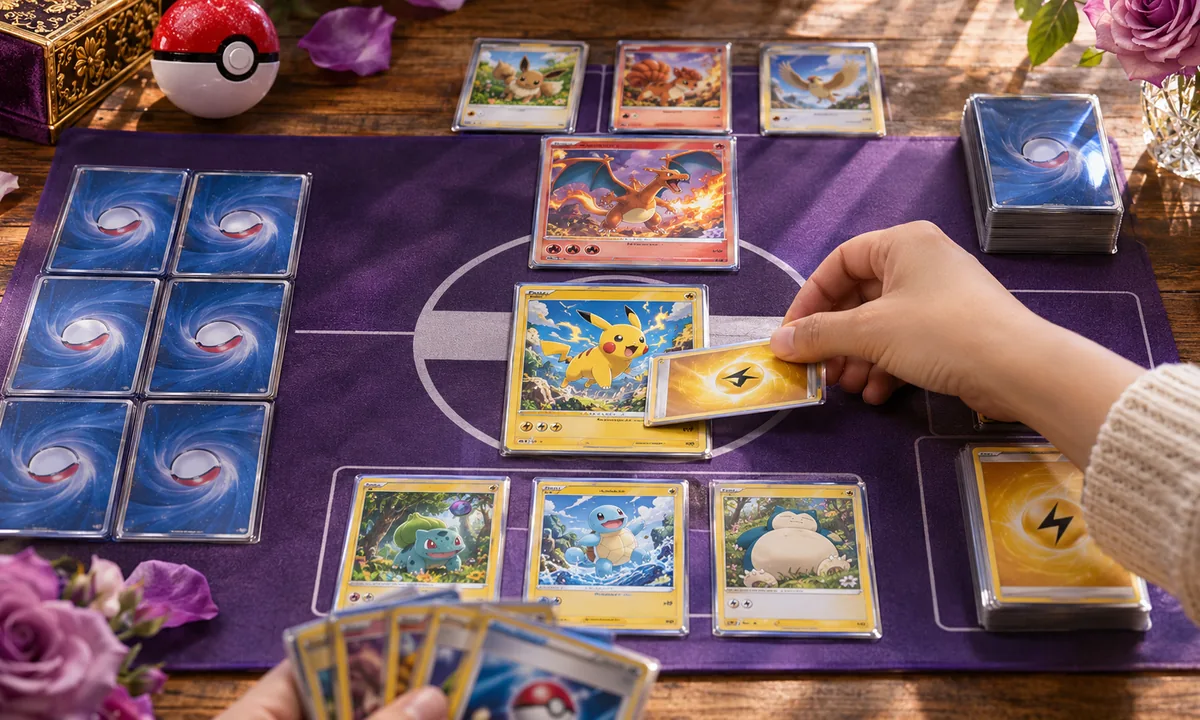
This is how each player's side of the table looks once setup is done. The zones and their limits come from the rulebook; where each pile goes comes from section 6.1.1 of the TCG Tournament Handbook, which at tournaments puts Prize cards on the opposite side from the deck and discard pile, and the Stadium between both Active Pokémon.
The mulligan step by step
The Advanced Rules section of the rulebook separates two cases. If neither player has a Basic, both reveal their hands and simply start over. If only one player lacks a Basic:
- That player announces the mulligan and waits while the opponent finishes setting up.
- They reveal the hand, shuffle it into the deck and draw again, as many times as needed.
- The opponent may draw one card for each extra mulligan. Any Basic Pokémon drawn this way may go onto the Bench.
- Both players reveal their Pokémon and play begins.
"Extra" is the key word. The rulebook's own example: both players take 2 mulligans, then Player A takes 3 more, so Player B may draw up to 3 cards. The two mulligans each player took cancel out. "Up to" also means the draw is optional, which matters when your deck is thin or you fear running out late in the game.
How often you'll have to redraw depends on how many Basic Pokémon you run. With 10 in a 60-card deck, a 7-card opening hand has at least one 74.1% of the time, so roughly one opening hand in four needs a mulligan; with 15 Basics it rises to 88.2%. To work it out for your own list, open the opening hand probability calculator, pick Pokémon TCG (60 cards, 7-card hand) and enter the total number of Basic Pokémon in the deck as the copies.
Tournament details
The TCG Tournament Handbook (7.4.1) adds two procedural points. The extra cards are drawn only after the player who mulliganed has placed an Active Pokémon, and the player drawing them must announce how many before drawing. The Active Pokémon already chosen can't be changed after seeing the extra cards; only the Bench can grow. If a player reaches 8 mulligans, the Head Judge may step in with a fixed procedure to find a Basic Pokémon and keep the round moving (7.4.2).
Common setup mistakes
- Setting Prize cards aside before checking for a Basic. Prizes come after the Pokémon are placed.
- Drawing extra cards for every mulligan instead of the difference.
- Swapping the Active Pokémon after drawing the bonus cards.
- Putting a Stage 1 down because "it's the only Pokémon I have".
What you can and can't do on the first turn
The player who goes first can't attack and can't play a Supporter on their first turn. Neither player can evolve a Pokémon on their own first turn. Everything else is allowed on turn one: you can attach an Energy, put Basic Pokémon on the Bench, play Items, Pokémon Tools and a Stadium, retreat and use Abilities. The player who goes second may attack and play a Supporter on their first turn, but still can't evolve unless a card says so.
| Action on your first turn | Going first | Going second |
|---|---|---|
| Draw a card | Yes | Yes |
| Put Basic Pokémon on the Bench | Yes | Yes |
| Attach one Energy | Yes | Yes |
| Play Items, Pokémon Tools, a Stadium | Yes | Yes |
| Play a Supporter | No | Yes |
| Evolve (including with Rare Candy) | No | No |
| Retreat | Yes | Yes |
| Use Abilities | Yes | Yes |
| Attack | No | Yes |
Each restriction has its own place in the rulebook. The attack restriction is in the attack step: on the first turn of the game, the starting player skips it and the turn simply ends once they're done. The Supporter restriction is in the Trainer card section. The evolution restriction appears in the evolution notes and covers both players: "neither player can evolve a Pokémon on that player's first turn unless a card says so."
The diagram shows the whole turn in the rulebook's order: three parts and, before the opponent plays, the Pokémon Checkup. The first-turn limits remove pieces from it but never change the order.
A zero-cost attack is still an attack
Some attacks have a cost of zero and need no Energy at all. They're still attacks, so the player going first can't use them on turn one. On the other hand, an Ability that draws cards, moves damage or searches the deck isn't an attack, and nothing in the first-turn rules stops it.
Worked example
You win the flip and choose to go first. You draw, bench two Basic Pokémon, attach an Energy to your Active, play two Items to search your deck and use a Benched Pokémon's Ability. You hold a Supporter and a Stage 1 card, but you can't play either, and you can't attack. Your opponent draws, plays a Supporter, attaches an Energy and attacks. Neither of you has evolved yet; both of you can start evolving on your second turns, as long as the Pokémon being evolved was already in play when that turn began.
Common first-turn mistakes
- Thinking the player going second can evolve on turn one.
- Skipping the Energy attachment on turn one because "nothing happens on the first turn".
- Using Rare Candy on your first turn. The card itself forbids it.
- Treating a 0-Energy attack as allowed for the first player.
When you can evolve a Pokémon
You can evolve a Pokémon if the evolution card in your hand says "Evolves from" that Pokémon's exact name and the Pokémon was already in play at the beginning of your turn. You can't evolve a Pokémon the turn it comes into play, you can't evolve the same Pokémon twice in one turn, and neither player can evolve on their own first turn unless a card says so. Active and Benched Pokémon can both evolve, and you can evolve as many different Pokémon as you like in one turn.
The test: was it in play when your turn started?
The rulebook frames evolution around one condition: X must be "the name of a Pokémon you had in play at the beginning of your turn". That single test explains most cases. A Basic you put on the Bench this turn fails it. A Basic that was on your Bench before you drew passes it, whether it's Active or Benched now. A Pokémon that evolved this turn counts as new in play, so it can't take a second evolution step until your next turn.
| Situation | Can it evolve now? |
|---|---|
| Basic benched on your previous turn, now your second turn | Yes |
| Basic benched earlier this turn | No |
| Your first turn, either player, Basic placed during setup | No, unless a card says so |
| Stage 1 that evolved earlier this turn, Stage 2 in hand | No, wait until next turn |
| Basic in play since last turn, Stage 2 in hand, Rare Candy in hand | Yes, through Rare Candy, if it isn't your first turn |
Rare Candy: from Basic to Stage 2
Rare Candy is an Item. The Scarlet & Violet printing on pokemon.com reads: choose one of your Basic Pokémon in play and, if you have a Stage 2 card in your hand that evolves from that Pokémon, put it on the Basic, skipping the Stage 1. It adds two timing limits of its own: you can't use it during your first turn, or on a Basic Pokémon that was put into play this turn. Note that the Stage 2 has to evolve from that Basic's line: the Stage 2's "Evolves from" names the Stage 1, so the Basic must be the one that Stage 1 evolves from.
Names have to match exactly
A Pokémon's name includes its owner or form. The rulebook gives Meowth, Alolan Meowth and Rocket's Meowth as three different names, and the same logic applies to Trainer's Pokémon: Iono's Bellibolt ex evolves from Iono's Tadbulb, not from a regular Tadbulb, and a regular Sandshrew can't become Brock's Sandslash. Levels and the δ Delta Species mark are not part of the name, so Graveler can evolve from Geodude LV. 12 but not from Brock's Geodude.
Current Mega Evolution Pokémon ex follow the normal evolution rules, but check what they evolve from. The rulebook's examples: Mega Lucario ex evolves directly from Riolu (not from Lucario), Mega Gardevoir ex evolves from Kirlia, and Mega Kangaskhan ex is a Basic Pokémon you play straight from your hand. Unlike the old Mega Evolution Pokémon-EX of the XY era, evolving into one doesn't end your turn.
Common evolution mistakes
- Benching a Basic and evolving it in the same turn.
- Evolving Basic to Stage 1 to Stage 2 in one turn without Rare Candy.
- Assuming Mega Lucario ex sits on top of Lucario.
- Mixing a Trainer's Pokémon line with the regular line of the same species.
What evolving keeps and what it clears
When a Pokémon evolves, it keeps its damage counters and every attached card (Energy, Pokémon Tool and the earlier evolution cards underneath). It loses all Special Conditions and every effect of attacks that was affecting it. Evolving never heals damage, so the evolved Pokémon's remaining HP is its new HP minus the damage already on it.
Worked example
Your Basic Pokémon with 70 HP has 4 damage counters (40 damage), is Poisoned and is under an opponent's attack effect that stops it attacking next turn. You evolve it into a Stage 1 with 120 HP. The 4 damage counters stay, so it has 80 HP left. The Poison marker comes off, and the attack effect ends because the rulebook says those effects end when the Pokémon evolves. The two Energy and the Tool it had attached are still there. The new Pokémon can use only its own attacks and Abilities, not those printed on the Basic underneath, unless a card says otherwise.
Things people get wrong
- Removing damage counters because "it's a new Pokémon".
- Keeping the Burned or Poisoned marker after evolving.
- Using an attack printed on the Basic card underneath.
- Thinking the Pokémon can evolve again that turn because it's "new": it can't, for exactly that reason.
Attaching Energy
You can attach one Energy card from your hand to one of your Pokémon each turn, Active or Benched, including on the very first turn of the game. That once-per-turn limit applies to the attachment from your hand that the rules give you. Card effects that attach Energy, such as an Ability or an attack, are separate and follow their own text.
An attack's cost is shown with Energy symbols. Each coloured symbol needs an Energy of that type attached; each Colorless symbol can be paid with any type. The rulebook's Nuzleaf example: an attack costing one specific Energy plus one Colorless needs at least two Energy attached, one of which must be of the specified type. Attacks don't discard Energy unless their text says so; attaching is what you do with your once-per-turn action, and paying an attack cost only means having the Energy there.
Energy attached to a Benched Pokémon stays with it when it moves to the Active Spot, and Energy stays attached when a Pokémon evolves or retreats. When a Pokémon is Knocked Out, its attached Energy goes to the discard pile with it.
Basic vs Special Energy, and how many you can play
Basic Energy is the plain Grass, Fire, Water, Lightning, Psychic, Fighting, Darkness, Metal or Fairy Energy card, and a deck can hold any number of them. Special Energy is any Energy card marked "Special" with its own text; like any other card, you can have up to 4 with the same name in your deck. Both are attached the same way and both count as your one Energy attachment for the turn.
| Basic Energy | Special Energy | |
|---|---|---|
| Which cards | The nine types listed in the rulebook glossary | Energy cards labelled Special, each with its own text |
| Copies per deck | No limit | Up to 4 with the same name |
| What it provides | One Energy of its type | Whatever its text says, often with an extra effect |
| Attachment from hand | Counts as your one attachment | Counts as your one attachment |
| Found by "search for a Basic Energy" | Yes | No |
A real example: Jet Energy
Jet Energy from Paldea Evolved is labelled Special on pokemon.com. While attached it provides one Colorless Energy, and when you attach it from your hand to a Benched Pokémon, you switch that Pokémon with your Active Pokémon. It can pay a Colorless cost but never a coloured one, which is the trade-off most Special Energy cards make: an extra effect in exchange for flexibility or type.
Reading effects that mention Energy
Card text decides which kind of Energy an effect touches. "Basic Energy" excludes Special Energy, "Basic Fire Energy" means only that card, and "Energy" alone includes both. Before building around a search or recovery card, check which word it uses. Some Special Energy cards are also ACE SPEC cards, which adds a separate one-per-deck limit covered in the special mechanics guide.
Common Energy mistakes
- Counting Basic Energy toward the 4-copy limit.
- Attaching a Basic and a Special Energy from hand in the same turn.
- Using a Special Energy that provides Colorless to pay a Fire symbol.
- Retrieving a Special Energy with an effect that only finds Basic Energy.
Deck building: 60 cards and 4 copies per name
A standard Pokémon TCG deck has exactly 60 cards, at least one Basic Pokémon, and no more than 4 cards with the same name, except Basic Energy. The limit counts names, not printings: four Pignite with four different attacks still use up all four slots.
What counts as the same name
- Different sets, artwork, rarity or finish don't create a new name.
- Levels don't count: Gengar, Gengar LV. 43, Gengar LV. 44 and Gengar LV.X share one name, so one of each fills your four slots.
- Owner and form names count: Meowth, Alolan Meowth and Rocket's Meowth are three names, four copies each.
- Card-family suffixes count: Miraidon and Miraidon ex are different names, and Pokémon ex and Pokémon-EX are different names too (4 Magnezone ex and 4 Magnezone-EX is legal).
- The δ Delta Species mark isn't part of the name.
Some cards add their own deck limits on top of this rule, such as ACE SPEC cards and Radiant Pokémon (one per deck). Those, and whether a card is legal in the Standard format, belong to the special mechanics guide. A card can respect the 4-copy rule and still be illegal in a given format.
For that second check, the format legality checker looks the card up by name and tells you whether it's legal in Standard or Expanded from its regulation mark.
For a first deck, the rulebook suggests one or two Energy types, 12 to 15 Energy cards, around 20 to 25 Trainer cards and the rest Pokémon, ideally 4 copies of your main Pokémon and of each stage of its evolution line. Those are starting guidelines, not rules.
Trainer card types: Item, Supporter, Stadium and Pokémon Tool
Trainer cards come in four types, shown in the card's upper-left corner. You can play as many Items and Pokémon Tools as you like in a turn, but only one Supporter and one Stadium. A Stadium stays in play until another replaces it, and each Pokémon can hold only one Pokémon Tool at a time. Whichever type it is, you do what the card says and obey the rule printed at the bottom.
| Type | Per turn | After you play it | Extra rules |
|---|---|---|---|
| Item | Any number | Discarded | — |
| Supporter | One | Discarded | The player going first can't play one on their first turn |
| Stadium | One | Stays in play | Only one Stadium in play; a new one discards the old one; you can't play a Stadium with the same name as the one in play |
| Pokémon Tool | Any number | Stays attached to a Pokémon | Only one Tool per Pokémon; it goes to the discard pile with the Pokémon if it's Knocked Out |
Stadium details
A Stadium affects the game for as long as it stays in play, often for both players. When either player plays a different Stadium, the old one is discarded and its effects end. Because you can't play a Stadium whose name matches the one in play, you can't "refresh" your own Stadium or answer your opponent's with a copy of the same card.
Pokémon Tool details
A Pokémon Tool works like an Item but stays attached to the Pokémon you play it on. You can attach several Tools in one turn as long as each goes on a different Pokémon. The Tool stays with the Pokémon when it retreats or evolves and is discarded with it when it's Knocked Out. Technical Machine cards are a kind of Trainer card you attach so the Pokémon can use the attack printed on them.
Worked example
On your second turn you play two Items to search and draw, a Supporter, and a Stadium that replaces your opponent's. You attach a Tool to your Active and another to a Benched Pokémon. That is all legal. A second Supporter or a second Stadium would not be, even if the first Stadium you played this turn was immediately replaced by an effect.
Using Abilities from the Bench
Yes, Benched Pokémon can use their Abilities. The rulebook says plainly that you can use Abilities from both your Active and your Benched Pokémon, as many as you want, before or after other actions, and using one doesn't stop you attacking. The limits come from the Ability's own text, such as "once during your turn" or "if this Pokémon is in the Active Spot".
Ability or attack?
Every attack has a cost and a name, may show base damage, and is used as the last action of your turn. Anything else on a Pokémon is an Ability or another kind of effect. The rulebook's example: Mantine's Call for Family does no damage but is still an attack, while Shuckle's Fermented Juice heals damage and is not one. That distinction decides whether an effect that stops attacks also stops an Ability. It doesn't, unless it says so.
Three kinds of Abilities
- Activated: you choose to use it, usually during your turn, and the text often limits it to once per turn per Pokémon.
- Always on: it works all the time, even without you announcing it, as long as its condition is met.
- Timed: it happens at a set moment, such as during Pokémon Checkup. Snorlax's Lazy Eating, which heals it between turns, is the rulebook's example.
Worked example: Munkidori
Munkidori from Twilight Masquerade has the Ability Adrena-Brain: once during your turn, if it has any Darkness Energy attached, you may move up to 3 damage counters from one of your Pokémon to one of your opponent's. Nothing in that text requires the Active Spot, so a Benched Munkidori with Darkness Energy can use it. With two Munkidori in play, each can use its own Ability once. Because this is an Ability and not an attack, the "up to 3" means you move at least 1 if you use it (see the "up to" section), and because it moves damage counters rather than doing damage, Weakness and Resistance don't apply.
Special Conditions and Abilities
The rulebook's Asleep and Paralyzed rules stop a Pokémon from attacking and retreating. They don't mention Abilities, so a condition on your Active Pokémon doesn't switch off its Ability unless a card says so. The idea that conditions turn powers off comes from the old Poké-Power, which the glossary still describes: most Poké-Powers stopped working when the Pokémon had a Special Condition. Modern Abilities don't carry that rule.
Retreating: cost, once per turn and what blocks it
Once per turn, you may retreat your Active Pokémon by discarding Energy from it equal to its Retreat Cost, then switching it with one of your Benched Pokémon. Asleep and Paralyzed Pokémon can't retreat; Confused, Burned and Poisoned Pokémon can. If the Retreat Cost shows no Energy symbols, retreating is free. You can still attack after retreating, with the new Active Pokémon.
Step by step
- Check the Retreat Cost in the lower right corner.
- Discard that many Energy from the retreating Pokémon. The Energy must come from the Pokémon that retreats.
- Switch it with a Benched Pokémon of your choice.
- Both Pokémon keep their damage counters and attached cards.
- The Pokémon that went to the Bench loses its Special Conditions and any effects of attacks.
Retreating vs switching
Retreating is a specific action with a cost and a once-per-turn limit. Card effects that switch your Active Pokémon are not retreating, so they don't use up your retreat for the turn and aren't blocked by the rule that Asleep and Paralyzed Pokémon can't retreat. Jet Energy is an example: attaching it from hand to a Benched Pokémon switches that Pokémon with your Active. The rulebook confirms that any route to the Bench, "whether it retreated or got there some other way", removes Special Conditions and attack effects.
Worked example
Your Active Pokémon is Confused, has a Retreat Cost of two Colorless and three Energy attached. You discard two of them and retreat to a fresh Pokémon on your Bench. The Confused Pokémon is no longer Confused on the Bench, keeps its damage and its last Energy. Your new Active can attack this turn if it has the Energy for it. If the old Active had been Paralyzed instead, retreating would not be an option; you'd need a card that switches Pokémon.
Special Conditions: the five states and how they combine
There are five Special Conditions: Asleep, Burned, Confused, Paralyzed and Poisoned. Only the Active Pokémon can have them, and a Pokémon recovers from all of them when it moves to the Bench or evolves. Asleep, Confused and Paralyzed are shown by turning the card, so only the most recent of those three applies; Burned and Poisoned use markers and can stack with any of them. That's why a Pokémon can't be Asleep and Paralyzed at once, but it can be Burned, Paralyzed and Poisoned together, the rulebook's own example.
| Condition | How it's shown | Effect | How it ends |
|---|---|---|---|
| Asleep | Card turned counterclockwise | Can't attack or retreat | Coin flip at each Pokémon Checkup: heads, it wakes up |
| Paralyzed | Card turned clockwise | Can't attack or retreat | At the Pokémon Checkup after its owner's next turn |
| Confused | Card turned upside down (top toward its owner) | Flip before attacking; tails, the attack fails and it gets 3 damage counters | Bench or evolve |
| Poisoned | Poison marker | 1 damage counter at each Pokémon Checkup | Bench or evolve |
| Burned | Burn marker | 2 damage counters at each Pokémon Checkup, then a coin flip: heads removes it | That flip, Bench or evolve |
Pokémon Checkup
Pokémon Checkup is the step between turns, formerly called the between-turns step. Special Conditions are handled in a fixed order: Poisoned, then Burned, then Asleep, then Paralyzed. Abilities and Trainer effects that say they happen during Checkup also happen here. The player whose turn comes next chooses the order of those effects, but all Special Conditions are resolved together: you can apply an Ability, then all conditions, then another Ability, but you can't slip an Ability between Poison and the Asleep flip. Once both players' checks are done, any Pokémon with no HP left is Knocked Out.
Combinations at a glance
- Asleep, then Paralyzed: only Paralyzed remains.
- Paralyzed, then Confused: only Confused remains, so the Pokémon can now retreat.
- Poisoned and Burned: 3 damage counters per Checkup (1 + 2), plus the Burn flip.
- Poisoned again: the new Poison replaces the old one; there's never a second marker. The same goes for Burned.
Asleep vs Paralyzed
Asleep and Paralyzed both stop the Active Pokémon from attacking and retreating. The difference is how they end: an Asleep Pokémon flips a coin at every Pokémon Checkup and wakes up on heads, while a Paralyzed Pokémon recovers automatically at the Checkup after its owner's next turn. A Pokémon can't be both at once, because whichever was applied last replaces the other.
The timeline, turn by turn
| Moment | Asleep | Paralyzed |
|---|---|---|
| Your turn: you attack and apply the condition | Card turned counterclockwise | Card turned clockwise |
| Checkup right after your turn | Coin flip: heads, it wakes up before its owner's turn | No change: its owner hasn't had their next turn yet |
| Your opponent's turn | If still Asleep: can't attack or retreat | Can't attack or retreat |
| Checkup after your opponent's turn | Another flip if still Asleep | Recovers automatically |
In practice, Paralyzed is a guaranteed lost attack for one turn, while Asleep is a gamble at every Checkup. An Asleep Pokémon can wake up before its owner even gets to play, or stay asleep for several turns in a row.
What still works
The owner can still do everything else on their turn: draw, bench Pokémon, attach Energy (including to the Asleep or Paralyzed Pokémon), play Trainer cards and use Abilities. The two ways out are evolving the Pokémon, which clears every condition, or moving it to the Bench with a card effect that switches, since retreating isn't allowed.
Common mistakes
- Flipping to remove Paralysis. Paralyzed never uses a coin.
- Skipping the Asleep flip at the Checkup right after the attack that caused it.
- Letting a Paralyzed Pokémon recover at the first Checkup, before its owner's turn.
- Paying the Retreat Cost of an Asleep Pokémon.
Confused: the coin flip before attacking
A Confused Pokémon can try to attack, but first you flip a coin. Heads, the attack works normally. Tails, the attack doesn't happen and you put 3 damage counters on your own Confused Pokémon. Confusion doesn't go away on its own and isn't cleared by a successful flip; it ends when the Pokémon goes to the Bench or evolves.
When to flip
The rulebook's full attack sequence puts the Confusion check early: after you announce the attack and apply effects that might alter or cancel it, and before you make the attack's choices or flip any coins the attack itself asks for. So if tails comes up, there's nothing else to resolve. The 3 damage counters are placed directly. They're not an attack, so Weakness and Resistance don't change them.
Retreating is allowed
Confused is not one of the two conditions that block retreat. Paying the Retreat Cost and moving the Pokémon to the Bench removes the Confusion, which is often better than risking 30 damage on your own Pokémon.
Worked example
Your Confused Active has 30 HP left. You flip before attacking: tails. The attack fails and 3 damage counters go on your Pokémon, which now has 0 HP left. It's Knocked Out when the game checks after the attack, and your opponent takes a Prize card for it. If you had retreated instead, it would be safe on the Bench and no longer Confused.
Poisoned and Burned: damage between turns
At each Pokémon Checkup, a Poisoned Pokémon gets 1 damage counter and a Burned Pokémon gets 2 damage counters, after which its owner flips a coin and removes the Burn on heads. A Pokémon can be Poisoned and Burned at the same time, taking 3 damage counters per Checkup. Poison has no coin flip: it stays until the Pokémon is Benched or evolves.
Markers vs counters
Both conditions use a marker that stays on the Pokémon. Make the markers look different from your damage counters, as the rulebook asks, so nobody mixes them up when counting HP. A second Poison or Burn doesn't add a second marker; the new condition replaces the old one.
Burn: counters first, flip second
The order matters. The 2 damage counters are placed before the coin, so a heads still costs the Pokémon 20 HP that Checkup. Removing the Burn marker never removes the damage it already did.
Worked example
Your opponent's Active has 50 HP left and is both Poisoned and Burned. At Checkup, Poison adds 1 counter and Burn adds 2, leaving 20 HP. They flip for Burn and get heads, so the Burn marker comes off but the Poison stays. At the next Checkup, Poison adds 1 more counter, leaving 10 HP. After all checks are done, any Pokémon at 0 HP is Knocked Out and the other player takes Prize cards for it.
Weakness, Resistance and the order of damage
Weakness and Resistance only apply to attack damage done to the opponent's Active Pokémon. Apply them in a fixed order: first effects on your Attacking Pokémon, then Weakness, then Resistance, and finally effects on the Defending Pokémon. Never apply them to Benched Pokémon. Most modern cards print Weakness as ×2 and Resistance as −30; always use the amount printed on the defending card.
The six steps
- Start with the base damage printed next to the attack. If there's a ×, + or − next to it, the attack text tells you the amount.
- Apply effects on your Attacking Pokémon, such as "this Pokémon's attacks do 40 more damage (before applying Weakness and Resistance)". If the damage is 0, stop here.
- Apply Weakness if the defender is weak to the attacker's type.
- Apply Resistance if the defender resists the attacker's type.
- Apply effects on the Defending Pokémon, such as "takes 20 less damage from attacks (after applying Weakness and Resistance)".
- Place 1 damage counter for each 10 damage. If the result is 0 or less, place none.
Worked examples
The rulebook uses a 20-damage attack against a Pokémon with Weakness ×2 to that type: 40 damage, 4 damage counters. With more modifiers, the order changes the result. Take an attack of 120 with a +30 boost on the attacker (before Weakness), against a defender with Weakness ×2 and an Ability that reduces attack damage by 20 after Weakness. That's 120 + 30 = 150, then 300 with Weakness, then 280 after the defender's reduction: 28 damage counters. Applying the −20 first would give 260 instead. These numbers are only an illustration of the order.
Resistance works the same way in its own step. A 60-damage attack into a −30 Resistance does 30. If your attack hits a Benched Pokémon as well, that Benched Pokémon takes the printed damage without Weakness or Resistance.
Common mistakes
- Applying Weakness to a Benched Pokémon.
- Applying a defender's "after Weakness and Resistance" reduction before doubling.
- Doubling damage counters placed by an effect: those ignore Weakness entirely.
- Continuing the calculation when step 2 leaves the damage at 0.
Doing damage vs placing damage counters
"Do damage" and "put damage counters" are different instructions. Damage goes through the six-step calculation, including Weakness, Resistance and any damage reduction. Damage counters placed or moved by an effect skip all of that: you just put them on the Pokémon. The rulebook says it directly: damage counters aren't affected by Weakness, Resistance or any other effects on a Pokémon.
That has practical consequences. A Pokémon with an effect that reduces damage from attacks still takes the full amount from an effect that places counters, unless the defending card's text also prevents effects. Confusion's 3 counters, Poison's 1 and Burn's 2 are counters, not damage. Munkidori's Ability moves counters, so a defender's Weakness doesn't double them.
A damage counter always means 10 damage. Players sometimes use 50- and 100-damage tokens for convenience, but when a card refers to "a damage counter", it means the standard 10. When an effect says to move or put "3 damage counters", that's 30 HP, whatever tokens you use on the table.
"Up to" and "any amount": when you can choose zero
In an attack's effect, "up to X" lets you choose any number from 0 to X. In Trainer cards and Abilities, "up to X" means from 1 to X. Searching your deck or discard pile for any card, with no type specified, always requires choosing at least 1. "Any amount" or "any number" always allows 0. This is the wording in the September 2026 rulebook.
The attack rule changed in February 2026. Pokémon's Professor Program announced that attack effects with "up to" now allow zero, and used Mega Lucario ex's Aura Jab as the example: a player may attach 0 Basic Fighting Energy even with one in the discard pile, reversing the earlier ruling. Guides and videos from before that date may still say you must choose at least one.
| Where the text appears | "Up to 3" means |
|---|---|
| Attack effect | 0, 1, 2 or 3 |
| Ability or Trainer card | 1, 2 or 3 |
| Search deck or discard for "any card" | At least 1 |
| "Any amount" anywhere | 0 or more |
Prize cards: setting them up and how many you take
Each player sets aside the top 6 cards of their own deck face down as Prize cards during setup. When you Knock Out an opponent's Pokémon, you take one of your own Prize cards into your hand, or more for certain Pokémon: 2 for a Pokémon ex and 3 for a Mega Evolution Pokémon ex. The first player to take their last Prize card wins. You never take cards from your opponent's Prizes.
| Pokémon Knocked Out | Prize cards taken |
|---|---|
| Regular Pokémon | 1 |
| Pokémon ex (including Tera Pokémon ex) | 2 |
| Mega Evolution Pokémon ex | 3 |
Older card families print their own number in their rule box, so read it there when an older card turns up in Expanded or casual play. Mega Evolution Pokémon ex count as Pokémon ex for every effect that mentions Pokémon ex, while Pokémon ex and the old Pokémon-EX are different names and different cards.
When a Knock Out happens
A Pokémon is Knocked Out when its damage is equal to or greater than its HP, for example 5 damage counters on a 50-HP Pokémon. Its owner puts it and every attached card in the discard pile, the opponent takes Prize cards, and the owner chooses a new Active Pokémon from the Bench. Check every Pokémon an attack affected: some attacks hit the Bench or even the attacker. Knock Outs from Poison, Burn or Abilities during Checkup happen after both players' checks, and Prizes are taken the same way.
Prize cards are hidden information
Prize cards stay face down, so useful cards can be stuck there for the whole game. That's part of the game, not an error. Cards you take go straight into your hand and can be played as normal on your turn.
The odds can be worked out. With 4 copies of a card in the deck, there's a 35.1% chance at least one starts among your 6 Prize cards; with a single copy, 10%. The Prize card odds tool gives the full distribution for however many copies you play.
How to win, and what happens if both players win at once
You win in three ways: take your last Prize card; Knock Out your opponent's last Pokémon in play, so they have no Benched Pokémon to replace the Active; or your opponent has no cards in their deck at the beginning of their turn. If both players meet a win condition at the same time, you play a tiebreaker game with 6 Prize cards, unless one player wins in two ways and the other in only one, in which case the player with two wins. Simultaneous Knock Outs alone don't make a tie: both players still need to have reached a win condition.
Simultaneous wins
Both players can win at once, for example when an attack Knocks Out both Active Pokémon, the attacker takes their last Prize card, and the defender's side has no Benched Pokémon left to promote. The rulebook's rule: if you win in both ways and your opponent wins in only one, you're the victor. Otherwise you play a tiebreaker.
The tiebreaker game
Both players set up a normal game, with 6 Prize cards and a coin flip for who goes first. The first player to take a Prize card, or to otherwise have fewer Prizes left than their opponent, wins. The other ways to win still apply. Until February 2026 the casual rule was Sudden Death with only 1 Prize card each; the tiebreaker game replaced it in the rulebook, matching what Play! Pokémon tournaments had already used since 2018. As we checked on 21 October 2026, the web glossary on pokemon.com still describes the old Sudden Death, so follow the rulebook PDF.
In tournaments, the TCG Tournament Handbook (7.4.3.1) uses the same tiebreaker game when both players take their last Prize card or Knock Out each other's last Pokémon at the same moment, and when time runs out on a game that needs a winner. Its winner is the first to gain a Prize card advantage or win outright.
What happens when you run out of cards
Running out of cards doesn't end the game by itself. You lose only if you have no cards in your deck at the beginning of your turn and therefore can't draw. If a card tells you to draw more cards than you have, you draw what's left and keep playing. So emptying your deck in the middle of your own turn is safe for now; the problem comes at the start of your next turn.
Draw effects vs the opening draw
The rulebook separates the two cases: you lose if you can't draw at the beginning of your turn, "but not if you cannot draw one because a card told you to do so". The same applies to looking: if a card says to look at the top 5 and only 3 are left, you look at those 3 and continue.
| Situation | Result |
|---|---|
| A Supporter says draw 6; you have 4 cards in deck | Draw 4, keep playing |
| You end your turn with 0 cards in deck | You lose at the start of your next turn, unless the game ends first or something puts cards back in your deck |
| Your opponent's attack discards your last cards | Same: the loss is checked when you'd draw at the start of your turn |
| You have 1 card left at the start of your turn | Draw it; you'll need cards back in the deck before your next turn |
The race against an empty deck
Because the check happens at the start of your turn, your opponent can win in the meantime, and you can win on your last turn by taking your final Prize card or Knocking Out their last Pokémon. Card effects that shuffle cards back into your deck can also save you before your draw. Count your deck before playing a big draw Supporter late in the game: the cards you draw aren't lost, but each one you take now is one fewer draw later.
Common mistakes
- Declaring a loss the moment the deck hits zero.
- Refusing to play a draw card because "I'd have to draw more than I have".
- Forgetting that Prize cards are not part of your deck and can't be drawn from.
Finding the cards for your deck
If these rules have you rethinking a list, perhaps more Basic Pokémon to avoid mulligans or a second Stadium, TradeMatches lets you keep lists of the cards you have and the ones you want, see matching collectors nearby and talk in your province's chat. Our guide to preparing and inspecting a Pokémon card trade covers the trade itself, and if you have spare copies after building, see what to do with duplicate Pokémon cards.
FAQ
Can you attach Energy on your first turn in Pokémon TCG?
Yes. Both players may attach one Energy card from hand on their first turn. The only first-turn limits are on attacking and Supporters for the starting player, and on evolving for both players.
Can a Paralyzed Pokémon use its Ability?
The rulebook says a Paralyzed Pokémon can't attack or retreat and says nothing about Abilities, so it can use them unless the Ability or another card says otherwise.
How many Special Energy cards can a Pokémon deck have?
There is no total cap on Special Energy, only the usual limit of 4 cards with the same name. A deck could run four of one Special Energy and four of another, as long as it stays at 60 cards and respects any ACE SPEC limit.
Does evolving heal a Pokémon?
No. Damage counters stay on the Pokémon after it evolves. Evolving does remove Special Conditions and attack effects, and the higher HP of the evolution means more room before a Knock Out.
Can I retreat and then attack in the same turn?
Yes. Retreating doesn't end your turn, and your new Active Pokémon can attack if it has the Energy for it.
Do I lose if my deck is empty but I have Prize cards left?
Only when you can't draw at the beginning of your turn. Prize cards don't count as your deck, so they won't save you from that draw.
Can a Benched Pokémon be Poisoned?
No. Special Conditions only affect the Active Pokémon, and a Pokémon that goes to the Bench recovers from all of them.
Sources and checks
On 21 October 2026 we read the official Pokémon TCG rulebook in English and Spanish, both marked "last updated September 2026", section by section for every rule above, and checked the mulligan and tiebreaker procedures in the TCG Tournament Handbook revised on 1 September 2026. Card texts quoted here (Rare Candy, Jet Energy, Munkidori) come from the official pokemon.com card database.
- Pokémon Trading Card Game Rules (PDF, last updated September 2026)
- Pokémon TCG Rulebook page on pokemon.com
- Play! Pokémon TCG Tournament Handbook (PDF, revised 1 September 2026)
- Play! Pokémon Rules & Resources
- Pokémon Professor Program: February 2026 rules changes ("up to" in attacks, tiebreaker games)
- Rare Candy, Scarlet & Violet 191/198
- Jet Energy, Paldea Evolved 190/193
- Munkidori, Twilight Masquerade 95/167