Riftbound Accelerate: cost and entering ready
On this page
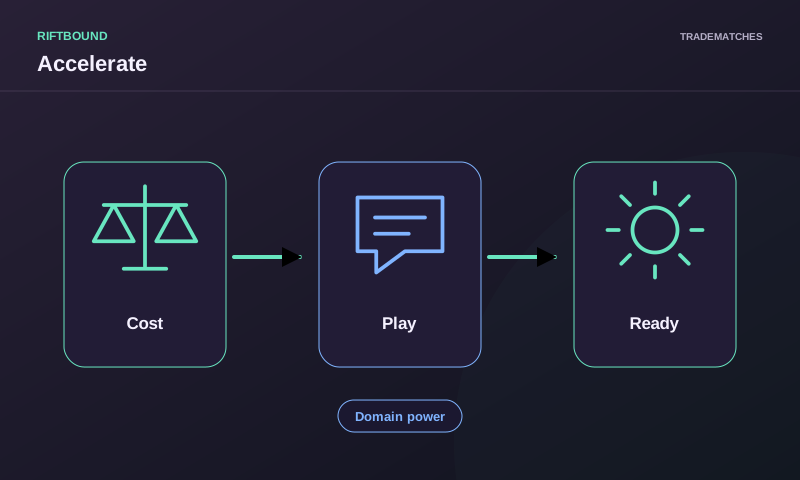
Accelerate lets a Riftbound unit enter ready when its controller pays an optional additional cost while playing it. It is not a button you can use later to ready a unit already on the board. The difference matters both for resource planning and for abilities that care about a unit becoming ready.
The cost combines one Energy with one appropriate Power. Those resources are different, and the required Power depends on the unit's domains under the current comprehensive rules. This guide explains that payment, the entry event and the practical decisions that follow, using illustrative examples rather than claims about an unbeatable deck.
What Accelerate changes
Units normally enter the board exhausted unless a rule or effect changes that entry. Paying Accelerate supplies a replacement that makes this unit enter ready instead. You make the decision during the process of playing the card, not after seeing what its first move accomplishes.
The comprehensive rules linked by Riot, especially section 805, distinguish this additional cost from an ability functioning on the board. The official rules hub is the place to locate later revisions before organised play.
For a simple example, imagine a unit with Accelerate in your hand. You can play it without paying the optional addition, in which case Accelerate does not supply ready entry. Alternatively, announce that you are paying the addition, include it in the total cost and follow the playing procedure. Once the unit is on the board, the missed choice cannot be retroactively added.
Energy and Power must be budgeted separately
The shorthand for Accelerate is one Energy plus one Power associated with the unit's domain, with the current rule explaining multidomain and domainless cases. Having enough Energy alone does not prove that you can pay the full total.
Suppose an illustrative unit's ordinary cost is three Energy and no Power. Paying Accelerate adds one Energy and the required Power. You need to satisfy both components of the final cost, together with any other relevant modifiers. It is incorrect to call this merely a one-Energy surcharge.
Now imagine that your available resources can supply the Energy total but not the required domain Power. You cannot replace the missing Power with extra Energy merely because the combined number looks sufficient. Check what each resource produces and what each part of the cost requires.
| Payment question | What to establish before playing |
|---|---|
| Ordinary unit cost | Required Energy and Power before optional additions |
| Accelerate decision | Whether you are adding its optional cost |
| Unit has one domain | Power matching that domain |
| Unit has several domains | Power matching one of those domains under the current rule |
| Unit has no domain | Power of any domain for this component |
| Final cost | All applicable additions and modifications together |
This table does not assign a cost to a real card. It organises the checks you apply to whichever unit you intend to play.
Multidomain wording: check the current rule
Riftbound's rules guidance has changed over time. Earlier FAQ explanations of the Accelerate shorthand should not be treated as permanently interchangeable with a later comprehensive rule. In the current rules checked for this guide, a unit with one or more domains uses Power matching one of its domains; a domainless unit can use Power of any domain.
For example, an illustrative unit with Fury and Chaos can satisfy that Power component with either relevant domain. That is different from automatically accepting Power from every unrelated domain. Read the current rule rather than inferring the answer from the presence of two domain icons.
If your playgroup remembers a different explanation, compare the dates and exact text of the documents. Resolve the discrepancy before committing resources in a tournament. A rules change is a reason to update a habit, not to combine incompatible versions into a new house interpretation without saying so.
Ready entry is not a readying event
Accelerate replaces entering exhausted with entering ready. The unit does not first enter exhausted and then perform a separate readying action. That distinction is explicit in the current rule and can affect interactions involving “becomes ready.”
Imagine an ability that rewards a unit becoming ready during play. Paying Accelerate does not create that event simply because the new unit is visibly ready. Its initial entry state and a later change of state are different events.
The reverse misunderstanding also occurs: a player announces an enter-the-board effect, then claims they can separately pay Accelerate before that effect finishes. The additional-cost decision belongs to playing the unit. Treating it as a later activation creates a timing opportunity that the keyword does not provide.
What can the ready unit do next?
A ready unit may be able to use the game's ordinary actions and abilities that require its readiness. Accelerate does not independently remove movement costs, location restrictions or the need for a legal timing window.
Consider a player who wants to play a unit and immediately move it toward a battlefield. They should budget the unit's ordinary cost, the Accelerate addition and any cost of the intended move. Spending every resource on ready entry can leave the player unable to complete the planned follow-up.
Likewise, readiness does not automatically grant Ganking, change the unit's Might or supply additional actions outside the rules. Inspect the actual movement permissions and card text. The keyword changes one important starting condition; the remainder of the plan still has to be legal.
Choosing whether the additional cost is useful
The strategic question is what the ready state lets you accomplish now. If the unit has no useful immediate action, paying the addition may use resources without improving the current turn. If an immediate legal move or activation matters, the payment can have a concrete purpose.
Compare two hypothetical plans with the same hand. In the first, you play the unit accelerated but cannot afford the follow-up you wanted. In the second, you play it normally and retain resources for another necessary card. Neither plan is universally correct; the useful comparison concerns the complete turn, not the excitement of a single keyword.
Before deciding, consider what the opponent can do in the relevant response windows and what board position the unit would actually reach. Ready entry is valuable when it supports a feasible sequence. It does not guarantee that the unit survives, reaches a battlefield uncontested or scores a point.
Multiple copies of Accelerate do not stack
Multiple instances of Accelerate are redundant under the current comprehensive rules. Gaining the keyword again does not make the unit enter “more ready” or supply repeated movement permissions.
Keep that distinction separate from a card effect checking whether a unit has Accelerate. A keyword can be a characteristic another effect refers to even when its own entry-related function is not currently doing anything on the board.
For a complicated interaction where the unit loses the keyword during cost finalisation, the rules also preserve the paid entry replacement. The basic practical habit remains to announce the payment clearly and complete the playing process before moving to another action.
Avoiding payment disputes
State the ordinary cost and the Accelerate addition before paying. Identify the Power used for the domain component, especially with a multidomain unit. Keep the unit's entry state clear when it reaches the board.
If you discover that the resources do not meet the legal final cost, do not invent a conversion or quietly pay later. Follow the appropriate rules for handling an illegal action, and ask a judge in organised play. Clear announcements make it easier to establish what was intended and what was actually possible.
Record the complete intended turn
Before paying Accelerate, describe the next legal action you intend the ready unit to take. Write the costs of playing the unit and that follow-up separately, then check the available Energy and domain Power for the whole plan.
This prevents a subtle planning error: the player correctly pays for ready entry but has budgeted a later move using the same resources twice. If the follow-up is no longer feasible, reassess whether ready entry still serves another purpose. The calculation should support an actual sequence rather than treating the keyword as an automatic upgrade worth paying for in every hand.
Frequently asked questions
Can I pay Accelerate after playing the unit?
No. It is an optional additional cost during the playing process. Its own function does not let you ready a unit already on the board. A different card or ability would need to provide that later readying effect.
Does a multidomain unit accept any Power?
Under the current comprehensive rule checked here, the Power must match one of that unit's domains. A unit with no domain uses any-domain Power for this component. Check updated rules rather than relying on an older FAQ shorthand.
Does Accelerate trigger an ability for becoming ready?
The Accelerate entry replacement does not create a separate becoming-ready event. The unit enters ready directly. A later actual change from exhausted to ready is a different event and should be evaluated under the relevant ability's wording.