Riftbound Ganking and moving between battlefields
On this page
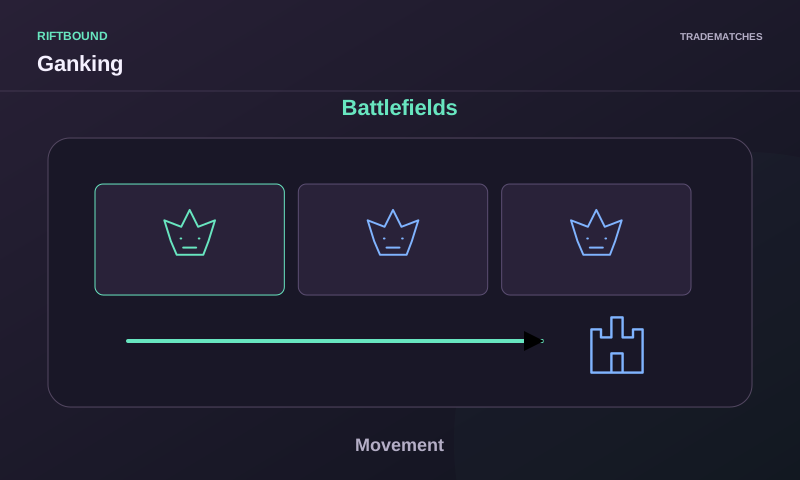
Ganking lets a Riftbound unit use its Standard Move to move directly from one battlefield to another. It adds a route to the normal movement permission. It does not make the move free, ready the unit or allow an ordinary Standard Move during Combat or a Showdown.
The unit still pays the Standard Move cost by exhausting, and the normal timing and destination restrictions remain relevant. Rules 144 and 810 in the official comprehensive rules explain the movement procedure and the keyword's added permission.
The route Ganking adds
Without an additional permission, a unit's Standard Move can take it from its Base to a battlefield or from a battlefield back to its Base. Ganking adds direct battlefield-to-battlefield movement. That can matter when you want to shift a unit between contested locations without first returning it to the Base.
The keyword does not remove the original routes. A unit with Ganking can still use an otherwise legal move from the Base to a battlefield, or from a battlefield to the Base. Ganking is an additional option, not an instruction forcing the unit to remain among battlefields.
| Starting location | Intended destination | Standard Move route |
|---|---|---|
| Your Base | A legal battlefield | Available through normal movement |
| A battlefield | Your Base | Available through normal movement |
| A battlefield | Another legal battlefield | Ganking provides this permission |
| Any location | A destination prohibited by the rules | Ganking does not override the prohibition |
Check the destination separately from the route. Being allowed to move from one battlefield to another does not guarantee that every battlefield is a legal destination in every game state, particularly in multiplayer situations involving other players' units or combat.
Passive permission does not mean a free move
Ganking itself is a passive ability without an activation cost. The Standard Move you perform using its permission still costs the exhaustion of the unit. These statements describe different things and are compatible with each other.
An already exhausted unit cannot simply exhaust again to pay that ordinary cost. If another effect readies it later, a new legal Standard Move may become possible when the other requirements are satisfied. Ganking alone supplies neither the ready effect nor an extra movement activation.
When a player says “Ganking is free,” clarify whether they mean that the keyword has no separate fee or that the unit can move without exhausting. Only the first describes the passive keyword correctly. The cost of the actual action remains.
Use the normal movement window
A Standard Move belongs to the player's Main Phase and cannot be performed in a Closed State, during a Showdown or during Combat. Ganking changes the route, not those timing restrictions. A ready unit cannot interrupt a resolving sequence simply because its destination would be another battlefield.
This matters when a player wants to rescue a unit during combat by moving it away. Ganking does not supply that response window. If a separate spell or ability moves the unit, read that effect's own timing and instructions rather than treating it as a Standard Move.
For the same reason, Ganking does not let you move your unit during an opponent's turn merely because the unit is ready. Locate the normal action window first. Then check the cost, origin, destination and any effects modifying the move.
A simple battlefield transfer
Imagine a ready unit with Ganking at battlefield A. During a legal Main Phase window, you want it at battlefield B. Check that B is a legal destination, declare the Standard Move and pay its cost by exhausting the unit.
The unit arrives through the normal movement process. Its presence may have consequences for contesting the destination and the resulting game sequence, but Ganking itself does not say “score a point,” “win combat” or “take an extra turn.” Resolve those other systems under their own rules.
Now change the example so the unit at A is already exhausted. The route is still permitted by Ganking, but the ordinary exhaustion cost is not payable in that state. You need a relevant effect or a later opportunity when the unit is ready; announcing the keyword again does not solve the cost problem.
Moving several units together
The Standard Move rules allow multiple units to move simultaneously as one game action. Their destinations must be the same, though their origins need not be. Their exhaustion costs are also paid simultaneously.
For example, a ready unit with Ganking at battlefield A and a ready unit at your Base may be able to move together to battlefield B. Each unit must have a legal route to B and be able to pay its own cost. The Base unit does not need Ganking for its ordinary Base-to-battlefield route.
If another selected unit is at battlefield C without Ganking or another relevant permission, it cannot borrow the first unit's keyword. Check each unit individually before combining the move. One legal participant does not make every other route legal.
You also cannot describe moves to two different battlefields as the same simultaneous Standard Move. The common destination requirement remains. Separate legal actions may be possible at appropriate times, but they are not one action merely because you announce them together.
Effects that move units use their own instructions
A spell or ability can instruct a unit to move. That movement is governed by the effect's text and the game's movement rules. It is not automatically the unit's Standard Move, and it does not necessarily require Ganking just because the origin and destination are different battlefields.
Conversely, the existence of an effect that moves one unit does not grant all units a new standard route. Identify the source of each proposed movement. If you are using the unit's inherent Standard Move, Ganking supplies the battlefield-to-battlefield option; if you are resolving another instruction, read that instruction.
This distinction prevents two opposite errors: refusing an effect-directed move because the unit lacks Ganking, and using Ganking to ignore the limitations of an unrelated effect. The permission must come from the actual action or effect being used.
More copies of Ganking do not add moves
Multiple instances of Ganking are redundant. Giving an already-Ganking unit another instance does not grant two battlefield transfers, reduce the exhaustion cost or create a response-speed movement option. The same route permission remains available once the action's requirements are met.
Other abilities on the unit can still matter independently. A separate effect that readies the unit, changes its movement permissions or triggers from movement has its own text. Do not attribute all those results to Ganking simply because they appear on the same card.
When learning a new unit, read each ability separately before combining them into a plan. That makes it easier to identify which part supplies the route, which part changes the state and which part produces a triggered consequence after movement.
Plan the transfer around its actual cost
Also check whether an effect has removed the unit's abilities before announcing the route. A unit that normally has Ganking may lack it in the current state. Printed text is the starting point, but the permissions available now include the effects currently applying. If the added route is absent, you cannot use a past state of the unit as authority for a new Standard Move.
Ganking can make positioning more flexible, but exhausting a unit is a real decision. Compare what the unit contributes at the origin with what it will contribute at the destination. Consider the resulting board and normal scoring rules rather than assuming movement itself guarantees an advantage.
For a teaching game, use two labelled battlefields and a Base. Demonstrate the normal routes first, then add the direct route for one Ganking unit. Repeat the example with that unit exhausted so the permission and cost become visibly separate concepts.
At an event, describe the intended action before moving several cards if there is a disagreement. Give the judge each unit's origin, destination, readiness and relevant abilities. Those facts make the ruling clearer than saying only that the group is “ganking.”
Frequently asked questions
Does Ganking let an exhausted unit move normally?
No. A Standard Move still requires paying the exhaustion cost. Ganking does not ready the unit or remove that cost.
Can I use Ganking during Combat?
Not as an ordinary Standard Move. The normal timing restrictions remain. A separate moving effect must be evaluated through its own text and timing.
Does a second instance of Ganking grant another move?
No. Multiple instances are redundant. Additional movement opportunities require some other applicable effect or change in state.