Riftbound Hidden: hiding and playing a card
On this page
Hidden in Riftbound lets you pay to place a card face down at a battlefield you control, then play it from there on a later turn under the keyword's permissions. Hiding isn't playing. The card must meet battlefield requirements, availability and targets; you cannot hide any card or treat it as an immediate reaction without reviewing the sequence.
Which cards can be hidden
Hidden is a keyword that can appear on spells, units and Gear. The rule permits the Hide action for cards that have it, from the permitted zones, during your turn and in an open state. Being playable as a Reaction for another reason does not give a card Hidden. The two abilities solve different problems.
Before preparing the card, check its text and the zone from which you hide it. The current rules also provide for the Champion Zone when applicable; do not assume the permission is limited to cards in hand. You must identify the permission of that copy, not simply hide the card you would like to reserve for later.
The battlefield has to be available
The ordinary action requires a battlefield that you control and does not already have a hidden card face down. You cannot use a neutral or rival battlefield to prepare a surprise under the ordinary rule. Nor can you stack multiple hidden cards in that space because there is unused space on the playmat.
Choose the battlefield according to where the effect will be useful and your ability to maintain control. The card is linked to that location. If you need to answer elsewhere on the table, hiding it in a distant battlefield can limit the effect when the time comes to use it. The later cost reduction does not eliminate selection and location restrictions.
Pay to hide and pay to play
Hidden's general procedure includes paying the indicated resource cost to hide. Then, from the next turn, it grants permission to play from Hidden ignoring its base cost according to that rule. Do not turn “ignore base cost” into "ignore all costs and conditions": there may be additional costs and card requirements that continue to apply.
If the text uses symbols, check which resource each represents. Do not confuse generic Energy with domain Power. To learn, point to the symbol on the card and announce how you pay for it. Runes and resources have their own rules, and an informal explanation like "I pay one" can hide what part of the cost you're meeting.
Hiding does not open a chain
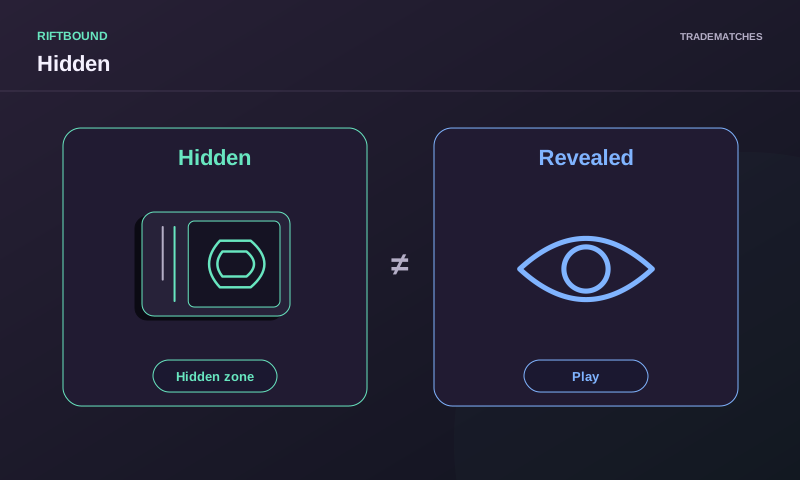
Hide is not a Play variant. Hiding does not satisfy conditions that require playing a card, and it does not open the chain that playing would open. This explains why merely hiding a unit neither puts it into combat nor immediately produces its play effect. It remains face-down under the Hidden procedure.
When you later play it from that state, the play process and its chain do occur. Then you must announce what is necessary and follow priority and response rules. Do not omit this phase by saying that "I already paid to hide it": the payment to hide prepared a future possibility, but it did not resolve the effects of the card.
When can you use it
Ordinary authorization starts on the next turn, which may be the opponent's turn. You cannot hide a card and immediately use that same preparation during the turn you hid it in as if it were a ready Reaction. Distinguish the preparation turn and the subsequent turn in which the permission takes effect.
A simple example: hide a card in your turn while you control the battlefield. Your turn ends and the opponent's turn begins. If you maintain the necessary conditions and there is a valid window, you can consider playing it from Hidden. If instead you are still in your preparation turn, you need another specific permission to execute a different action; Hidden alone does not make that permission available earlier.
Targets are often linked to the battlefield
The rules restrict certain choices of a card played from Hidden to the battlefield where it was hidden. A spell that chooses units does not automatically become a global response. If there are no valid targets under those restrictions, you cannot announce it by ignoring the limitation. Exceptions depend on the text restricting the choice in a way that makes it impossible to comply with it in that battlefield.
The play effects of a hidden permanent also require that reading. If the unit enters and its effect chooses another unit, check the required location for each target. When there are several choices, they are evaluated individually. Do not use an exception applicable to one target to exempt the other targets from Hidden's restrictions.
Units and Gear enter where they were hidden
A permanent played from Hidden must enter the corresponding battlefield. This can allow a Gear to appear there even if you normally play it to the Base. That entry exception does not remove subsequent card type rules, such as corrections that can be applied to an unattached Gear located in a battlefield.
The unit also does not gain universal permission to act because it enters an advanced location. Check how it enters, its keywords and the sequence in which it is played. If you are in a combat or Showdown, the reaction must be resolved by the rules of that moment. The strategic surprise comes from legal preparation, not from ignoring the status of the card.
What happens if you lose control of the battlefield
Keeping the card hidden depends on retaining control of that battlefield. If you stop controlling it, the relevant Cleanup procedure sends the card to its owner's Trash. You can't leave it there for later or move it silently to another battlefield. Check game state corrections when battlefield control changes.
Before removing your last units or leaving a battlefield, consider what happens to the hidden card. Sometimes keeping that preparation requires maintaining a presence that you would prefer to move. This is a resource decision: protecting a future possibility can have a cost in mobility or units. There is no universal answer without looking at the game.
Hidden information and fair play
Place the card so as to distinguish which battlefield it belongs to without revealing its identity. Do not inspect an opponent's hidden cards or demand to know their name before the rules make it public. When playing it or when the procedure takes it to a public zone, retain the information necessary to verify that the preparation was legal.
In an event, do not try to repair an irregular Hide action yourself if subsequent actions have been taken. Explain when you hid it, where it was hidden and what changed, then call the judge. The clear position of battlefields and cards face down helps resolve the question; mixing hidden cards with runes or resources can erase that context.
Prepare the card on the right battlefield
Suppose you control battlefields A and B and want to hide a spell that selects a unit. If the threat you intend to answer is on B, do not choose A merely because it seems safer. The ordinary targeting restriction may stop the spell from affecting that threat. Check the text and any specific exception before choosing the location. A future discount is of little use if the card has no permitted target when you need it.
Then consider the following turn. If you prepare the card on A and lose control before using it, Cleanup sends the hidden card to the appropriate Trash. Regaining the battlefield later does not restore that preparation. If you retain control, you still need a valid playing window and must meet requirements Hidden does not remove. Separate three decisions: where to hide, when playing becomes permitted and which targets will be legal.
During deck testing, record why a preparation could not be used: losing the battlefield, lacking a target or being unable to pay an additional cost. Each suggests a different adjustment. Combining them all into a vague complaint that Hidden did not work discards information useful for card selection and movement planning.
Frequently asked questions
Does hiding count as playing the card?
No. Hide and Play are different actions. The effects that need you to play the card are checked when you really play.
Can I use it on the same turn I hid it?
Not by Hidden's general permission. Authorization from that state starts from the next turn.
Can I choose targets from any battlefield?
Not generally. Location restrictions and express exceptions to the text and rules apply to each choice.