Reactions and the chain in Riftbound
On this page
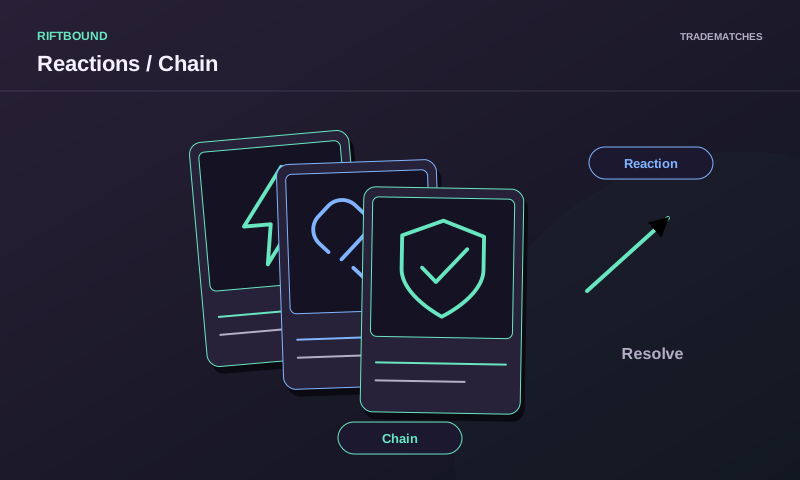
In Riftbound, Reaction is a time-based permission: it allows you to play a card or activate an ability even when a chain already exists and during any player's turn, as long as its other requirements are met. The chain organizes pending cards and abilities to be resolved. Knowing the difference between "I can play now" and "what resolves first" avoids two common mistakes: attempting to respond with a card without permission and assuming that everything added to the chain functions the same way.
What is a chain in Riftbound?
A chain is a temporary zone that appears when a card is played or an ability is activated. Elements enter pending, go through a resolution process, and are then resolved according to the rules. There can be only one chain at a time; if a player plays another legal card while a chain exists, it is added to the existing chain. The chain is not a list of already-resolved cards nor a place where future actions are stored.
On the battlefield, it's helpful to physically separate or announce elements in the order they were added. This allows you to identify which one is most recent, what targets or costs were set, and who receives the next opportunity to act. A ability triggered can also create a chain element. Not all elements behave the same during resolution, so the full rulebook prevails over a quick analogy with other games.
Open state and closed state
Riftbound calls open state a moment without a chain and closed state one in which a chain already exists. In a closed state, the general rule limits what can be played or activated to cards and abilities with Reaction, except for other explicitly granted permissions. This is the central utility of the keyword. In an open state, the player with the appropriate opportunity can perform the actions permitted for that moment.
The turn state can also be neutral or within a Showdown or combat. During a Showdown, rules restrict actions to those with Action or Reaction. Therefore, "there is combat" and "there is a chain" are distinct questions: a Showdown can occur in either an open or closed state. Identifying both axes helps avoid playing a normal action during a chain or treating a Reaction as if it only exists during combat.
What exactly does Reaction allow?
The rules define Reaction as a permissive keyword. A card with Reaction can be played in a closed state during any player's turn; an ability with Reaction can be activated under those conditions. It also retains Action permissions and any other permissions granted by its own text. Reaction does not modify the instructions of the effect: if it says move, heal, or choose a target, those instructions remain unchanged.
It also retains the card type restrictions. A unit with Reaction does not gain the ability to play on any battlefield: by general rule, it remains limited to its controller's base or a battlefield they control, unless a specific permission is granted. Similarly, a card requiring a legal target or a payable cost cannot ignore those requirements simply because it has Reaction. The permission responds to "when"; the other rules respond to "how" and "where".
A simple step-by-step response
Imagine a player plays a spell that affects a unit. That spell creates an element in the chain. Once the corresponding steps are completed, the other player receives priority to add a legal Reaction before the spell resolves. If the Reaction protects that unit and resolves at the right moment, the spell's result can change. There's no need to invent an "interruption" outside the system: the response is part of the chain.
The useful sequence is: announce the initial card; complete the play steps and pending tasks; offer the opportunity to respond when the process allows it; add and finalize the Reaction; allow priority to pass as appropriate; and resolve elements in the order specified by the rules. Once an element is resolving, no new Reaction can be inserted mid-instruction. The opportunity to respond exists before that resolution begins.
Priority and passing
Priority identifies who can act next. The player with priority can play a legal card or activate an ability for that state, or pass. When all players pass in sequence without adding anything, priority passes to resolve the corresponding element. Adding a response breaks that sequence of passes and requires re-offering opportunities. That's why it's not enough for a player to simply say "pass" once to resolve the entire chain if the other player still has the chance to act.
After resolving an element, if other elements remain in the chain, there may be a new opportunity to act before the next one. This allows responding to what follows pending after seeing the effect of the most recent element. It does not equate to going back and modifying something already resolved. The rules refer to FEPR—the process of finalizing, executing, passing, and resolving—with tasks addressed when appropriate. Following this order prevents skipping legal responses in complex plays.
The most recent element usually resolves first
After relevant passes, the rules resolve the most recently finalized element. Thus, a Reaction added to protect a unit usually resolves before the previous spell it responds to. Then, the chain state and priority are rechecked. It is not a license to undo costs, targets, or events already completed: the Reaction affects what remains pending according to its text.
There's an important nuance: upon finalizing certain elements—such as units, gear, or abilities that add resources—the rules may cause them to resolve immediately rather than waiting for the same step as a regular spell. That's why the phrase "everything goes in reverse" is too broad for Riftbound. To teach a specific play, indicate what type of element entered the chain and consult its resolution path. The common example of two spells does not describe all cases.
Reaction does not replace costs or targets
Before a card or ability is ready to resolve, the play process includes decisions, costs, and a legality check. A Reaction requiring a unit choice is invalid if no legal choice exists at the required moment. If an effect imposes an additional cost, Reaction does not eliminate it. The rules distinguish pending elements from finalized ones precisely to order these checks without assuming everything is fixed when the card name is announced.
The keyword may depend on a condition. The rules allow cards or abilities to receive Reaction while a requirement is met—even if that condition is determined during the play process. If the condition fails at the legality check, the play actions are undone according to the applicable rule. Do not extend this advanced case to all cards: for most responses, it's sufficient to check whether the card has Reaction and whether its other requirements are met.
Action versus Reaction
Action and Reaction are not power labels. Action expands the moments when you can play or activate something, especially during a Showdown; Reaction includes Action permissions and also allows entry during a closed state. An Action effect does not automatically become Reaction just because you want to respond to an opponent's card. If a chain already exists, look for the Reaction keyword or an explicit equivalent permission before announcing the play.
Example: An Action spell may be playable during a Showdown when there is no chain. If another player plays something and the chain opens, the same spell does not gain permission to be added as a response. A Reaction card can do so, subject to costs and restrictions. The difference is in timing, not in one "beating" the other. An Action effect can be very powerful and still have fewer activation opportunities.
Reaction outside of a Showdown
The keyword is not reserved for battles over fields. It can be relevant at other moments of the turn and during an opponent's turn, depending on the situation and the card's text. The rules define Reaction as a permission for closed states of any turn and do not restrict it to Showdowns. However, not all moments of the game open a free opportunity to act: mandatory tasks and the resolution of an element follow their own order.
A useful way to think about it is: "When do I receive a window to respond? Does my card have permission?" If the answer is yes, verify target, cost, and restrictions. If there is no window because an effect is already halfway through resolution, Reaction does not create a new pause. The same discipline helps players familiar with other TCGs but who must learn the specific names and exceptions of Riftbound.
Common mistakes when announcing a response
The first is playing a card without Reaction in a closed state. The second is using Reaction to ignore the zone where a unit can be played. The third is resolving the entire chain at once after a pass, without returning priority when other elements remain. The fourth is assuming that units, gear, and resource abilities behave exactly like spells. The fifth is trying to respond to an instruction that is already being executed.
To avoid these mistakes, announce a clear phrase: "There is an open chain; I have priority; I play this Reaction; I choose this target and pay this cost." Then let the other player respond according to the procedure. If a specific interaction depends on a card's text or an update, use the current Core Rules from the official Rules Hub. The Riftbound rules are updated, so an older explanation may omit an important exception.
Practical summary
Reaction allows action in a closed state and during any player's turn, without removing costs, targets, or zone restrictions. The chain gathers pending elements, and the official process determines when they are finalized, who has priority, and which one resolves first. In a typical response example, the most recent element resolves first; certain types of elements have immediate resolution upon finalization. If you separate permission, legality, and order, most chains become manageable.
Frequently Asked Questions
Can I play a Reaction card while another card is resolving?
No response is added during the resolution of an element. You must use a priority window before the element begins or when a new opportunity opens afterward.
Can a unit with Reaction enter any opponent's battlefield?
No, solely by having Reaction. It retains normal zone restrictions for playing units, unless another text grants a specific permission.
Does Action allow responding to an already-open chain?
Action alone does not grant the closed-state permission that Reaction provides. Check whether the card has Reaction or another explicit authorization.
Official Source: Riftbound Rules Hub, Core Rules as of July 2026.