Riftbound unit owner versus controller
On this page
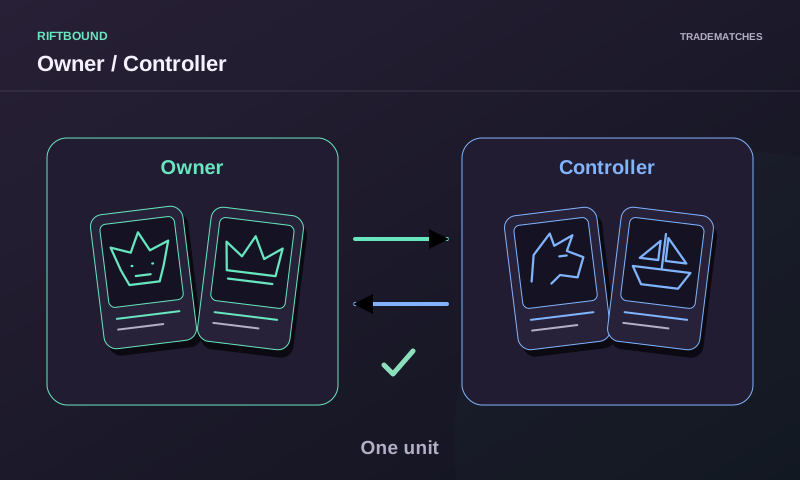
A Riftbound card's owner and current controller can be different players. Taking control of a unit does not transfer ownership of the physical card or let you put it into your own private zones. When it would enter a player's non-Board zone, the rules send it to its owner's corresponding zone. Control of a unit is also different from control of a Battlefield.
Identify three separate relationships
The game owner is the player who brought the card into the game, or the player who created a game object when that definition applies. This can differ from legal ownership: if A lends a deck to B before play and B brings it into the game, B is its game owner. Control identifies who currently handles the object's game actions and relevant abilities. Battlefield control identifies the relationship between a player and a location for the game's location and scoring procedures. They can interact, but they are not synonyms.
The current Core Rules' Silver Rules explicitly prevent a player's cards from entering another player's non-Board zones and list the relevant destinations. Their ownership and control sections govern how an object's references are interpreted. Use the Rules Hub's current document for an unfamiliar interaction, especially when a card changes control with a duration or additional movement instructions.
For a teaching exercise, label a unit “owner A, controller B.” Label its Battlefield separately. You can then answer questions without erasing one identity to record the other. A physical position on your half of the table is a reminder of control; it is not a new owner label.
Trace a controlled unit through possible destinations
Imagine a hypothetical effect legally gives B control of A's unit. If that unit is killed and must enter Trash, it goes to A's Trash. If an instruction returns it to a hand, it belongs in A's hand. If it is recycled to a deck, use the owner's appropriate deck, with the exact placement and procedure determined by the effect.
| Hypothetical movement of A's unit while B controls it | Ownership check |
|---|---|
| Killed and placed in Trash | A's corresponding Trash |
| Returned to hand | A's hand |
| Recycled into a deck | A's appropriate deck, following the instruction |
| Banished | A's corresponding Banishment |
| Moved between legal Board locations | Check control and movement permissions; ownership stays A |
The table assumes the unit is actually affected and the stated movement occurs. It does not bypass protection, choices or a card's special instruction. “It goes to the owner” answers whose zone to use, not whether a proposed effect is legal.
“Your” depends on the effect's perspective
An ability using “your” needs the correct controller or rules-defined perspective. You should not treat a borrowed card as permanently describing its original player whenever its text refers to friendly units or a Base. Nor should you assume that every reference to a card's name names any object with that title: Riftbound's self-reference rules matter.
Take a hypothetical unit whose ability affects friendly units at a location. If B currently controls the unit and the ability is used under B's perspective, its eligible friendly units can differ from those eligible when A controlled it. Ownership has not changed; the effect's scope is evaluated under the appropriate rules for its controller.
For an ability already on the chain when control changes, check who controls that ability and how it refers to its source. Do not guess that every pending effect is automatically reassigned with the physical card. State when the ability was generated, when control changed and what its text refers to. Those timing details decide a more complex interaction.
Read the duration instead of inventing a return
Some effects grant control temporarily; others may use different conditions or no simple until-end-of-turn phrase. Record the duration from the actual effect. A unit does not necessarily return at the end of the turn because another game has a familiar temporary-control mechanic.
Suppose a hypothetical effect says that B gains control for the stated turn. Mark that duration visibly while the effect applies. If the unit leaves the Board before the duration ends, do not move a card back out of its owner's hand or Trash merely to complete a visual “return.” Its zone movement has already changed the object or made the control situation irrelevant as the rules specify.
If the source of a control effect leaves play, read whether the effect depends on that source remaining. A duration and a condition are not interchangeable. “Until this turn ends” and “while you control this source” describe different termination tests. Document the actual words in a practice game rather than assigning one standard lifetime to all borrowed units.
Unit control does not itself award a point
Riftbound scoring examines the relevant Battlefield procedures and conditions. Gaining control of an object is not an instruction to score merely because it improves your position. Determine the resulting location state and any subsequent conquest or holding condition through the scoring rules.
Imagine B controls A's unit at a Battlefield where A still has another unit. The location situation differs from B controlling the only unit there. The owner of the borrowed unit does not automatically make it A's unit for every control calculation; conversely, gaining control does not skip combat or a scoring procedure that still needs to happen.
Use the separate conquest and holding guide for point timing. This article's purpose is to keep card identity and zone destinations correct while those procedures occur. Having a distinct notation for owner, controller and location prevents a scoring argument from becoming a dispute about whose physical card it was.
Keep borrowed physical cards recognisable
In casual play, different sleeve colours or an agreed removable marker can help identify ownership. Do not attach adhesive labels to another collector's card. At an event, follow the organiser's sleeve and component requirements; convenience does not override those requirements.
When moving a borrowed card into a destination, announce its owner as well as the destination. “Your unit goes to your Trash” is clearer than sliding it into your own pile and attempting to reconstruct identities at the end. If several identical prints are borrowed, preserve the information needed to return the correct physical cards.
Game control is not a real-world trade. A spell cannot convey digital or legal ownership outside the game, and borrowing a unit on the Board is not agreement to exchange collectibles. Separate play actions from any actual exchange discussion. For a collection record, use the trade's agreed physical identity and condition; for a game record, use the temporary control state.
Frequently asked questions
Does taking a unit let me put it in my own hand?
No. Ownership governs the corresponding non-Board zone. If an effect moves an opponent-owned unit to hand, the rules direct it to its owner's hand.
Does moving a unit to my side transfer ownership?
No. Physical layout can represent current control, but it does not change who owns the card within the game.
Is controlling a unit the same as controlling its Battlefield?
No. Evaluate object control and Battlefield control separately, then apply the relevant location and scoring procedures to the resulting state.