Conquer vs Hold battlefields in Riftbound
On this page
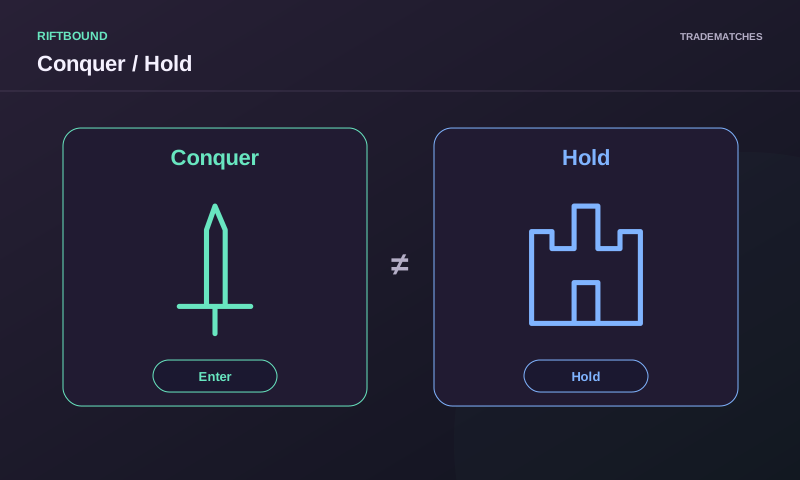
In Riftbound, Conquer and Hold are two ways to score a battlefield, but they occur at different times. Conquer happens when you gain control of a battlefield you haven-'t yet scored during that turn. Hold happens when you maintain control of a battlefield at the beginning of your turn and haven-'t scored it yet that turn. This distinction determines which abilities trigger and when you get the opportunity to add the point.
First, control; then, scoring
A battlefield can be controlled by a player or not. Gaining control and scoring are related, but not interchangeable. A Showdown can end in a situation that allows you to take control; after that, the rules check whether Conquer applies. Hold, on the other hand, looks at whether you maintained control at the start of your turn. The board and the score tracker must separately reflect both of these conditions.
This distinction prevents saying "I conquered again" every time you keep units on the battlefield. Conquer refers to gaining control at the moment specified by the rules; Hold refers to maintaining it until the beginning of your turn. A card that says "when you conquer" does not activate simply because you remain there. Another card that says "when you hold" does not activate if you take control mid-turn.
When does Conquer occur?
The Core Rules describe Conquer as scoring when you gain control of a battlefield you haven-'t yet scored during that turn. It often happens at the end of a Showdown procedure, after determining the result and checking who controls the battlefield. It is not an action you freely announce just because you have a unit there. The result of the combat or Showdown and the control rule are both necessary.
Example: A battlefield was uncontrolled, you move units there, and at the end of the confrontation, you are the only player meeting the conditions to control it. If the rules state that you conquer and you haven-'t scored it yet that turn, Conquer occurs. Then you apply the score and the corresponding abilities. If an enemy unit remains in a way that the Showdown has no winner, do not convert your presence into a conquest automatically.
When does Hold occur?
Hold is checked during the Beginning Phase of your turn: you maintain control of a battlefield and haven-'t scored it yet that turn. You do not need to fight a combat again at that moment just to score by holding. You must maintain control until the appropriate moment. If your opponent took control earlier, simply remembering you controlled it last turn is not enough.
Example: You conquer a battlefield during your turn and your units remain there when your next turn begins. If you still control it and there is no other impediment, you can score that battlefield by Hold during the beginning phase. In this example, conquest and holding belong to different turns. If your opponent gains control between the two turns, your expectation of Hold disappears; the previous score does not preserve lost control.
A battlefield is scored only once per turn
The rules impose a clear limit: each player can score each battlefield once per turn via Conquer or Hold. This prevents receiving multiple points from the same battlefield by changing its state several times within the same turn. It also limits the abilities that trigger from that scoring: a Conquer or Hold ability linked to a battlefield must not trigger more than once per scoring event.
Imagine you score a battlefield by Conquer, then lose and regain control during the same turn. The regain may affect control, but it does not create a second ordinary score of that battlefield for you that turn. That’s why it’s wise to keep a discreet marker of which fields you’ve already scored. In a game with multiple moves, relying solely on the current position of units may hide that the limit has already been used.
What you gain when scoring
When scoring by Conquer or Hold, the normal procedure usually grants you up to one point, subject to score and victory limits. Then, the battlefield’s scoring abilities are checked: Conquer abilities if the battlefield was conquered, and Hold abilities if it was held. "Scoring a battlefield" and "gaining a point" are connected, but the rules allow situations where the scoring process occurs without adding the expected point.
This precision matters with cards that prevent gaining points or with the special restriction on the final point. A guide that simply says "Conquer = immediate point" could be wrong in those cases. To resolve them, first record whether the Conquer or Hold event occurred, then apply the scoring result and the corresponding abilities. The official Riftbound FAQ clearly distinguishes gaining points from the act of conquering or holding.
Abilities "When I conquer" and "When you conquer"
An ability that says "When I conquer" looks at the presence and conquest of the unit specified according to the card’s conditions. "When you conquer" refers to the player who achieved the conquest within the scope set by the rules and the card text. Neither of these automatically becomes "when you hold". If a card has a Conquer ability, identify which unit was present and whether the battlefield was actually scored by that method.
The rules recognize these abilities as triggered. Once the appropriate event occurs, they enter the chain procedure when applicable, with their targets, costs, and conditions. Do not advance the effect before determining the Showdown result. Also, do not use it if you simply occupied the battlefield without a conquest occurring. The full text may add a requirement, such as being in a specific battlefield or exhausting a card.
Abilities "When I hold" and "When you hold"
Hold abilities are tied to maintaining control during the beginning phase. If a card says "When I hold", check whether the unit participates in holding the battlefield according to the wording and rules. If it says "When you hold", verify that the player controls the battlefield and scores it by Hold. The presence of a unit with that phrase does not cause holding to occur outside the designated phase.
Planning differs: a Conquer ability can reward taking the battlefield now; a Hold ability rewards maintaining it until your next turn start. The opponent has time to challenge that control. The difference is not merely terminological and can influence where you place units, when you spend resources, and which fields you protect. Still, strategic decisions do not replace the literal verification of each trigger.
Conquest after combat and without combat
Conquest is often associated with combat, but you should not define it exclusively as "winning a battle". The rules allow Showdowns without combat that can result in a change of control and a conquest if the other conditions are met. For example, an effect that alters which units each player controls in a battlefield can lead to this situation. The relevant event is gaining control and scoring according to the procedure, not necessarily having launched a traditional attack.
At the same time, not every combat victory guarantees a conquest. There may be control conditions, scoring limits, or results that prevent declaring it. After clearing the combat and determining the winner, follow the regulation order for control and the Conquer event. The updated official documentation explains these steps in more detail than an informal rule like "the one who wins combat scores".
What happens if the battlefield is contested?
A battlefield with units from multiple players may be contested. Its control status is determined by the rules, not by who arrived first or who has the unit of highest strength in isolation. If, at the end of the corresponding procedure, no winner is established to take control, do not invent a conquest. For Hold, you also need to effectively control the battlefield when checking your beginning phase.
In a game, it’s useful to announce "controlled", "uncontrolled", or "contested" when the board changes. These words help distinguish the conditions for scoring. If an interaction with effects moves or removes units during a Showdown, wait to resolve it before recording the point. A snapshot of the previous card positions does not replace the actual state at the time of verification.
The special case of the final point
Riftbound has a special restriction for earning the final point via Conquer. If you attempt to gain it by conquest while being one point away from victory or more, you must have scored all battlefields during that turn; if not, you draw a card instead of gaining that point by Conquer. The rules clarify that points from other sources are not subject to this specific Conquer condition.
This rule does not turn Conquer into Hold nor eliminates the Conquer event itself. It explains why a player might say "I conquered, but I drew a card instead of scoring the final point". Keep track of battlefields scored during the turn before applying the final point. If a card modifies the ability to gain points, separate the scoring event from the point added to the score tracker.
How to keep track without debate
At the start of your turn, identify the battlefields you control and check which ones score by Hold. Mark each one after applying its point and its abilities. During the turn, when a Showdown gives you control of another battlefield, verify whether you’ve already scored it and announce Conquer only if appropriate. Maintain a separate control tracker from the score tracker. With three battlefields on the board, this small discipline usually avoids most errors.
If a card says "when you conquer or hold", it is not two activations from the same event: it triggers when the appropriate method occurs, according to its text and the scoring limit. If there are multiple cards with triggers, order them according to the chain procedure. In a complex situation, consult the current version of the Core Rules and the Rules Hub errata, because the printed text of a card may have been clarified.
Practical summary
Conquer rewards gaining control and scoring a battlefield you haven-'t scored during that turn. Hold rewards maintaining that control until the beginning of your turn and scoring it there. Each battlefield is scored once per player and per turn; the scoring event determines which abilities trigger. The final point by conquest has an additional condition. If you record control, scoring method, and turn, you’ll know when each phrase applies without confusing it with combat.
Frequently Asked Questions
Can I activate "when I conquer" while holding a battlefield?
No, via Hold. That ability requires a conquest; a Hold ability requires the holding event as specified in its text.
Can I score a battlefield again if I regain it during the same turn?
No, via normal scoring of the same battlefield by that player: the limit is one score per battlefield and per turn, whether by Conquer or Hold.
Does conquering always add a point?
Normally scoring allows gaining up to one point, but there are restrictions—especially for the final point by Conquer. The event and the point must be verified separately.
Official sources: Riftbound Rules Hub and current Core Rules; Official FAQ on Conquer, Hold, and scoring.