Riftbound Tank: assigning lethal damage first
On this page
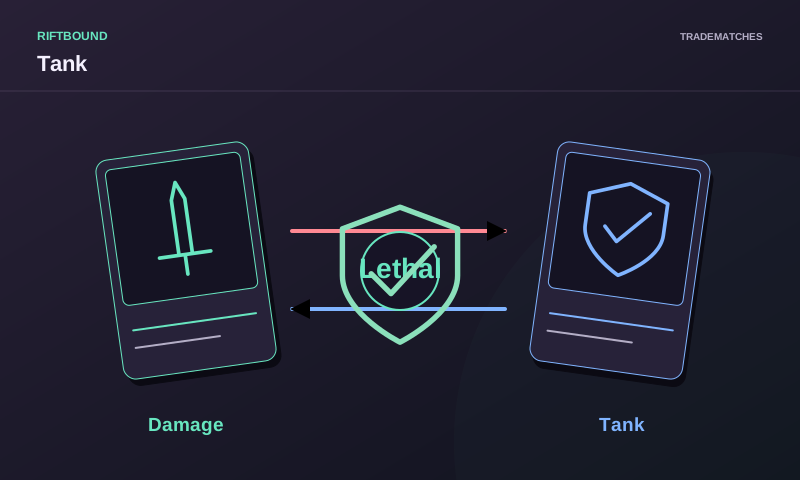
Tank in Riftbound changes the assignment of combat damage. A unit with Tank must receive lethal damage before damage can be assigned to a unit without Tank controlled by the same player in that combat. With several Tanks, all of them need lethal assignments before a non-Tank becomes an eligible assignment.
Tank does not automatically prevent damage or make its unit survive. It constrains the sequence in which a player's combat damage can be distributed. Use the current combat rules together with rule 815, rather than interpreting the keyword as a generic shield.
Identify the group that is actually in combat
Start with the units participating in the combat and their current controllers. Tank protects the assignment priority within the relevant group controlled by the same player. A Tank somewhere else on the Board does not draw damage from an unrelated battle just because you own it.
Also distinguish ownership from control. The keyword refers to the same controller, not simply the person whose deck originally contained the cards. If a control-changing effect is relevant, evaluate the group using the current rules and actual state.
Before assigning anything, point out which participating units have Tank. This small announcement prevents an opponent from allocating damage to a preferred non-Tank and only afterward discovering that the proposed assignment was illegal.
Lethal is a rules calculation, not a preferred amount
Determine the amount that counts as lethal under the combat rules using the unit's current Might, damage and any relevant modifiers. Do not assume the printed number on the card is always the complete answer. Effects resolved before damage assignment can change the calculation.
The examples here use undamaged units, stated Might values and no additional modifiers. If a Tank has 4 Might in that simple situation, assigning 4 damage meets the example's lethal requirement. Assigning only 3 does not let you move on to a non-Tank.
Keep damage assignment distinct from the eventual result of damage. A prevention or other applicable effect may change what actually happens afterward. Tank's instruction concerns making a legal assignment; it is not a guarantee about every subsequent consequence of that assignment.
One Tank creates a clear first threshold
Imagine a defending group containing a 4-Might Tank and a 2-Might non-Tank. The opposing player has 5 combat damage to assign, with no other effects involved. At least 4 must first be assigned to the Tank before the non-Tank can receive any.
That leaves 1 for the non-Tank if the player chooses that distribution. Assigning 2 to the non-Tank and only 3 to the Tank would violate the Tank priority, even if that arrangement would remove a strategically important unit.
If only 3 damage is available, the non-Tank does not become a legal destination by splitting the amount. Assign it according to the combat assignment rules and the Tank restriction. The shortage means you cannot satisfy the threshold that unlocks assignments to the other unit.
Several Tanks do not permit skipping the remaining ones
Suppose two undamaged Tanks have 3 and 4 Might, accompanied by a 2-Might non-Tank. Before the non-Tank can receive assigned damage, both Tanks need lethal assignments: 7 damage altogether in this uncomplicated example.
The player assigning damage may choose which Tank to address first. However, the rules still require assigning lethal to one unit before moving to the next. You cannot distribute small nonlethal portions across several Tanks and then start assigning damage to the non-Tank.
With 6 available damage, you could satisfy one Tank's threshold and assign the remainder to the other as permitted by the combat rules. You would not have enough to unlock the non-Tank. With 8 available, satisfying both thresholds could leave 1 for it.
| Simple opposing group | Damage available | Relevant restriction |
|---|---|---|
| Tank 4, non-Tank 2 | Three | Non-Tank cannot receive an assignment yet |
| Tank 4, non-Tank 2 | Five | Four to Tank first; one can remain |
| Tanks 3 and 4, non-Tank 2 | Six | Both Tank thresholds cannot be satisfied |
| Tanks 3 and 4, non-Tank 2 | Eight | Seven satisfies both; one can remain |
Multiple instances on one unit are redundant
The current rules say that multiple instances of Tank are redundant. Giving an existing Tank another instance does not create an additional damage layer or double the amount that counts as lethal for that unit.
The distinction between two Tank units and two instances on one unit is important. Two units produce two separate assignment thresholds. One unit with the keyword twice remains one unit for this purpose, subject to its actual combat characteristics.
When building or reviewing a deck, do not count repeated Tank grants as automatically multiplying protection. An effect may have other useful text, but an extra instance of this particular keyword is not itself another body that must receive lethal damage.
Tank applies at combat damage assignment
Rule 815 specifically places the restriction in the Combat Damage step. A spell or ability that deals damage according to its own text is not automatically forced to target a Tank first. Check that effect's targets and instructions rather than importing the combat assignment rule.
For example, an effect that can legally deal damage to a chosen non-Tank is not redirected simply by the existence of a nearby Tank. The legality depends on the effect and other applicable rules. Tank by itself is not a universal targeting prohibition.
This difference gives the keyword a practical limit. It can make a group harder to dismantle through ordinary combat assignment while leaving other interactions available. Describing that limit accurately helps players evaluate the keyword without overstating its defensive reach.
Resolve earlier effects before locking in the numbers
Showdown and other combat windows can allow actions that change the group before damage assignment. An effect might remove a participating Tank, change Might or otherwise alter the relevant state. Use the state after those actions have resolved.
Do not announce an assignment using an obsolete board snapshot. If a Tank no longer participates when damage is assigned, its former presence does not create a lasting priority requirement. Conversely, a unit that has gained Tank in time can matter even if it did not have the keyword at the start.
Check duration and scope when a keyword is granted temporarily. A modifier that ended before the assignment step should not be kept because a player still remembers the earlier animation or announcement. The actual current characteristic is the relevant input.
Assignment order and combat result are different records
Write down an example in two parts: first the legal distribution of damage, then the damage and consequences after other relevant rules are applied. This avoids deciding that an assignment was illegal merely because the final result did not kill a Tank.
It also avoids assuming every unit will act or survive in a particular order solely because damage was assigned to it first. Combat damage procedure, simultaneous events and defeat processing are governed by their own rules. Tank only modifies the assignment question described here.
In a disputed game, reconstruct the available damage, participating units, current characteristics and chosen distribution. A claim such as “the Tank should have absorbed it” does not provide enough information to determine whether the assignment or a later damage interaction caused the disagreement.
Use Tank deliberately when choosing a group
An undamaged Tank with a meaningful lethal threshold can make it costly to reach a fragile non-Tank through combat damage. Compare that threshold with the opponent's available combat damage, rather than assuming the presence of the keyword always protects everything else.
Several Tanks can raise the total threshold, but their individual characteristics still matter. A group with two small Tanks is not automatically better than one larger Tank in every situation; available damage, other effects and your own tactical objective can change the decision.
These are planning considerations rather than guaranteed matchup outcomes. Tank does not prevent a player from using other legal removal, and an opponent may have enough damage to meet every threshold. Evaluate the specific board before relying on a general deck-building slogan.
Practise with written assignment exercises
Create three simple exercises using one Tank, two Tanks and no Tanks. State the Might, available combat damage and absence of modifiers. Ask a partner to propose a distribution, then verify the Tank thresholds before considering any strategic preference.
Next change one input, such as removing a Tank before damage or granting Tank to another unit. Recalculate rather than memorizing the first answer. This makes clear that the keyword responds to the current group and characteristics, not the initial arrangement.
For a real tournament interaction involving prevention or unusual modifiers, consult the current core rules and a judge. Identify the exact effects instead of extending an exercise that deliberately excluded them. The official rules hub is the appropriate place to confirm which revision governs the event.
Frequently asked questions
Can I split damage between several Tanks before assigning lethal to one?
The Tank rule preserves the general requirement to assign lethal to a unit before moving to the next. It does not authorize an arbitrary nonlethal split.
Does Tank force every damage spell to hit that unit?
No. Its described restriction concerns combat damage assignment. A spell or ability follows its own targeting and damage instructions.
Does giving Tank twice make a unit twice as protective?
No. Multiple instances on the same unit are redundant. Several separate Tank units are a different situation.