Showdown vs combat in Riftbound
On this page
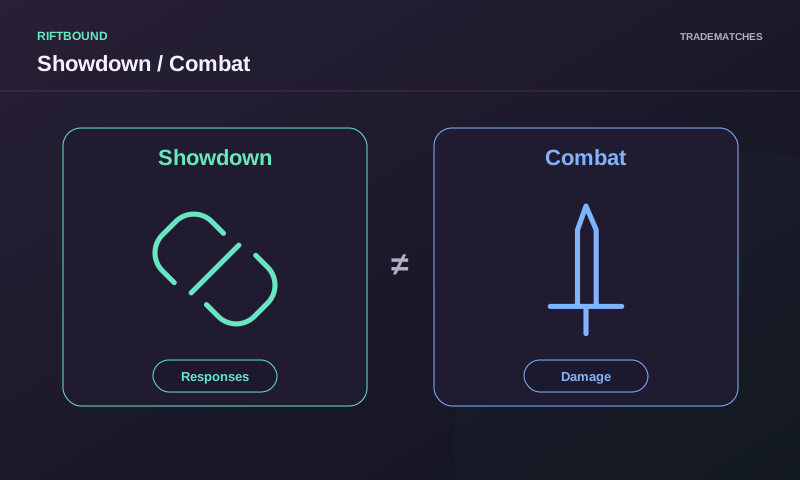
In Riftbound, Showdown is the conflict that begins around a Battlefield under specific conditions; combat is the portion of that conflict where units controlled by different players are present on that Battlefield. The distinction matters because a Showdown can exist without unit combat, and an already-open Showdown can transition into a Combat Showdown when the situation changes. The official rules revised this relationship with Unleashed and subsequently published a clarification. If you learned an earlier explanation, review the current version before deciding when combat resolves or when a Battlefield scores.
Start with the Battlefield, not with unit strength
The initial question is whether the Battlefield is Contested, meaning it is disputed according to current rules. The Riot rule change document states that a Showdown is prepared on contested Battlefields where a unit is present and its controller does not control the Battlefield. Then, check who controls the units present. If units are controlled by different players, there are conditions for a Combat Showdown; if not, the Showdown may exist without combat. The size of the units does not determine the classification: a large unit facing a small one remains combat if both are present and under control by different players.
A way to avoid confusion is to separate Battlefield state, unit presence, and Showdown procedure. The state can change as a result of moving or playing a unit. Presence determines whether there are units under opposing control. The procedure opens or changes during the designated cleanup windows set by the rules. If you combine those three steps into one phrase—“I entered, therefore I fight immediately and win”—you risk missing opportunities for response or applying a control that hasn't yet been established.
What is a Showdown without combat?
The intuitive case is when a unit arrives on a Battlefield that becomes contested without any opposing units already present. There is a dispute over the Battlefield, but no opposing units to fight. Official notes refer to this situation as a non-combat showdown. Do not invent a defender to inflict combat damage. What applies is following the applicable Showdown steps, allowing the actions the rules permit, and reaching the cleanup that updates the Battlefield state and its consequences.
This does not mean the Showdown is irrelevant. An opponent may have cards or abilities that interact with the Battlefield or with the unit. Additionally, effects that say “during a Showdown” do not necessarily require combat; the specific text may distinguish it. When building decks, observe whether a card requires a fight between units or only that a dispute is established. This distinction allows evaluating movement cards, tricks, and responses without assuming every conflict ends in damage.
When does it become a Combat Showdown?
The Unleashed rule change explains that if a contested Battlefield contains units controlled by different players when the dispute should be opened, it opens as a combat showdown. If there was already a non-combat Showdown and a combat situation arises on that same Battlefield, the next cleanup may convert it into a Combat Showdown. Previously, according to the official explanation, the procedure required ending one Showdown and opening another; the revision allows a transition that better reflects what happens at the table.
The word “next” is important. You should not interrupt the middle of an effect’s resolution and announce a new combat at any moment. First, the action or chain of effects is completed according to the rules, then the relevant cleanup occurs, the Battlefield state is observed, and the transition is applied. Riot published a FAQ for Unleashed to clarify precisely when a prepared Showdown is marked: the revised wording places it at the cleanup following the application of Contested. If there is doubt in a tournament, the current Core Rules and the official clarification are better references than an older third-party description.
A step-by-step table sequence
Imagine a Battlefield with only your unit present and you are not established as its controller. An action causes the Battlefield to become contested. During the subsequent cleanup, conditions are checked and a non-combat Showdown may open, since there is still no opposing unit present. During the corresponding window, the opponent places their own unit on the same Battlefield. Now there are units under opposing control. When the cleanup marking the procedure arrives, the dispute may transition into a Combat Showdown. Only then do you apply the relevant combat steps. Each milestone answers a different question: is it contested? Are there opposing units? Has cleanup occurred?
Now change a detail: the opponent does not place a unit, but removes your unit. You can no longer apply the same sequence by inertia. It may no longer meet the condition to keep the Battlefield contested or to initiate combat; you must follow the actual state and the cleanup steps. The rules do not convert a Showdown into a binding promise of combat. This example shows why it is useful to physically display units on each Battlefield and announce actions one at a time.
What changes during combat?
In a Combat Showdown, the combat steps established by the Core Rules are followed, including windows to play cards and abilities, the designation of attackers and defenders as appropriate, and damage assignment. Riftbound rule changes specifically mention that it was clarified when these designations are obtained and that assigning damage and inflicting damage are distinct operations. Simply stating “my unit has more Might, so I win the Battlefield” is insufficient; there may be responses, simultaneous damage, or effects that modify the situation before control is updated.
The exact order of playing spells and resolving chains depends on the phase of the Showdown and the specific text of each card. Do not use a general explanation as a substitute for the detailed procedure. In a friendly game, announce that you want to respond before your opponent deals damage. In a competitive game, identify the exact window and ask the judge if a specific effect can activate there. This discipline is especially useful when a card says “Attack,” “Defend,” or “Conquer,” because these are triggers with different conditions.
Showdown, control, and scoring
Riftbound is won by contesting and controlling Battlefields to accumulate points, but a dispute does not automatically equate to conquest. You can open a Showdown that changes in nature, retain units, and still fail to meet the required conditions to score. Conversely, removing all opposing units does not always equate to scoring a point at that exact moment. The cleanup, control, and victory rules determine the outcome. Avoid shortcuts like “I won the combat, so now I can claim the Battlefield” without checking the state and the window.
This nuance changes tactical decisions. If you have a response that can prevent an enemy unit from arriving, you might maintain the dispute without combat and preserve resources for another Battlefield. If you wait for the transition, you might use a trick specifically effective in combat, but you assume the risk that the enemy unit arrives with protection. The best play depends on your hand, the score, available Battlefields, and active effects at each moment. A good reading of the state avoids wasting spells to resolve a conflict that hasn’t yet occurred.
Common errors that cause disputes
The first is calling every Showdown “combat.” When there are no units under opposing control on the Battlefield, identify the dispute as non-combat and ask what actions are permitted. The second is opening two consecutive Showdowns where the revised rule allows the existing one to change type. The third is resolving the transition mid-action, before cleanup. The fourth is assuming a controlled Battlefield cannot become contested: the official clarification states that Contested can be applied even if a controller exists, and that control is adjusted afterward according to the cleanup sequence.
It is also easy to retain an outdated definition of “staged” or “opened.” Riot explained in its FAQ that some earlier rule phrases gave a misleading impression of the intended sequence. If two players cite different versions, compare dates and documents. The official rules center publishes the current Core Rules, patch notes, and errata. For an event, the current regulation and the arbitral interpretation take priority. Social media screenshots are useful for identifying doubt, not for replacing the source.
How to practice without memorizing the entire rulebook
Place three paper markers next to a Battlefield during some games: “current control,” “contested,” and “units from each player.” Each time an action occurs, first update the units present; then apply the Contested conditions and cleanup; finally announce what type of Showdown is open. Remove the markers when the sequence becomes natural. This is a useful practice because it forces you to distinguish visible data from regulatory conclusions and reveals the exact point where a disagreement arises.
Another practice is to reconstruct a play after finishing it. Ask: what action caused Contested? What was on the Battlefield when cleanup occurred? When did the second unit arrive? What responses could each player play? If two players disagree, locating the first differing response often resolves the rest. The goal is not to extend each turn, but to immediately recognize when a unit entering a Battlefield opens a simple dispute and when it initiates or transforms combat.
Frequently Asked Questions
Can a Showdown exist without two units facing off?
Yes. Current rules distinguish a non-combat Showdown when the Battlefield is contested but there are no units under opposing control present to fight. Follow the procedure of that Showdown; do not assign damage to a non-existent opponent.
Can a non-combat dispute become combat?
Yes. If units under opposing control arrive on a contested Battlefield, the revised rule allows the transition during the relevant cleanup. It does not require treating the situation as two independent Showdowns.
Does an enemy unit entering mid-effect initiate combat?
No, do not skip the sequence. Complete the action and corresponding responses; then apply the cleanup and check the transition conditions. For a specific card interaction, consult the current Core Rules and the official FAQ.
Checked sources
After a Showdown, see when a battlefield is conquered or held and how Reactions work.