Capture and rescue in Star Wars: Unlimited
On this page
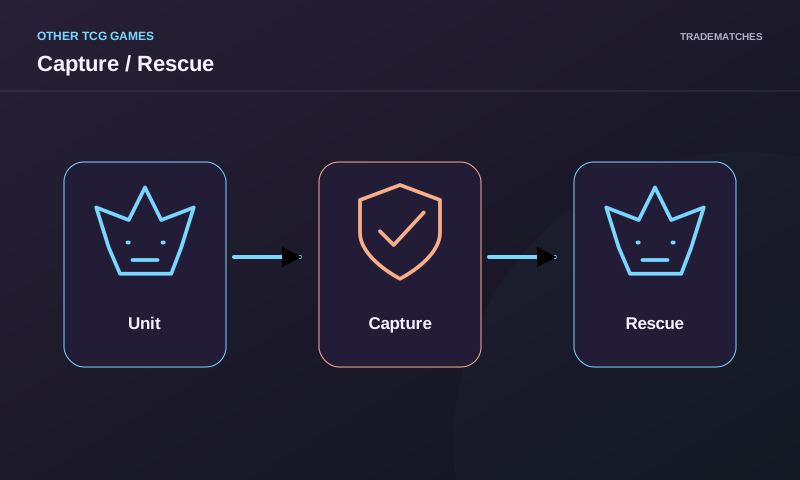
In Star Wars: Unlimited, capturing places a rival unit face-down under the unit that holds it prisoner. The captured unit loses its upgrades. When its guarding unit leaves play, it is rescued and returns exhausted under its owner’s control. That return is not playing the card, so it does not trigger a When Played ability simply because it has been rescued.
What a capture represents
The unit that holds another prisoner acts as a guard or captor. The captured card no longer functions as a normal unit in its arena while it is face down below it. It does not provide its statistics to the guarding unit and is not an upgrade that increases its attack. The physical placement identifies which guard has that prisoner.
To represent it, leave visible the edge of each lower card and separates prisoners from face-up enhancements. If there are several guards on the table, don't stack all the captured in a common pile. You need to know what guard’s departure rescues each prisoner. A clear organization avoids returning a card because a unit that was not actually its captor died.
Capturing is not defeating
Although the unit ceases to participate normally in its arena, a capture does not become a defeat by occupying a different area. Do not automatically activate abilities that demand defeat. Also don't put it on the discard as an intermediate step by habit. Solve the action that the card actually allows and retain the unit captured under the indicated guard.
This difference can change which tool should be used. A defeat eliminates the target in another way; a capture creates the possibility of a subsequent rescue. Don't assume the rival has definitely lost that unit. In assessing the exchange, consider the state of the guard: if it is easy to remove it, the prisoner can return earlier than you had anticipated.
What Happens to Upgrades
The official explanation of capture indicates that the captured unit loses its upgrades. Do not hide a full stack of unit and upgrades under guard to return it intact afterwards. Resolve the corresponding destination of these upgrades and retain the unit card as a prisoner. The tokens and physical cards must be managed according to the rules of their type.
Imagine a reinforced unit with an upgrade that raises its statistics. After the capture, the guard keeps the unit, not a promise that it will regain those bonuses when rescued. When rescued, check its state as a returning unit, without automatically repositioning the lost upgrades. This difference makes it possible for the capture to undo an investment from the opponent even if it can then rescue the card.
The rescue depends on the exit of the guard
Official documentation indicates that prisoners are rescued when the guard leaves the game for any reason. Do not limit that condition to defeating it by an attack. If an effect returns it to hand or other action removes it, you must check the rescue as well. What matters in this procedure is the exit of the unit that kept the capture.
For example, a tool that returns the guard to the hand can be a rescue route even if it does not inflict damage. Before using it, confirm that it may affect that target and that there is no specific restriction. The principle of rescue does not override the requirements of the chosen effect. First you need a legal action that removes the guard; then you apply the consequences of its departure.
Exhausted and with its owner
The rescued unit returns exhausted under the control of its owner. Do not expect to attack with it immediately just because it has returned. Being in play and being ready to use an action that demands to exhaust it are different states. Any modification of that state needs a rule or effect that really allows it.
The owner is the person to whom the card belongs in the game, and may be different from the person who controlled it before the capture. In an interaction with changed control, retain the owner's reference. Using different sleeves helps to recognize physical belonging, but the sleeves do not replace the record of who started with the card or text of the effects that changed the control.
Rescue does not trigger When Played
The rescue reintroduces the unit in play by the corresponding procedure; it does not count as playing it. Therefore, an ability that says When Played is not activated only by that return. This distinction is one of the reasons for reading the full trigger instead of describing all entries as "putting down a unit".
Suppose the card usually gets an advantage when you play it from your hand. If it returns through rescue, you don't get that advantage by analogy. Another effect with a different condition should be checked according to its own text. Do not extend When Played's response to all entry abilities or assume that no other interaction can exist: identify the event that each ability demands.
Several prisoners and several guards
A table with several captures needs a precise association between guard and lower cards. As one guard leaves, attend to the prisoners that this guard maintains and not to the captures of another. Also resolve the relevant abilities by following the current procedure. Announcing which cards are coming back allows both players to check owner and status.
To train this reading, place two guards and one prisoner under each. Withdraw only the first and ask which unit should return. Then repeat with two prisoners under the same guard. Exercise does not require memorizing a combination of cards: it teaches you how to preserve the physical relationship you need when an action changes multiple objects on a complex table.
Deciding whether it is worth rescuing
Compare the cost of withdrawing the guard to the usefulness of the prisoner you will recover exhausted. You may be interested in it because it provides a persistent ability or because it will be available later. However, the rescue does not guarantee an immediate additional attack nor does it return old upgrades. Calculate the play with the actual state of return, not with the strongest version it had before it was captured.
You must also consider the unit of the opponent you withdraw. Rescuing a small unit by an action that also removes a dangerous guard can have value for both results. Instead, devoting all your resources to recovering a unit that no longer changes the game can leave your base unprotected. The rule describes the result; the position decides whether to invest in producing it.
Check restrictions before announcing the action
Read who can capture, which targets it allows, and what unit will remain as a guard. Do not convert a general description into permission to capture any component of the game. If a card excludes leaders or another category, that restriction remains relevant. The possibility of rescue later does not correct a capture that was never legal.
At an event, present the text that initiated the capture and any control or upgrade effects that existed. Avoid summarizing the case as "this card was under it". The reason it was placed there matters. This guide deals with captured units; another card physically placed under one unit could represent a different interaction and require a different resolution.
Compare two rescue routes
If you can defeat the guard in combat or return it to hand with an effect, compare the cost and restrictions of both routes. Rescue does not require the guard to leave through combat, but the bounce effect must legally affect that guard. A card mentioning return is insufficient if its target restrictions involve a cost, arena or other condition the guard does not meet.
Then plan around the rescued unit returning exhausted. If your sequence expected an immediate attack, it needs another legal permission; ordinary rescue does not ready the unit. The upgrades lost during capture do not return through that process either. You can recover an important unit and still need another turn or further resources to restore its former pressure.
With several guards present, identify the prisoners held under each before resolving a departure. Removing one guard does not release cards beneath another. Keeping these groups clear helps you choose the most useful rescue and prevents every captured unit on the table being returned by mistake.
Frequently asked questions
Can I only rescue by defeating the captor?
No. The departure of the guard for any reason can produce the rescue. Check that the action used to remove it is legal.
Is the unit getting its upgrades back?
Not automatically. The capture loses those upgrades; the rescue does not reconstruct the pile it had before.
Does rescue trigger When Played?
Not for being rescued. It returns exhausted with its owner through that procedure and is not considered played.