Star Wars Unlimited Bounty: who collects and when?
On this page
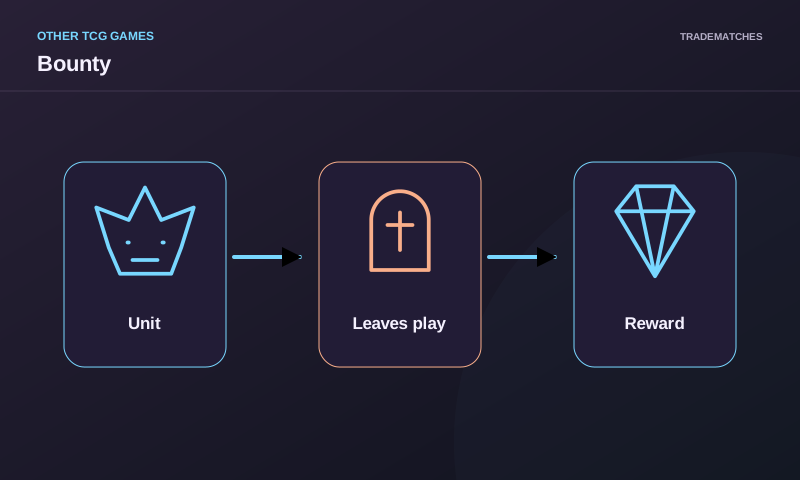
Bounty in Star Wars Unlimited is a reward ability resolved by an opponent of the unit's controller when that unit is defeated or captured. Collecting it is optional. Returning the unit to hand is not automatically a Bounty event, and several Bounties on the same unit remain separate abilities.
The reward belongs to an opponent, not necessarily the person whose card originally printed the keyword. Identify the controller of the unit immediately relevant to the event, the event that occurred and the applicable Bounty text before drawing cards or taking another benefit.
The keyword introduces a reward effect
Bounty is followed by ability text describing the reward. Different cards can grant different rewards; the keyword alone does not say how many cards to draw, how much to heal or what resource change to perform. Read each actual Bounty on the unit.
The rules treat the reward as a triggered ability associated with defeat or capture, with the important difference that an opponent controls its resolution. A Bounty is not a permanent item you transfer into your hand when the unit is removed. The benefit occurs through resolving the relevant ability.
When an upgrade or another effect grants Bounty, record which unit has received it and the exact reward. A reminder saying only “has Bounty” is insufficient if multiple different grants are present. The missing reward text can become a genuine gameplay disagreement after the source card moves.
Defeat and capture can trigger it
The keyword covers both defeat and capture. Defeating a unit through combat or an appropriate effect can therefore lead to its Bounty, while a capture event can also provide the reward even though the captured card has not been defeated into the discard pile.
This matters because capture and rescue are distinct movements. Do not wait until the captured unit later leaves its captor before acknowledging the original Bounty event. Conversely, rescuing the unit does not by itself repeat the already processed capture reward.
Use a simple practice record: unit captured, Bounty triggered, reward collected or declined, captured unit remains associated with the captor. Keeping those separate facts avoids the misleading shorthand “I get the Bounty when the unit goes away,” which does not identify the required event.
Returning to hand is a different event
A unit returned to its owner's hand has not automatically been defeated or captured. The normal Bounty keyword therefore does not trigger solely from that return. Read any card that explicitly instructs collecting a Bounty through another procedure, because that extra wording is the actual permission.
Similarly, moving a unit into another zone through a different instruction needs its own event check. Do not equate every form of removal with defeat. A player may choose a return-to-hand effect partly because its actual procedure differs from defeating a unit and granting an opponent its rewards.
| Event or situation | Ordinary Bounty check |
|---|---|
| Unit defeated | Relevant Bounties trigger |
| Unit captured | Relevant Bounties trigger |
| Unit merely returned to hand | No automatic defeat or capture trigger |
| Unit rescued | Not automatically a second capture reward |
| Effect explicitly says collect a Bounty | Follow that effect's specific instruction |
| Reward declined | That Bounty has not been collected |
Who is allowed to collect?
Bounty resolves for an opponent of the player controlling the unit with Bounty. In a normal two-player game, that generally identifies one opposing player. The name of the card's owner is not a replacement for checking its current controller and the relevant event.
If you defeat your own unit with Bounty, you do not collect the reward yourself simply because your effect caused the defeat. The rules still allocate the Bounty to an opponent. This can be an important cost when sacrificing units or using effects that defeat your own board.
The same distinction matters with control changes. A Bounty attached to a unit is not permanently earmarked for the player who first announced it. Check the controller at the relevant point and apply the current rules rather than following the original physical owner of the cardboard.
Multiplayer selects the relevant opponent
In games with more than two players, the reward's recipient needs a more specific check. The rules identify the opponent who defeated or captured the unit as the one who must be selected to collect that Bounty in that circumstance. You cannot arbitrarily redirect a reward to a friend who did not cause the event.
When a player defeats or captures their own Bounty unit, the rules describe choosing an opponent. Record that choice clearly instead of assuming the ordinary two-player result when there are several opponents available. Multiplayer's political possibilities operate within the selection rules.
For a Twin Suns practice case, label the unit's controller A and the opponent whose effect defeats it B. Identify B as the relevant collecting opponent for that event. Then test A defeating their own unit and consult the self-removal selection rule. These are different situations despite the same card reaching the discard pile.
Collecting is optional
Resolving a Bounty ability is optional under the current rules. A player can decline it, even if the printed reward usually looks beneficial. An effect drawing cards, for example, may have consequences the player wants to avoid in the actual game state.
If the player declines, they are not considered to have collected that Bounty. This matters to other effects checking whether a reward was collected. Do not mark a Bounty as collected merely because it triggered or because the player was offered the opportunity.
Distinguish declining the entire reward ability from selectively editing its instructions. If you choose to resolve it, follow its text and any applicable choices. Optional collection does not provide a general permission to take only the convenient half of a multi-part reward.
Multiple Bounties are independent
A unit can have more than one Bounty, including repeated grants of the same Bounty. The rules treat each as an independent ability. Do not merge two identical rewards into one untracked payment merely because both would draw a card.
For a hypothetical unit with one Bounty drawing a card and another healing two damage from a base, record both when the triggering event occurs. The collecting player can make the relevant optional decision for each ability. The outcome can include one reward, both or neither, depending on their choices and the rules.
If two grants have the same text, the separate ability record still matters to effects caring about collecting Bounties. A two-card draw arising from two collections is not always equivalent to one Bounty instructing a two-card draw. Preserve the event structure instead of recording only the final hand size.
Bounty shares the triggered-ability window
Bounty resolves in the same window as applicable When Defeated or When Captured abilities on the unit. You do not automatically resolve every Bounty before every other trigger because its reward appears more visible. Apply the current rules for simultaneous triggered abilities and their controllers.
This becomes significant when a unit has its own departure effect as well as an opponent's reward. The board, hand or available choices can change depending on the legal order. Identify all the triggered abilities and who controls each before selecting an order.
For a complicated case, state the triggering event, the affected unit, its controller, the Bounty texts and the other relevant triggers. That is enough information for a judge to locate the sequencing question. “It died with a bounty” alone can conceal the exact order-dependent interaction.
Plan removal with the reward included
Before using an effect that defeats your own unit, account for what the opponent may receive from its Bounties. The unit's departure might advance your plan while also increasing the opponent's hand or healing their base. The cost of the play is broader than the unit you personally lose.
When choosing how to remove an opposing unit, compare defeat, capture and other zone changes through their actual rules. Avoid treating Bounty as an automatic reason to choose one method in every game. Your available cards, timing and the unit's other abilities determine the useful line.
A clear Bounty marker improves both decisions and communication. Keep its exact reward accessible while the unit is in play, announce the relevant event and confirm whether each reward is collected. This prevents accidental draws that are difficult to undo after hidden information has changed.
Frequently asked questions
Can I collect the Bounty on my own defeated unit?
Not through the normal Bounty allocation. An opponent of that unit's controller resolves the reward. In a two-player game, defeating your own unit can therefore give the opponent the collecting opportunity.
Is a returned-to-hand unit enough to trigger Bounty?
Not by itself. The ordinary keyword is tied to defeat or capture. An effect explicitly instructing a different way to collect must be read as its own permission.
Must I take every reward offered?
No. Resolving each Bounty ability is optional. If you decline it, that Bounty is not considered collected; if you accept, follow its actual instructions.